Immigration Filing Error Prevention Strategies
Missed filings now trigger denials instead of corrective notices as USCIS backlogs explode.

The old mental model, where a filing error cost you a few weeks and a corrective letter, is no longer accurate. Pending cases rose from 9.7 million to 11.3 million between FY2025 Q1 and FY2026 Q1, a 16.5% increase, while average backlog clearance time nearly doubled over the same window. In April 2026, USCIS completed only 40% as many cases as it completed in April 2025. A filing error today costs the applicant their place in a backlog that has grown by more than 1.6 million cases, while their visa clock runs regardless. [These statistics require citation to a specific USCIS data release or third-party report.]
The critical policy shift is this: USCIS officers now deny applications without first issuing a Request for Evidence or a Notice of Intent to Deny when required documents are missing. The petition is reviewed on what was submitted. That's it. [A citation to the relevant USCIS policy guidance or Federal Register notice is needed to support this claim.]
Previously, a minor omission typically generated an RFE, giving the applicant somewhere between 30 and 87 days to correct the record. That buffer no longer exists as a matter of right. The standard for an acceptable initial filing has risen accordingly, which sounds obvious until you realize how many practitioners are still preparing petitions as though the old safety net is intact.
The escalation risk compounds everything. When a denied applicant lacks lawful status, USCIS initiates removal proceedings via a Notice to Appear. This applies even to applicants with U.S. citizen family members. [A citation to the relevant USCIS policy memorandum or regulation is needed here.] Errors that once generated a correctable delay now carry a direct path to denial and, in some cases, removal.
The natural follow-up question is which specific errors are most likely to trigger this outcome. The answer is more finite than most applicants assume.
The Ten Filing Errors Most Likely to End a Petition Before an Adjudicator Reads It
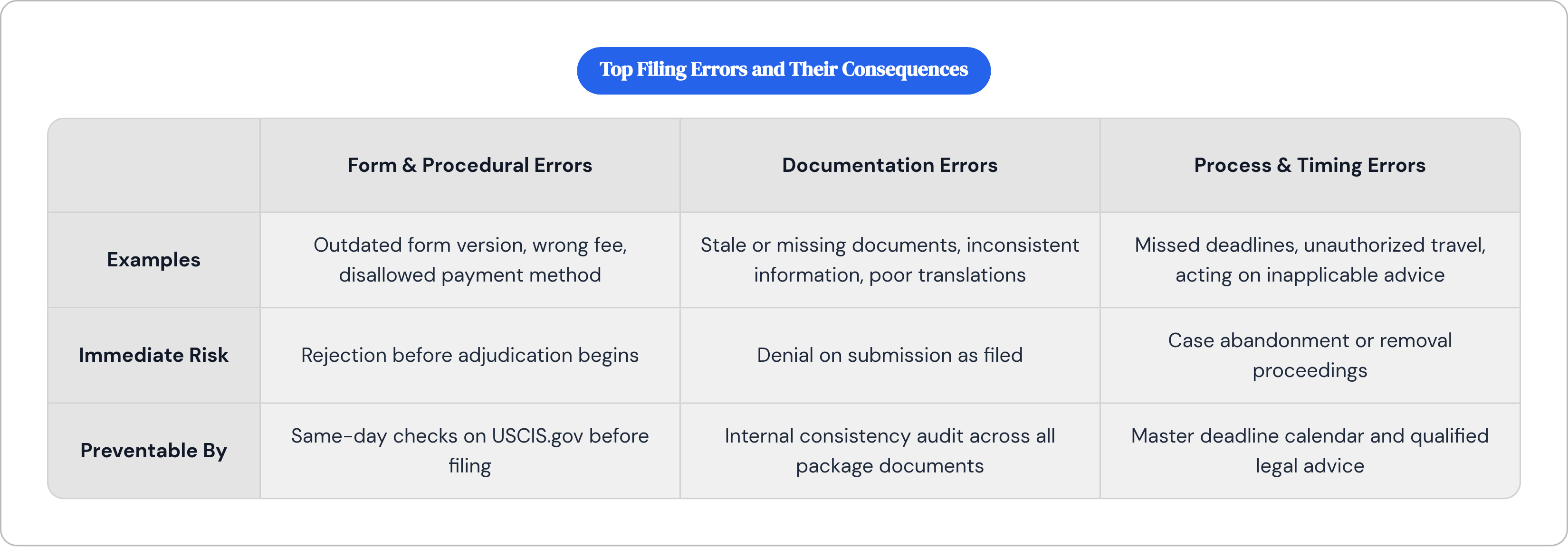
These are not edge cases. Each one appears with regularity in rejected filings, and each is entirely preventable.
1. Incomplete or Inconsistent Forms
Blank fields, misspelled names, and conflicting dates across documents are the most common triggers for rejection before substantive review even begins. USCIS adjudicators cross-check submissions against government databases, and inconsistencies that appear cosmetic surface as red flags in both automated and manual review. The officer is not going to call you to clarify.
2. Outdated Form Versions
USCIS enforces strict edition requirements. Using a superseded version triggers rejection regardless of how well the content is completed. Form I-765 was updated on August 20, 2025; only the newest edition was accepted as of March 5, 2026. [These dates require citation to the relevant USCIS announcement or Federal Register notice.] A form that was current at download can become invalid by postmark date, and USCIS does not announce these transitions widely. Third-party sites frequently host outdated versions. Download directly from USCIS.gov, every time, on the day of filing.
3. Incorrect or Outdated Fees
Wrong fee equals rejected form, returned without processing, requiring full resubmission. The fee landscape is unusually volatile. H.R.1-mandated fees apply to petitions postmarked on or after July 22, 2025; FY2026 inflation-adjusted fees apply to petitions postmarked on or after January 1, 2026. The premium processing fee for Form I-129, covering H-1B, L-1, O-1, TN, and other classifications, rose sharply to $2,965 effective March 1, 2026. [These fee figures and effective dates require citation to the relevant USCIS fee schedule or Federal Register notice.] The correct fee is whichever is in effect on the postmark date, not the date of preparation.
4. Wrong Payment Method
USCIS no longer accepts personal checks, business checks, money orders, or cashier's checks for paper-filed forms unless a specific exemption applies. For mail-in submissions, accepted methods are credit, debit, or prepaid card via Form G-1450, or a U.S. bank account via Form G-1650. [These payment method restrictions require citation to the relevant USCIS policy or announcement.] A technically correct fee amount submitted through a disallowed payment method still results in rejection.
5. Insufficient or Stale Documentation
Bank statements that do not clearly show required income levels, expired passports submitted as identity evidence, older tax returns used where recent ones are required: all of these result in rejection. For documents issued abroad, apostilles and consular certifications are frequently omitted. An officer reviewing a foreign document without proper authentication has no obligation to assume it is valid, and generally will not.
6. Inconsistent Information Across the Package
Different addresses, dates, or spellings for the same person or event across different forms within the same package signal either carelessness or deception. The officer has no way to distinguish between them, and no obligation to try. Poorly translated documents, where the translation does not match the underlying source, compound this problem in ways that are difficult to recover from later.
7. Missed Deadlines, Initial and Responsive
Missing the initial filing window is obvious. Less obvious: missed biometrics appointments, interview dates, or status expiration dates mid-process can derail an otherwise intact case. Every USCIS notice carries an implied deadline and should be treated as one until confirmed otherwise.
8. Inadequate RFE Responses
When an RFE is issued, USCIS expects a complete response within the given window, typically 30 to 87 days. A late response is treated identically to no response: automatic denial. A response that addresses only part of the RFE, or fails to directly rebut the officer's stated concern, invites denial on the same grounds.
9. Unauthorized Travel During a Pending Application
Departure can constitute abandonment of a pending application, trigger unlawful presence consequences, or require advance parole not yet obtained. Every applicant I have seen caught by this rule was unaware it applied to short trips, and practitioners sometimes fail to flag it clearly enough.
10. Acting on Informal or Category-Inappropriate Advice
Social media groups and online forums share individual outcomes as though they generalize. They do not. Immigration eligibility is highly fact-specific: prior entries, status history, family circumstances, and employer type all change the analysis. A strategy that worked for someone in a different visa category, or a different country of birth, is not a strategy. It is a data point from an incomparable case.
What RFE Trends Reveal About Where Petitions Most Often Fall Short
One immigration support organization reported RFE rates up roughly 23 percentage points since 2024, as of March 2025, with surges concentrated in employment-based petitions on Forms I-129 and I-140, and in adjustment of status on Form I-485. [This organization should be identified and the report explicitly cited.] Historical context makes this more alarming. H-1B RFE rates were 21.4% in FY2017, peaked at 40.2% in FY2019, dropped to 16.2% in FY2021, and stood at 10.5% in FY2023. [These figures require citation to the relevant USCIS data release or USCIS Office of Policy and Strategy report.] The current environment is returning to, and in some categories exceeding, the prior peak.
There is also a seasonal pattern worth knowing. RFE rates reached elevated levels in December 2024, compared to substantially lower rates earlier in the same fiscal year. [This figure requires citation.] Applicants filing in those windows should treat RFE preparation as near-certain, not contingent.
What RFEs Are Actually Citing
The most actionable part of this data is what officers are writing in the RFEs themselves. The recurring themes across 2025 and 2026 filings cluster around a few specific failures: insufficient linkage between submitted evidence and the specific regulatory criterion being claimed; weak proof-of-employment or job-duties documentation in employer-sponsored petitions; absence of independent corroboration for claims of impact, commercialization, or adoption in self-petitioned cases; and missing or thin explanation of "national importance" in NIW petitions. [The source for these recurring themes should be explicitly cited.] Officers want explicit mapping, not inference. The burden is on the petitioner to connect the dots.
EB-1A and EB-2 NIW as Case Studies
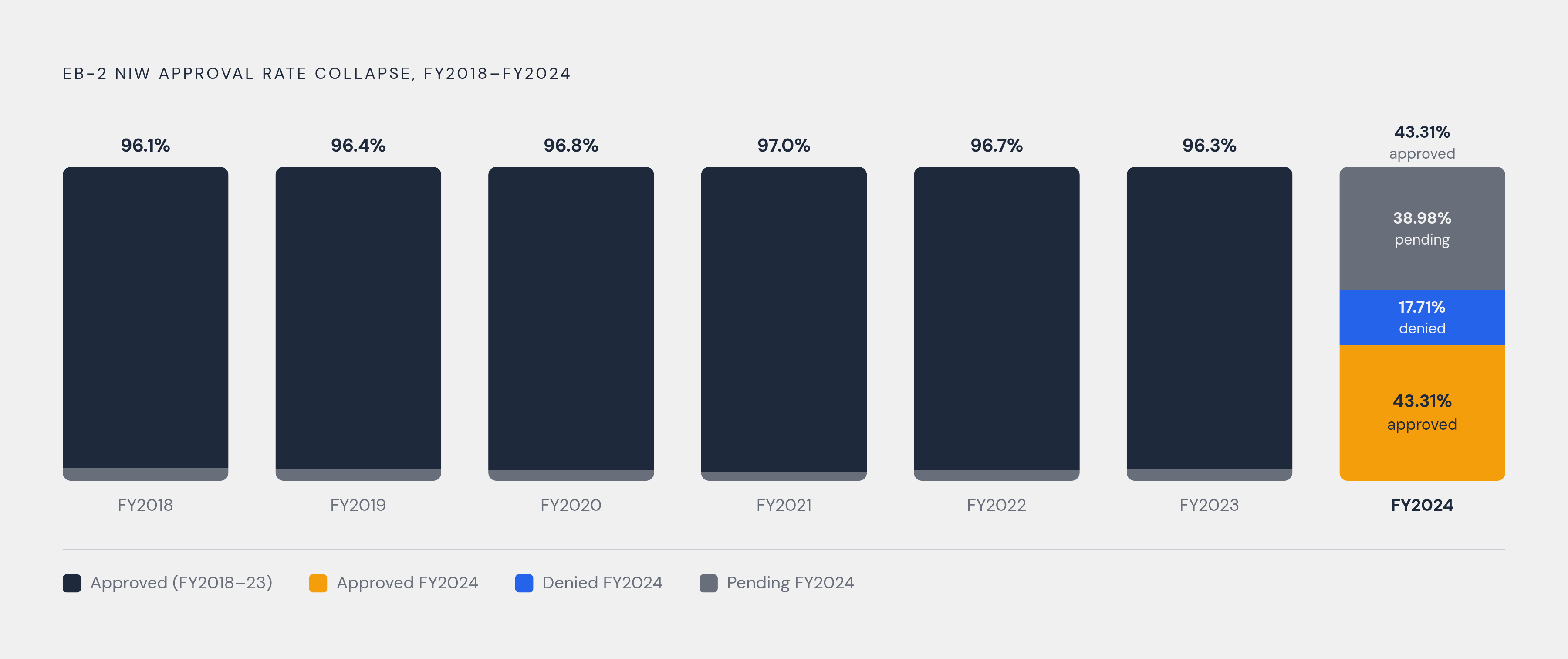
The approval rate data for self-petitioned categories illustrates the current environment with uncomfortable clarity. The EB-1A approval rate fell from 70.50% in FY2023 to 60.65% in FY2024. RFEs are currently being issued in a large share of EB-1A filings, yet effective responses still achieve majority approval. [These figures require citation to the relevant USCIS data release.] The RFE itself is not the end of the case; the quality of the response is decisive.
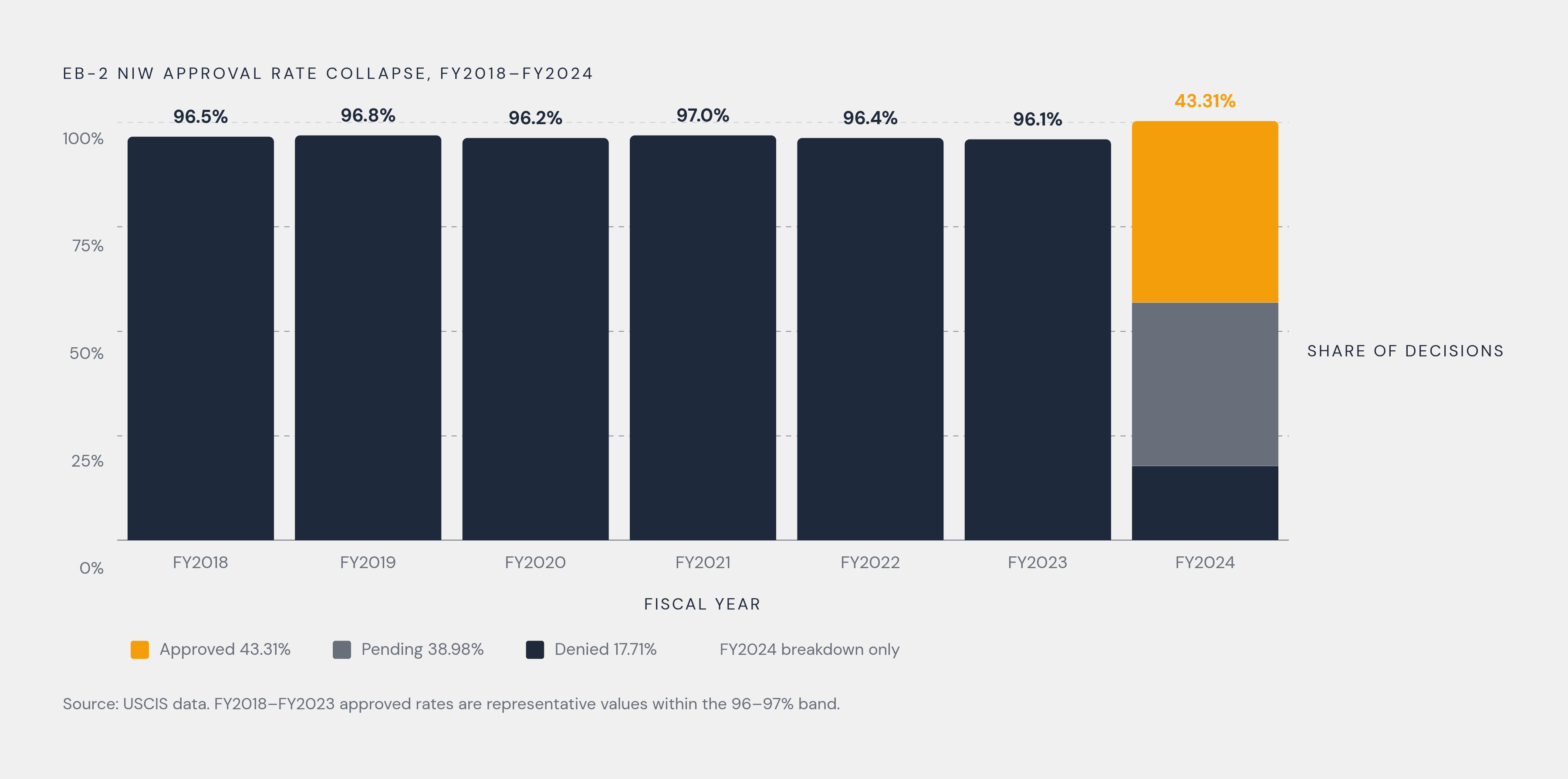
The EB-2 NIW numbers are harder to absorb calmly. Approval rates that ran between 96% and 97% from FY2018 through FY2023 collapsed to 43.31% in FY2024, with 17.71% denied outright and 38.98% still pending. [These figures require citation to the relevant USCIS data release.] That is the most dramatic single-category swing in the available data, and it happened in one fiscal year.
One structural concern compounds this: a pattern has emerged where denial notices repeat language from the original RFE verbatim, raising legitimate questions about whether additional evidence submitted in response is being thoroughly reviewed. [The source or basis for this observation should be explicitly cited.] The practical implication is that a weak initial response is particularly difficult to recover from, because the second look may not differ meaningfully from the first.
A Pre-Filing Checklist Framework That Catches the Errors Most Likely to Sink a Petition

A checklist is only as useful as the process it sits inside. What follows is a staged framework, because different checks apply at different points in the filing cycle, and compressing them all into a single pre-submission review guarantees that some things get missed.
Stage 1: Form Verification, Before Completing Anything
Confirm the form edition directly on USCIS.gov on the day of filing, not the day of download. Verify the current fee on the same day the package is assembled, with the understanding that the operative date is the postmark date. Confirm the accepted payment method for the specific form and filing venue before anything else. These three checks take ten minutes and prevent the most common reasons a package never enters adjudication at all.
Stage 2: Internal Consistency Review, Before Assembly
Name spelling: cross-check every document in the package, including passport, I-94, prior approvals, employer letter, and financial documents, for identical rendering of the applicant's name and date of birth. Run every address and every event date against every other document where the same information appears. Every foreign-language document must have a certified English translation that matches the source document exactly, not just in substance. Translators who paraphrase create inconsistencies that look, to an adjudicator, like alterations.
Stage 3: Evidence Completeness Audit Against the Specific Petition Type
Pull the USCIS policy manual section for the specific benefit category and use it as a checklist. Not the general instructions: the evidentiary standard. For employment-based petitions, job duties documentation must be explicit and tied directly to the classification sought. Do not assume the officer will infer the connection between a job title and a qualifying role, because the data from 2025 and 2026 confirms they are not doing that.
For self-petitions, including EB-1A and EB-2 NIW filings, independent corroboration is the current RFE trigger. Letters from collaborators, citation records, evidence of adoption or commercialization, and external validation of claimed impact all qualify. Self-described claims do not. Financial documents should be verified for currency, completeness, and whether the figures actually meet the stated threshold. Every document issued outside the United States should be flagged, and the requirement for an apostille or consular certification confirmed before assembly.
Stage 4: Deadline Mapping
Build a master calendar at the start of the process. It should include the initial filing deadline, the expected RFE response window if one is issued, the biometrics appointment window, and travel authorization status throughout. Every USCIS notice should be treated as deadline-bearing until confirmed otherwise. Preserve delivery records for every mailed submission; a lost filing with no delivery proof is an error that never appears in the record but still costs the applicant their place in the queue.
Stage 5: The Final Read, Simulating the Adjudicator's Review
Read the complete package as if encountering it for the first time. Does each evidence item directly support the criterion it is meant to prove, or does the connection require inference? Flag every gap where the internal answer is "the officer will understand." That assumption is the source of most RFE triggers reflected in the 2025 and 2026 data. For complex petitions, a second reader who has not been involved in drafting will catch inconsistencies the primary preparer has stopped seeing; at a certain point, familiarity with a document is its own liability.
How to Build an RFE Response That Actually Addresses What the Officer Asked
Receiving an RFE is not evidence the petition failed. EB-1A petitions receiving RFEs still achieve roughly 60% approval with effective responses. [This figure requires citation.] The RFE is an invitation to make explicit the argument the original filing left implicit.
Read the Entire RFE Before Drafting a Single Word of the Response
Officers sometimes bury a secondary concern in language that appears to be elaborating on the first. Missing any cited ground means the response is incomplete even if it addresses the most prominent concern thoroughly. The number of distinct grounds cited in the RFE is the minimum number of distinct sections required in the response. Read it twice. Read it a third time if the petition is complex.
Mirror the RFE's Structure in the Response
Address each cited concern in the same order it appears in the RFE, with a labeled section that explicitly references the concern being addressed. This is not a stylistic preference. Given the pattern of denial notices repeating RFE language verbatim, an unstructured response, however substantively complete, carries a higher risk of incomplete review. Match the structure, and make it impossible for the officer to claim a concern was not addressed.
Make the Evidentiary Connection Explicit, Every Time
The current adjudication environment makes explicit mapping mandatory. Do not submit additional evidence and expect the officer to connect it to the criterion. The response letter must perform that connection, in direct language, for every piece of evidence submitted. "This letter from Dr. X demonstrates that the petitioner's work meets the criterion of critical role as defined in 8 C.F.R. § 204.5(h)(3)(viii) because..." is not over-explaining. It is the floor. The officer reviewing a 200-page response package on a compressed timeline is not going to do interpretive work on the petitioner's behalf, and the FY2024 EB-2 NIW approval rate collapse is the clearest available evidence of what happens when petitioners assume otherwise. [The source for the FY2024 EB-2 NIW approval rate data should be explicitly cited.]