Online Immigration Services vs Licensed Attorneys
Attorney representation dramatically improves approval odds, especially for complicated cases.

The label is almost aggressively vague, which is part of the problem. When someone says they used an "online immigration service," they mean any of three things that share almost nothing in common, legally or practically. Getting this taxonomy wrong is how people end up making expensive, sometimes irreversible mistakes.
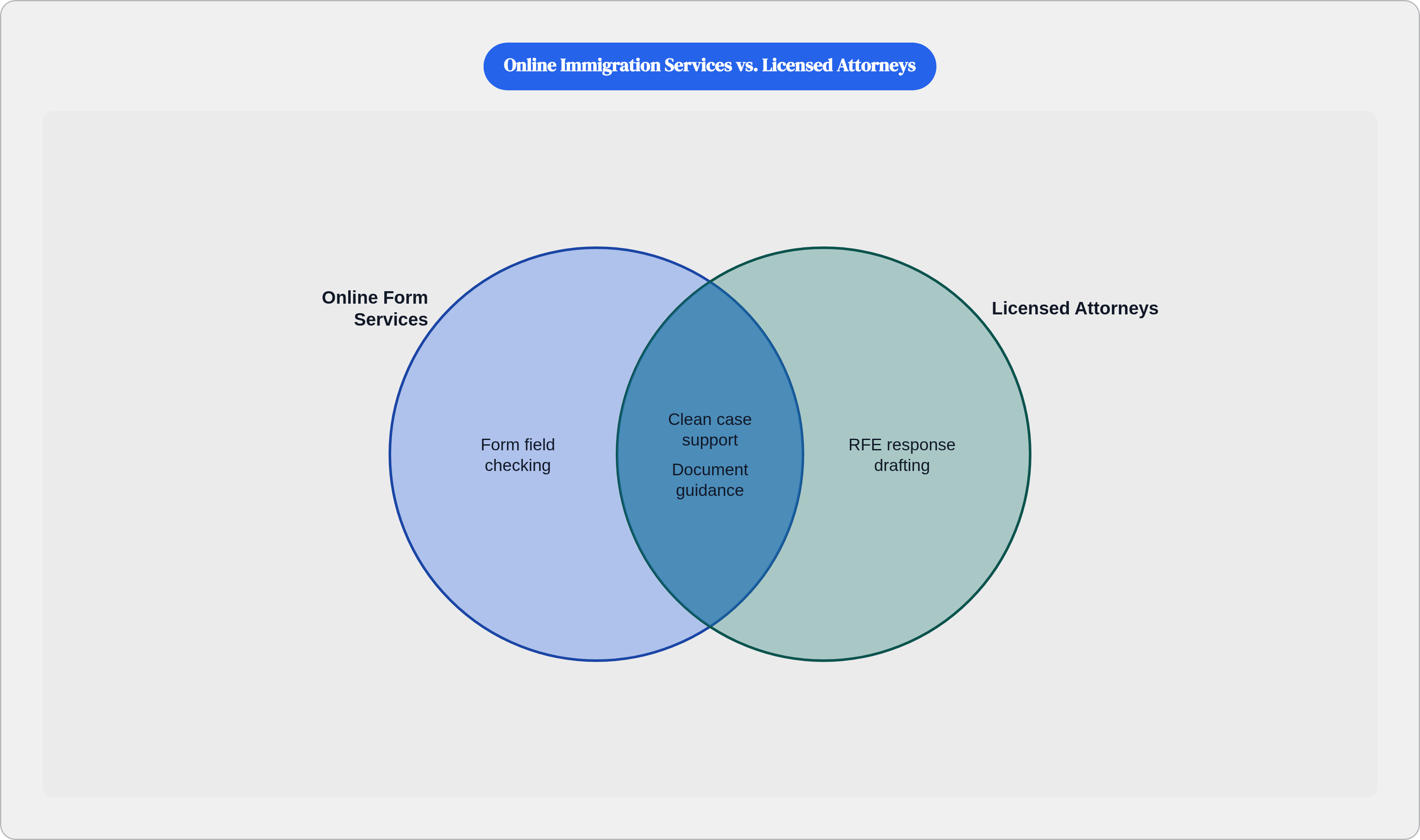
The first category is pure form-preparation software. These platforms walk users through USCIS form fields, flag incomplete entries, and occasionally prompt for supporting documents. No licensed attorney reviews your specific situation; no one is legally accountable for the output. The software is checking your boxes, not your case.
Then there is the hybrid model: a proprietary platform combining guided form preparation with licensed attorney review before submission. The better versions use automated screening to flag common RFE triggers, then route the file to a human attorney who signs off. Boundless operates roughly in this space, pairing guided self-service with access to independent licensed attorneys for review. The platform is explicit that its content does not constitute legal advice, but the attorney connection is real and verifiable. This is a substantively different product from pure software.
The third is an attorney marketplace: a platform connecting users with independent licensed attorneys for consultations or limited-scope representation. The platform itself is not a law firm. You are hiring the attorney through it, not the platform. Marble sits in a different tier entirely, operating as a full-service immigration law firm with direct attorney representation, which means attorney-client privilege, a duty of care, and a licensed professional accountable for the work.
One question cuts through all the marketing: is a licensed attorney reviewing my specific application, or is software checking my form fields? Everything else follows from that.
What a Licensed Immigration Attorney Actually Does That Software Cannot
The most persistent misconception in this space is that attorneys are expensive form-preparers. That framing, largely perpetuated by unlicensed consultants who actually are only form-preparers, misses the entire point of legal counsel.
Before filing anything, a competent immigration attorney reviews the applicant's full status history: prior visa types, every entry and exit, any period of unlawful presence, prior USCIS interactions, prior denials, criminal history and its interaction with grounds of inadmissibility, tax compliance issues that surface during adjustment of status, travel record anomalies. The goal is identifying problems before they become denials. Most self-filers skip this step, not because they are careless, but because they do not know what they are looking for — and not knowing what you are looking for is exactly when you need someone who does.
Here is where skipping it actually costs people money. An RFE triggered by an incomplete or inconsistent application delays a case by three to six months. By the time it arrives, the applicant frequently has to hire counsel mid-process to respond, at hourly rates that exceed what a flat-fee engagement upfront would have cost. For someone on OPT or H-1B timelines, that delay is not a bureaucratic inconvenience. It can end work authorization entirely.
Beyond error-catching, attorneys make strategic decisions software is incapable of: which visa category to file under, whether to file now or wait for a stronger evidentiary record, how to frame discretionary factors in a petition narrative. These are judgment calls shaped by case history and pattern recognition built over years of practice. No algorithm substitutes for them.
Where the Outcome Data Actually Separates Represented from Unrepresented Applicants
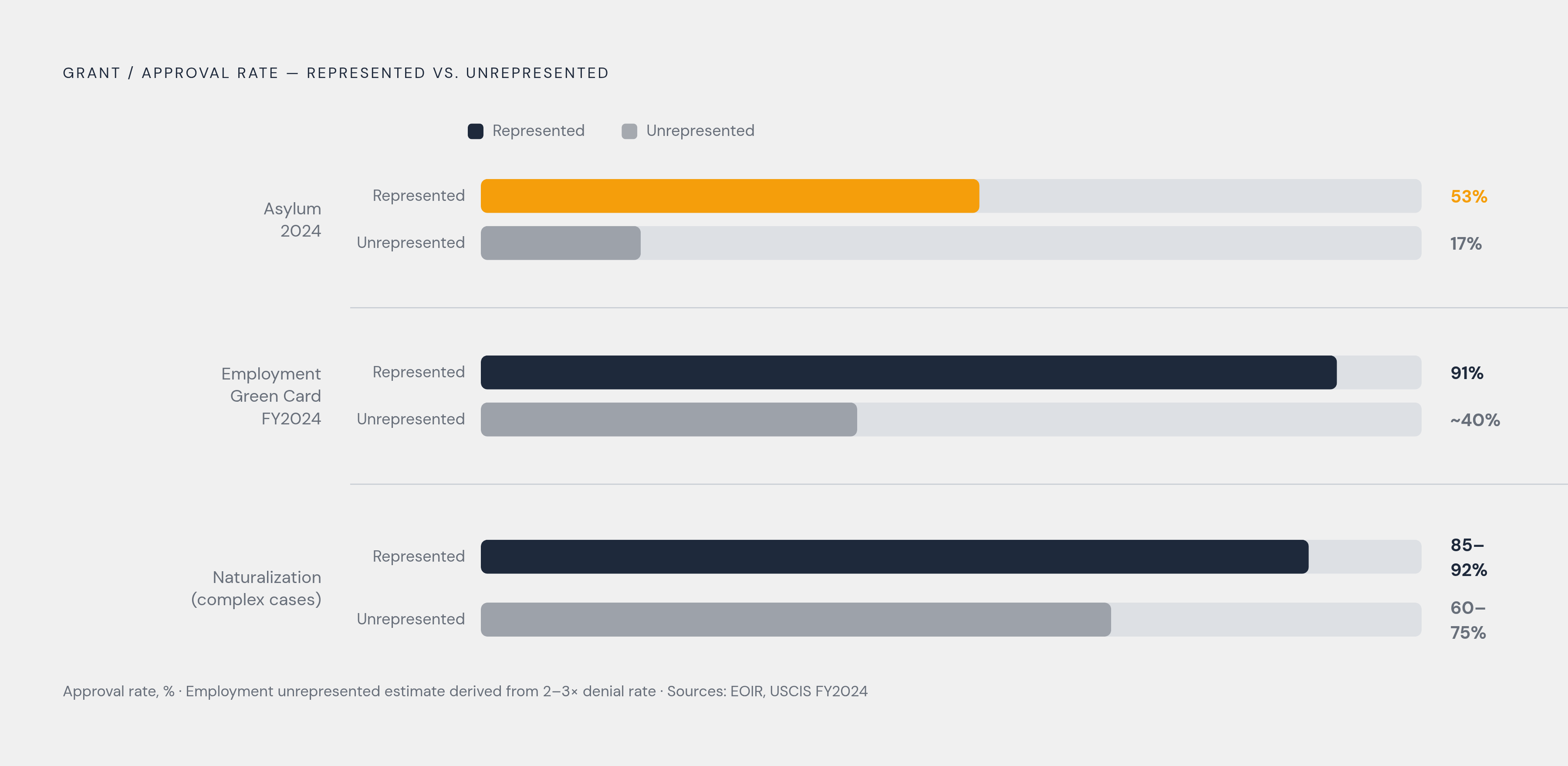
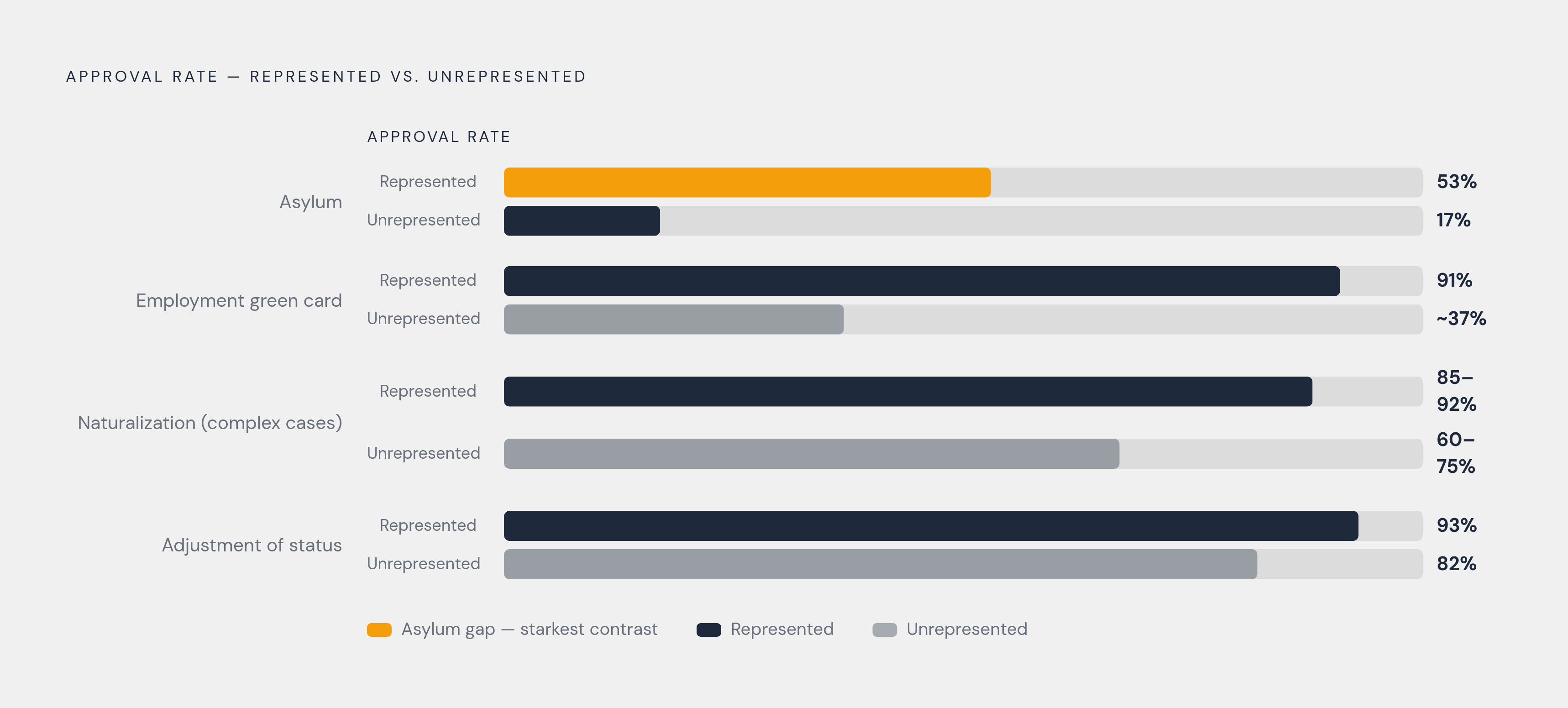
The asylum numbers are the starkest illustration available. In 2024, applicants with legal counsel were granted asylum at a substantially higher rate; those without representation received relief at 17%. That is roughly one in two versus one in six, drawn from the same applicant population, subjected to the same evidentiary standards, adjudicated by the same system.
Employment-based green card applications tell a similar story. Attorney-represented applications reached a 91% approval rate in FY2024. Adjustment of status data from USCIS shows a pro se denial rate roughly two to three times higher than for represented applicants. The $1,500 saved on attorney fees becomes arithmetically irrelevant when the application is denied and must be refiled, duplicating both government filing fees and attorney costs on the second pass.
The gap narrows considerably in genuinely clean cases, and this is worth acknowledging honestly. A substantial portion of both employment-based and family-based applications are filed without legal representation, and in truly uncomplicated circumstances, approval rates for self-filers come within a few percentage points of represented applicants. But the gap widens sharply when complications arise: prior overstays, criminal history, previous denials, discretionary waivers. Naturalization applications with complications see attorney-prepared cases reaching 85 to 92% approval, while self-filed cases with the same complications land in the 60 to 75% range. The reason is straightforward: attorneys identify and resolve disqualifying factors before submission rather than at the interview.
What the data shows, consistently, is that representation matters least when the case is genuinely clean and binary, and matters most when the applicant's history contains anything an adjudicator has discretion to weigh.
Cases Where Online Services and Self-Filing Are Genuinely Adequate
The highest self-filing success category is family-based petitions through immediate relatives: spouses, parents, and unmarried children under 21 of U.S. citizens. The relationship is either documented or it is not. The eligibility criteria are defined. For applicants with a genuinely clean history, a good form-prep platform or hybrid service is a defensible choice, and I mean that without qualification.
The conditions that make self-filing viable are specific, though: no prior visa violations, no overstays, no unlawful presence, no prior USCIS denials on any application, no criminal history of any kind, no tax compliance issues, and an application in a category with well-defined eligibility criteria. All of those must be true simultaneously. If even one is not, the risk profile shifts.
Even for clean cases, a one-time attorney consultation before submission, typically $200 to $500, is worth the investment. The consultation catches what software structurally cannot: grounds of inadmissibility the applicant did not know were relevant, an entry record inconsistency, a prior removal order from a decade ago that was never enforced and therefore never mentioned.
What online form-prep tools cannot do, regardless of case cleanliness, is assess the applicant's specific legal situation, identify grounds of inadmissibility, draft or respond to an RFE, or represent the applicant at an interview. Those are legal functions, not administrative ones. For a clean case, a quality hybrid platform plus a one-time consultation is a legitimate option. For anything with a complicating factor, it is a gamble on a timeline that has no pause button.
Case Types Where Attorney Judgment Actually Changes the Outcome
Adjustment of status with any complicating factor, including prior overstay, prior denial, or any criminal record, is the category where representation transitions from preferable to necessary. The adjudicator has discretion. Discretionary determinations are won and lost on how cases are framed, not just whether forms are complete.
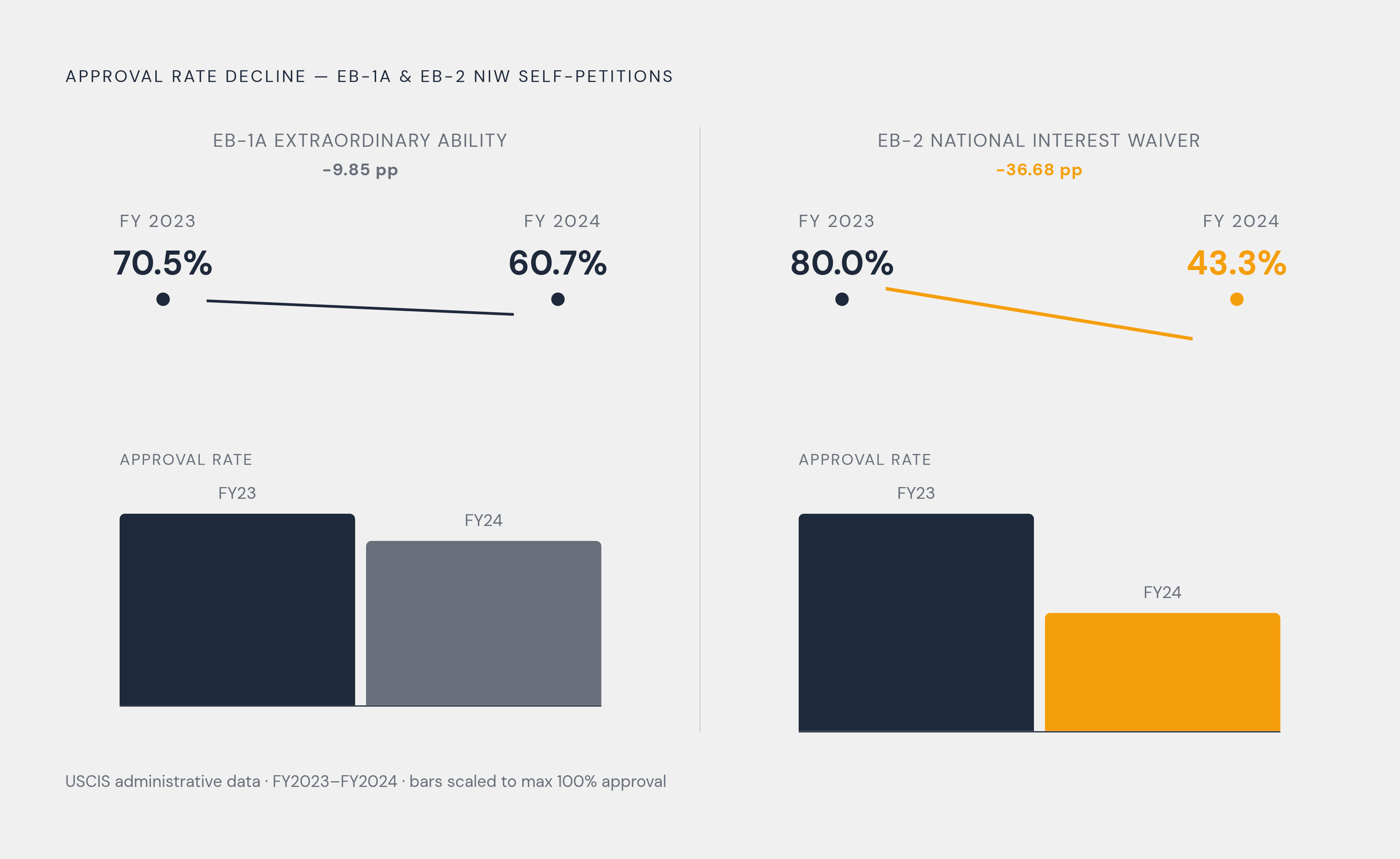
The employment-based self-petition categories illustrate how much the evidentiary standard shifts depending on who is constructing the argument. EB-1A extraordinary ability petitions saw approval rates decline from 70.50% in FY2023 to 60.65% in FY2024. The evidentiary standard is not codified with mathematical precision, so how evidence is selected, organized, and argued is a real variable in the outcome. The EB-2 National Interest Waiver category is more striking still: approval rates fell from 79.99% in FY2023 to 43.31% in FY2024. Well under half of petitions are being approved. Petition narrative and evidence selection are where those cases are won or lost, and no software generates a compelling NIW argument. Forms do not win waivers; arguments do.
Any case involving a waiver of inadmissibility belongs in the same category, for the same reason. Waivers are discretionary by design. The strength of the hardship argument, the completeness of the equities presented, the framing of the applicant's circumstances: these are the determinative factors.
OPT-to-H-1B transitions where timing is tight are another category where errors carry consequences that compound quickly. An RFE or processing delay can create a gap in work authorization that is not recoverable without departure. First-time employer sponsors add another layer of risk: the employer's HR team is often unfamiliar with the process, which means errors can originate from both sides of the filing simultaneously, and no one on either side necessarily knows it.
The Real Danger in the Middle: Unlicensed "Consultants" and Notario Fraud
Between legitimate platforms and licensed attorneys sits a category that causes genuine, sometimes catastrophic harm: unauthorized practitioners marketing themselves as "immigration consultants," "notarios," or "visa specialists." The confusion is not accidental, and the harm is not theoretical.
In Latin America and several European countries, "notario publico" denotes a professional with credentials roughly equivalent to a licensed attorney, authorized to represent others before government agencies. In the United States, a notary public is authorized only to perform limited ministerial functions: witnessing signatures, administering oaths. Fraudsters exploit this gap deliberately because the confusion is built into the terminology, and because their target clients often arrive from countries where the title carries genuine legal authority.
The scale of the problem is documented and growing. The FTC received nearly 2,000 immigration-related complaints in 2025 alone, up from roughly 960 per year from 2021 through late 2024. Over five years, reported losses to immigration fraud exceeded tens of millions of dollars in FTC complaints, and that figure is almost certainly a substantial undercount; many immigrants avoid reporting fraud out of fear of immigration consequences for themselves.
What notario fraud costs its victims extends well beyond the financial loss. Missed deadlines cannot always be recovered. Incorrect or incomplete forms filed with USCIS create a record that must be corrected. False claims filed with the government create civil or criminal exposure for the applicant, not the fraudster. In cases where legal status could have been preserved, a fraudulent filing sometimes produces the opposite result.
Enforcement is improving but inconsistent. New York City passed increased notario fraud penalties in June 2025; similar legislation advanced in Florida; California and North Carolina attorneys general issued statements in late 2025 addressing the problem. The fraud increasingly operates through phone calls, social media, and messaging apps, with fraudsters impersonating police or immigration officials, and the operations rebrand quickly when complaints accumulate.
The practical filter is simple: before paying any immigration service provider, verify their state bar number through the relevant state bar's public directory, or confirm they are an accredited representative listed with the Board of Immigration Appeals. If neither check produces a result, stop there.
How to Read the Pricing Ranges Without Being Misled by Them
Attorney hourly rates in 2025 run from approximately $150 to $350; most green card matters are handled on flat fees ranging from $2,500 to $8,000, with complex categories like EB-1A reaching $15,000 and above. For specific case types, flat-fee benchmarks are more useful than hourly estimates: family-based green card petitions typically run $1,000 to $3,500; adjustment of status falls in the $2,000 to $5,000 range; naturalization for a straightforward case runs $1,500 to $2,500, and $3,000 to $5,000 or more when complications require resolution before submission.
The cost comparison that matters is not attorney fee versus platform fee. It is the total expected cost of the platform approach, including the probability-weighted cost of a denial and refile, against the attorney fee upfront. USCIS data puts the pro se denial rate at 18% versus 7% for represented applicants. A denial means refiling, which duplicates both government fees and attorney costs.
For international professionals on visa deadlines, the months of delay from an avoidable RFE or denial carry costs that dollar figures do not fully capture: lost work authorization, expired job offers, visa status that lapses during the gap. Anyone who has watched a client lose a job offer because an RFE pushed their timeline past the offer deadline knows this is not a hypothetical.
How to Vet Any Service Provider Before Handing Over a Filing
The foundational question, before evaluating features or pricing, is whether a licensed attorney reviews the specific application or whether software is checking form fields. Everything else is secondary to that.
For online platforms, four things require verification. First, whether the platform is a law firm or a technology company, since the distinction determines attorney-client privilege and legal accountability. Second, whether attorney review is included in the base price or is an upsell. Third, which visa categories the platform actually covers, since many are built primarily for family-based cases with limited employment-based functionality. Fourth, what happens if an RFE is received, because some platforms end their engagement at submission and leave the applicant without support at exactly the moment it is most needed.
For attorneys, verification is direct: state bar membership is searchable in every state's public directory, and accredited non-attorney representatives appear on the Board of Immigration Appeals accreditation list. It is also worth asking whether the attorney practices immigration exclusively. The law changes frequently enough that generalists operating across multiple practice areas miss things a dedicated immigration practitioner would catch as a matter of routine.
Certain red flags signal unauthorized practice regardless of what the provider calls themselves: guarantees of visa approval or specific outcomes; no verifiable bar number or BIA accreditation; requests for payment in cash or through money transfer applications with no receipt; pressure to sign documents immediately. Any one of these is sufficient reason to walk away.
Applying the Stakes Framework to Your Own Situation
The decision is not binary. It scales to the actual risk in the specific filing, and the relevant question is always the same: what is at stake here, and who is qualified to manage it.
For a clean case with no complicating history and a well-documented immediate relative relationship, a quality hybrid platform with attorney review, supplemented by a one-time consultation, is a legitimate and cost-effective option. The outcome data supports it in that specific, narrow circumstance.
For any case involving a prior overstay, a prior denial, any criminal history, a discretionary waiver, an employment-based self-petition, or a deadline where a delay would terminate work authorization, attorney representation is not an upgrade. It is the appropriate tool for the actual task. The outcome data on represented versus unrepresented applicants in those categories is not marginal: it is the difference between a 53% grant rate and a 17% one.
Figure out what is at stake. Then price the appropriate level of representation. In that order.