I-9 Compliance Software and Remote Verification Tools
Remote verification now requires E-Verify enrollment and carries strict compliance deadlines.

The Immigration Reform and Control Act of 1986 requires every U.S. employer to verify the identity and work authorization of everyone they hire, no exceptions, no exemptions for the three-person startup or the Fortune 500. That verification happens on Form I-9, which comes with two deadlines welded into one document: the employee fills out Section 1 by their first day of work, and the employer finishes Section 2 within three business days of the start date. Employers keep every completed I-9 on file for active employees, then hold onto it for a set window after someone leaves. That's the whole system, laid out on paper.
Here's where people get tangled: I-9 and E-Verify are not the same thing wearing two names. The I-9 is the form every employer must complete. E-Verify is a separate electronic system that checks I-9 data against DHS and Social Security records, and it's optional for most private employers, though nine states and federal contractors above certain size thresholds require it. Two systems, two purposes, and one recurring mix-up in HR meetings everywhere.
The form itself got a refresh, too. USCIS released an updated edition dated January 20, 2025, good through May 31, 2027. Section 1's category language changed from "a noncitizen authorized to work" to "an alien authorized to work," List B document descriptions swapped "gender" for "sex," and the DHS Privacy Notice got rewritten. These are small changes, the kind an auditor checks for anyway.
For international hires, the I-9 carries real weight. It's the gate the offer has to pass through before it's legally real, and nothing else about the hire matters until it clears.
How remote I-9 verification became permanent and what it actually requires
Before the pandemic, the rule was rigid: someone had to physically look at the employee's documents, in person, no exceptions. COVID broke that model in about a week, and DHS responded by temporarily letting employers inspect documents remotely, so long as physical copies followed within three business days.
That fix became permanent on August 1, 2023, and permanence came with a catch a lot of employers still haven't clocked. To use the remote alternative procedure, the employer has to be enrolled in E-Verify and in good standing at every hiring site using it. No enrollment means no legal path to remote verification, and it doesn't matter if the company is fully remote and has never once leased an office.
The mechanics carry the same specificity as a tax form. The employer receives and examines full copies of the employee's identity and work documents within three business days of the start date, runs a live video session where the employee shows those same documents on camera, and applies the procedure the same way across every qualifying site. Location-based carve-outs are fine; picking favorites among employees is not. Employers also have to finish the required E-Verify tutorials before any of it counts.
Then there's the backlog. DHS kept extending the relaxed-enforcement window from the pandemic years, and employers now have until March 31, 2026 to go back and physically re-inspect any I-9 completed remotely under those relaxed rules between March 20, 2020 and that date. After April 1, 2026, the grace period disappears, and any I-9 not handled through in-person inspection or the permanent alternative procedure is simply non-compliant. There's no partial credit, no half points for effort.
One more wrinkle, from June 2025: USCIS started notifying E-Verify employers about a "Status Change Report" listing revoked Employment Authorization Documents for parolees whose work authorization DHS is pulling. An employee who shows up on that report has to be reverified. For international workers on EADs or other time-limited authorization, this rewrites the whole calculus. Their authorization can shift after the I-9 is already filed, and filed correctly, which means compliance stops being a one-time event and turns into ongoing monitoring. Whether anyone budgeted the headcount for that is a separate question nobody wants to answer.
Why the enforcement climate in 2025 and 2026 makes software a practical necessity
Start with the fine schedule, since it's the floor, not the ceiling. As of January 2025, paperwork violations run from $288 to $2,861 per form, and a mid-size employer with a few hundred sloppy I-9s on file is looking at six figures before anyone even discusses intent. Knowingly hiring unauthorized workers costs $716 to $28,619 per worker, depending on whether it's a first offense or a repeat one, according to figures reported by PacSigning in 2025. E-Verify employers who skip notifying DHS about continued employment after a final nonconfirmation face $973 to $1,942 per employee.
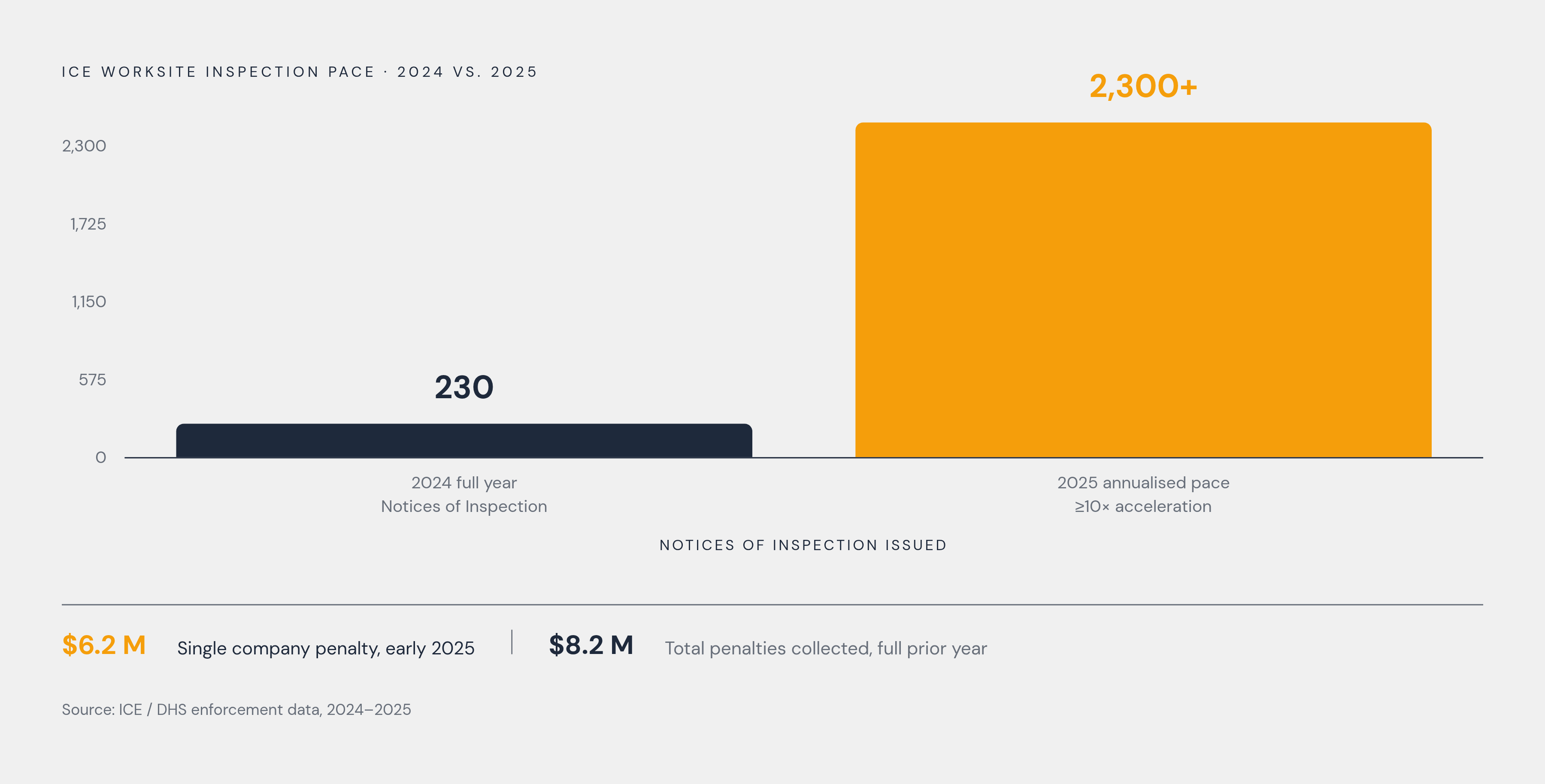
Dollar figures are one thing; the enforcement rate is what should actually keep HR departments up at night. Roughly 230 Notices of Inspection went out in all of 2024. i9 Intelligence reported that ICE's inspection pace in the first half of 2025 ran at least ten times faster than that. In the first seven months of the current administration, ICE publicly reported at least 40 worksite enforcement actions and over 1,100 arrests tied to them.
Then there's the number that made compliance officers sit up straight: a Colorado company got hit with a single $6.2 million penalty in early 2025. OutSolve reported that figure exceeded the roughly $8.2 million collected in total during the entire final year of the prior administration. One company, one penalty, surpassed a year's worth of enforcement under the old regime, and that comparison is worth sitting with for a second.
ICE also rewrote its inspection guidance so that errors once treated as correctable "technical or procedural" issues now get filed under "substantive" violations, the kind that carry immediate penalties instead of a chance to fix and resubmit. And in April 2025, ICE and the IRS signed a memorandum of understanding giving Homeland Security Investigations access to IRS employer records for immigration enforcement. Two agencies that didn't used to talk shop now share a filing cabinet.
The industries in the crosshairs have widened, too. Construction, agriculture, food service, and hospitality were always targets. Now technology, consulting, healthcare, and engineering, the sectors leaning hardest on H-1B and other work-visa hiring, are drawing attention as well. Legislation points the same direction: the "One Big Beautiful Bill Act" included significant new funding earmarked for ICE worksite enforcement, and more than a dozen states introduced bills in 2025 to expand E-Verify mandates.
For any employer with international workers on staff, the math doesn't forgive much. Visa-based work authorization means more document types, more expiration dates, more reverification triggers than a workforce of U.S. citizens presents. Manual tracking doesn't fail all at once; it fails one missed date at a time, and each miss makes the next one more likely.
What I-9 compliance software actually does at each stage of the process
The problem software solves isn't glamorous. People filling out forms by hand make mistakes: missing fields, mismatched dates, the wrong document type entered in the wrong box. Each error is nearly invisible on its own and expensive at scale, which is exactly the combination that turns into a bad audit two years later.
At onboarding, the software walks the employee through Section 1 with field-level checks, catching incomplete or contradictory entries before submission. It shows the correct list of acceptable documents and stops employers from asking for more than the law allows, itself a common and usually accidental violation. For remote hires, the platform runs the live video session, captures document images, and timestamps the interaction so there's a record if anyone ever asks.
On the E-Verify side, these platforms submit I-9 data without requiring anyone to re-type it, cutting down on the data-entry mismatches that trigger delays. Case results and Further Action Notices show up inside the same workflow HR already uses. E-Verify+, which went live nationwide in 2025, changes part of this picture: employees enter their own data and documents into personal accounts, get status updates directly, and the employer's burden around issuing Further Action Notices shrinks.
Manual systems tend to break down in the ongoing part, not the initial filing. Automated expiration tracking flags HR well before a work authorization document runs out; Paycom, for instance, sends reminders at 90-day intervals. Reverification workflows kick off automatically when a document expires or a status changes, and the Status Change Reports USCIS started issuing in June 2025 can feed straight into these monitoring queues instead of sitting in someone's inbox unread for a month.
When the audit lands, what these platforms produce is the paper trail: encrypted, centralized storage with a timestamp on every action taken on every form. A documented, consistent process is worth more than it sounds, especially now that ICE reclassifies more errors as substantive rather than technical. USCIS also has E-Verify NextGen in development, which would push I-9 completion and E-Verify closer together at the system level, letting employees enter their own information directly and cutting employer data-entry work further still.
The platforms employers use and what separates them
No single platform wins here. The right one depends on workforce size, how many hires are remote, what HR system is already running, and whether the company is enrolled in E-Verify in the first place.
Among the standalone I-9 specialists, Mitratech Tracker I-9 markets itself as built for enterprise use with immigration legal expertise behind it, and cites zero client fines over more than two decades, the kind of claim that lands with an organization where I-9 defensibility is the entire reason for buying software. WorkBright goes mobile-first, built for high-volume onboarding, a good fit for employers hiring large numbers of hourly or remote workers who need speed and self-service more than legal firepower. EMP Trust, i9 Intelligence, and Clear I-9 by HRlogics all lean into remote-work capability, which matters most where the alternative procedure is the operational center of gravity rather than a side feature.
On the enterprise end, Equifax I-9 HQ and Mitratech I-9 Compliance target large organizations that need centralized controls, multi-location workflows, and deep system integrations. Background screening firms like HireRight and First Advantage/Sterling bundle employment eligibility verification into a broader pre-hire screening program, which suits recruiters who'd rather buy one system than stitch two together. HCM platforms like Paycom and Paylocity fold I-9 and E-Verify into a much larger payroll and onboarding stack, appealing to employers who want one system of record instead of a point solution bolted onto everything else.
A few things matter regardless of who's shopping: E-Verify enrollment support, since that's a prerequisite for the remote alternative procedure and not a nice-to-have, live video capability that produces a timestamped and auditable record, automated expiration and reverification alerts, real depth in the audit trail, and a form version that stays current when USCIS updates it, which it did in January 2025.
That E-Verify enrollment point changes the whole conversation before software even enters the picture. The Migration Policy Institute reported that as of June 30, 2025, only 14 percent of U.S. employers were enrolled in E-Verify. Which means most American employers cannot legally use the permanent remote alternative procedure right now, no matter how good the software they buy is.
Where identity verification technology fits into the I-9 workflow and where it doesn't
I-9 compliance software manages the legal process. Identity verification technology authenticates the documents inside that process. These are complementary jobs, and mixing them up is how a company ends up buying the wrong tool and wondering why the audit still went sideways.
Modern identity verification platforms go well past what the I-9 form itself requires. They authenticate government-issued IDs against known security features, match a live selfie or video against the photo on the document, run liveness detection to tell a real person apart from a deepfake or a still photo, and flag documents matching known fraud patterns. A range of dedicated identity verification platforms exist in this space, none of them I-9 software but many built to plug into I-9 workflows, offering capabilities such as document authentication, biometric matching, liveness detection, and global identity data coverage.
This category is getting more attention for a concrete reason, not an abstract one. Evolving document fraud techniques are increasing pressure on standard document review, which makes pairing AI-based authentication with I-9 workflows a risk decision now, not a luxury upgrade.
Some I-9 platforms build document authentication directly into their product; others hook into dedicated identity verification vendors through an API instead of building it themselves. Either way, none of this erases the live video requirement baked into the permanent alternative procedure, and the employer or an authorized representative still has to be on that call. For employers hiring internationally, where the document mix runs to passports, visa stamps, EADs, and I-94 records instead of a driver's license and a Social Security card, automated authentication earns its keep. Manual review of that much document variety is exactly where mistakes cluster.
What the I-9 process means for international workers navigating a sponsored job offer
The I-9 doesn't ask a visa question directly. It asks a work authorization question. But for an international hire, those two things are stitched together tightly enough that treating them as separate concerns is a mistake, and an expensive one at that.
Work authorization for international employees is almost never permanent on paper. EADs expire, and visa-based work authorization is tied to a status with its own end date. That means the reverification trigger isn't a rare event happening to someone else's HR department; it's a near-certainty sitting on the calendar from the day the I-9 gets filed. A sponsored job offer is the first checkpoint in a process that keeps checking, indefinitely, for as long as the person holds the job. Employers who treat the I-9 as a one-time form and international hires who assume the paperwork wraps up once the job starts are making the same mistake, just from different chairs.