Employer of Record Services for Hiring Foreign Workers
EOR services let companies hire abroad without setting up a foreign legal entity.

An Employer of Record is a third-party company that becomes the legal employer of a worker in a country where the hiring company has no entity of its own. The client directs the work; the EOR owns the paperwork, the payroll, the tax filings, and the legal risk. That split is the entire product, and it's what the rest of this piece unpacks. Setting up a foreign subsidiary takes 3 to 9 months and costs $20,000 to $100,000; an EOR gets someone on payroll in 5 to 14 days. Most companies buy the speed and skip the fine print, and the fine print is exactly where this arrangement gets interesting.
The specific problem EOR solves for companies wanting foreign workers in the U.S. and abroad
Two different jobs get lumped under the same three-letter acronym, and that's the first mistake. The first job is straightforward: a U.S. company wants to hire someone who lives in Portugal and has no plans to leave. The EOR employs that person under Portuguese labor law, runs payroll in euros, files the local taxes the U.S. company has no legal standing to file itself. No entity, no lawful payroll, so the EOR becomes the entity by proxy.
The second job is immigration law wearing a payroll company's clothes. A firm wants to bring a foreign national into the U.S., or some other country, to work in person, and someone has to sponsor the visa. That means filing petitions, managing attestations, and staying on the hook for compliance reporting for as long as the worker holds status. Many visa categories require sponsorship from a recognized legal employer, and an EOR can fill that role, but the job just got a lot more specialized than cutting a paycheck.
Tech is where the confusion shows up hardest. A 12-person startup chasing a product roadmap has no immigration department and no intention of building one just to hire an engineer in Warsaw or sponsor an H-1B for a designer in Toronto. Treating EOR-for-payroll and EOR-for-sponsorship as the same purchase is the single most common mistake buyers make, and it's worth naming plainly: one is an administrative fix, the other is a legal commitment that outlives the contract.
How EOR visa sponsorship actually works in practice
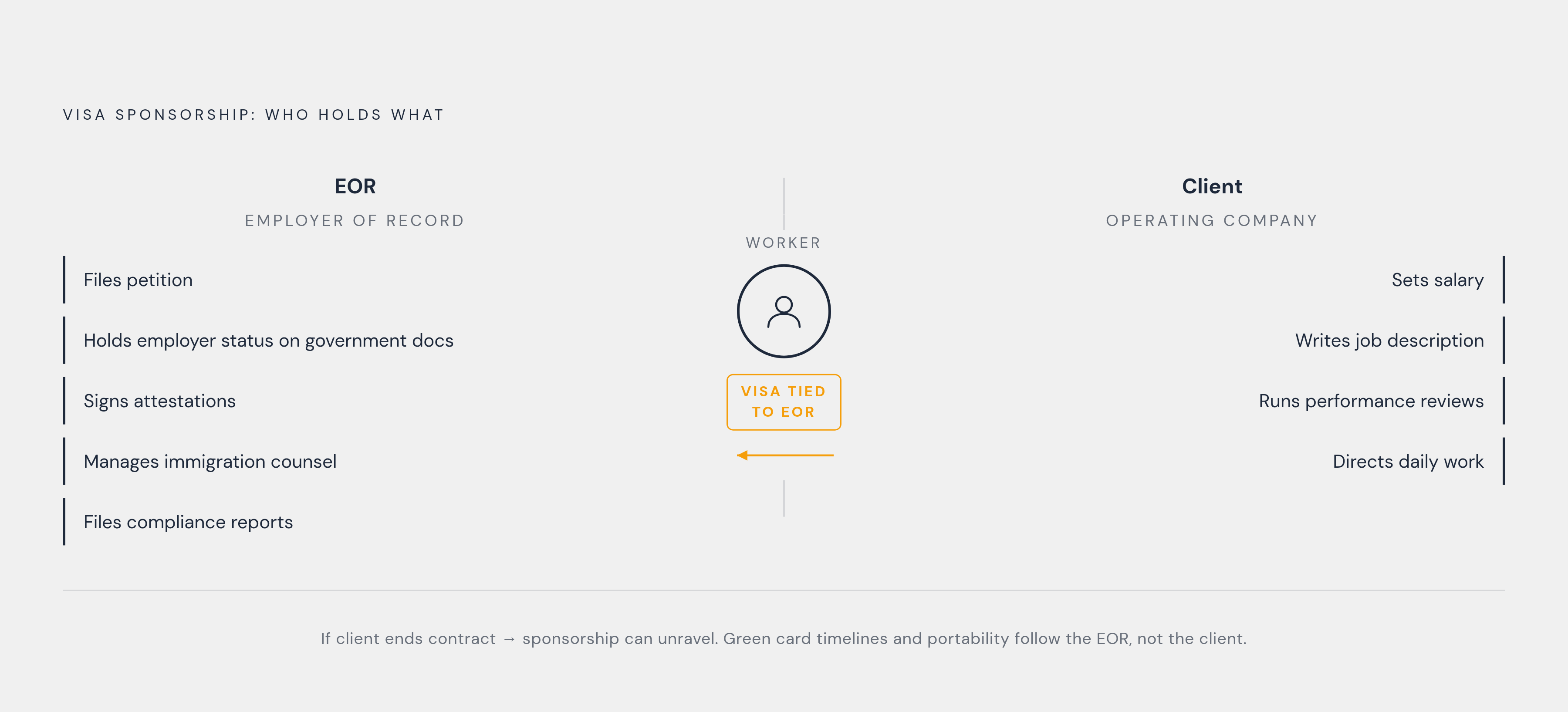
When an EOR sponsors a visa, it files the petition as the legal employer, not the client. The name the government cares about is the EOR's, not the client's. The client company that assigns the work, sets the salary, and runs performance reviews is, legally speaking, a bystander.
The EOR handles petition prep, keeps documentation compliant, manages the relationship with immigration counsel, signs employer attestations, and files whatever ongoing compliance reports the visa category demands. The client keeps the job description, the pay, the day-to-day direction, the performance conversations. Two entities, one worker, and the legal weight sits with the one that isn't running the meetings.
For the worker, that split has teeth. The visa is tied to the EOR, so if the client ends the contract, sponsorship gets complicated fast. Any move toward a green card, or toward a future employer change, has to be weighed against that reality, not against the hope that the "real" employer will just carry the sponsorship forward once things get serious.
Not every visa category treats this the same way. Different visa categories each carry different rules about who counts as sponsor of record and how cleanly an EOR can step into that role. Some EOR providers have built dedicated immigration and relocation services for exactly this kind of cross-border move, which is a real differentiator since most haven't bothered. The practical ceiling: EOR sponsorship works when the employment relationship is expected to last and the client-EOR arrangement stays stable for the life of the visa. Short-term or project-based work is a bad fit here, because the visa clock and the contract clock tend to run out at different speeds, and the worker ends up holding neither.
EOR vs. PEO vs. setting up your own foreign entity — where each model fits
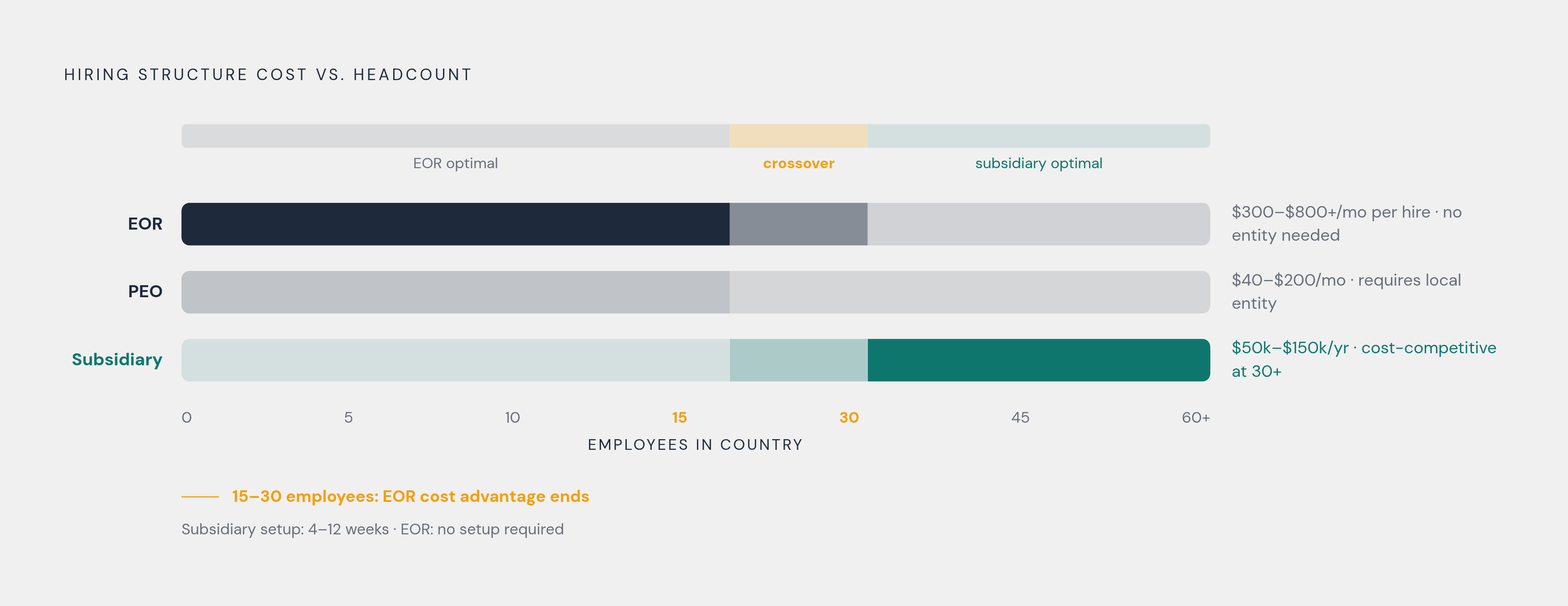
Three structures carry three different assumptions about what the client already has on the ground. Pick wrong and it's an expensive way to learn the difference.
An EOR is the sole legal employer and takes on full compliance liability; the client needs no in-country entity at all. That's the right tool when the company has zero legal footprint where the worker lives. A PEO, a Professional Employer Organization, is a co-employment setup instead: the client stays the legal employer, and the PEO just administers HR, which only works if the client already has a legal entity in that country. PEOs typically run 2% to 12% of payroll, or $40 to $200 per employee monthly, well under EOR's $300 to $800-plus. That premium buys something specific: no entity setup cost, and someone else holding the compliance bag when things go wrong.
Things go wrong more than buyers expect. Companies hiring internationally report at least one compliance incident 74% of the time, and the average cost of a single violation runs around $42,000. That's the number that turns the EOR premium from overhead into insurance against a fine that dwarfs a year of fees.
A foreign subsidiary is the cleanest structure for scale and for owning intellectual property outright. Setup takes 4 to 12 weeks on average, longer in jurisdictions thick with red tape, and running compliant employer infrastructure costs $50,000 to $150,000 a year before the first hire shows up. The crossover point where a subsidiary starts beating EOR on cost lands around 15 to 30 employees in a single country, later than most founders assume when they're eyeing entity setup on principle instead of spreadsheet. Germany complicates the math further: its 18-month cap on labor leasing arrangements forces companies out of EOR structures on a legal timer, regardless of headcount or cost preference. Anyone building proprietary tech should own IP through a local subsidiary and wait out that crossover point, because an EOR employment contract will never give that protection, and that gap is not close.
What EOR services actually cost in 2026
Sticker prices in 2026 run from $199 to $1,200 per employee per month, with most buyers landing between $400 and $700. Deel lists at $599, Remote at $599, Multiplier starts at $400, Oyster HR runs $699, Papaya Global starts around $650. Some providers charge a percentage of gross salary instead, typically 10% to 20%; on a $60,000 salary at 15%, that's $750 a month, right in line with the flat-rate providers at the high end.
None of that is the real number, and treating it as such is how budgets blow up mid-year. Total employer cost is salary plus statutory employer burden plus the EOR fee, and the statutory burden swings wildly by country: single digits in some countries, rising steeply in others. The same base salary can cost dramatically more in a high-burden country than in a low-burden one before the EOR fee is ever added. Published platform rates never include salary or statutory benefits. The gap between the number on the pricing page and the number on the invoice is the whole game, and it's the part most buyers skip past to get to a number they like.
Not every provider quotes a rate up front, either. Some providers publish starting prices while others keep pricing behind a sales call, which usually means the number depends more on the buyer than the service. EOR pencils out best for smaller teams in a given country, with the cost crossover against a subsidiary typically arriving somewhere between 10 and 30 employees. Past that, monthly fees start stacking up against what a subsidiary would cost to run, and the "fast and cheap" pitch quietly stops being either.
The major EOR providers and how their models differ
Two architectures split the market, and neither wins outright; each just fits a different problem. Some EORs employ workers through wholly owned entities in each country, buying tighter compliance accountability at the cost of slower expansion into new markets. Others run an aggregator model, leaning on a network of local partners to cover more countries faster, at the cost of a longer chain of parties responsible when something breaks.
Deel operates across a broad range of countries at $599 a month and fits companies that need full-time and contractor coverage on one platform. Remote runs at the same $599 price point and positions itself on in-country accountability. Rippling folds EOR into a broader HR and payroll system, a better fit for larger organizations that want global hiring in one platform rather than a standalone tool. Globalization Partners (G-P) tends to target larger buyers with broad country coverage, usually through the longer procurement cycles that come with larger accounts. Some providers pair EOR with immigration and relocation services, which makes them the sharper choice for companies moving people across borders rather than just hiring them in place. Multiplier and Oyster HR sit at competitive entry price points, $400 and $699 respectively, suited to companies hiring across a smaller set of countries.
For visa sponsorship specifically, country count is the wrong question. What matters is whether the EOR runs its own legal entities or leans on partners, how deep its immigration counsel bench actually goes, and whether it handles relocation and cross-border moves at all. Payroll competence across 150 countries says nothing about whether a provider can competently sponsor an H-1B, and buyers who confuse the two usually find out the hard way, mid-extension filing.
The real limitations of EOR for foreign worker hiring
Permanent Establishment risk sits at the top of the list. If an arrangement is structured, or even perceived, in a way that creates a taxable presence for the client company in another country, that company can end up owing taxes it never planned for. EOR reduces this risk rather than erasing it, and how much protection it actually delivers depends on how the work itself is structured, not just on which provider gets hired.
Then there's the dual-employer problem baked into every sponsored visa. The worker's status is tied to the EOR on paper, but the working relationship lives with the client in practice. If either relationship breaks, contract ends, worker gets offboarded, sponsorship can unravel in ways neither party fully controls. This is where provider quality diverges sharply: an EOR that runs flawless payroll across 150 countries is not automatically equipped to manage an H-1B extension or an adjustment-of-status filing. Asking directly about immigration infrastructure and legal counsel before signing isn't optional due diligence — it's the whole ballgame.
Long-term immigration paths, green cards especially, get harder under EOR arrangements precisely because the sponsoring employer of record might not be the company the worker ends up staying with long-term. IP ownership carries its own quiet risk: standard EOR contracts are built for payroll compliance, not for capturing intellectual property, so companies building proprietary technology with foreign talent under an EOR need dedicated IP assignment agreements reviewed by local counsel, not the EOR's boilerplate. Some limits aren't negotiable at all. Germany's 18-month labor leasing cap is a hard legal ceiling, not a pricing decision, and past 15 to 20 employees in one country, EOR fees often exceed what running a local subsidiary would cost outright.
What foreign workers and international job seekers should understand about EOR-sponsored roles
An EOR-sponsored job offer is a real job, with legitimate work authorization, and the model is used widely enough that it shouldn't raise red flags on its own. What it does require is understanding that the employment structure has an extra layer built in, and that layer carries consequences worth asking about before signing anything.
The visa is sponsored by the EOR, not by the company the worker will actually report to, and that distinction shapes everything from job security to what happens if the underlying client contract ends. Before accepting an offer like this, find out which entity is filing the petition and will appear on the work authorization, what happens to status if the client ends its agreement with the EOR, whether the EOR or the client plans to pursue permanent residency and on what timeline, and whether the role is a bridge toward direct employment or expected to stay EOR-structured indefinitely.
Most job boards don't distinguish between an EOR arrangement and a direct hire in the listing itself, so this information usually stays invisible until deep into the interview process, sometimes not until the offer letter lands. Searching by an employer's track record of direct sponsorship is a more reliable filter than applying to any post that mentions "visa sponsorship," since EOR-sponsored and direct-hire-sponsored roles carry very different long-term consequences under that same phrase. For OPT and CPT holders working against a visa clock, time spent discovering late that a promising offer doesn't serve the long-term immigration path is time that doesn't come back. Getting clarity on the sponsorship structure before the offer stage, not after, is the discipline that actually changes outcomes.