AI Resume Optimisation for US Job Applications
Tailored resumes convert to interviews at nearly double the rate of generic ones.

Job applications in the US have grown two to three times over in recent years, according to Huntr's research, and the median time to first offer hit 108 days in Q1 2026, up from 83 days the quarter before. Too many resumes, too few signals, and a hiring process that increasingly relies on software to make the first cut before a human ever opens the file — that's the real bottleneck. For international candidates, every one of those 108 days comes out of a visa clock that doesn't pause for anyone. Optimizing how you apply, not just how often, is the only lever that actually moves the number.
How employers are using AI to screen resumes before any human sees them
Nearly every hiring manager now touches AI somewhere in the process. A 2025 Insight Global survey found 99% of hiring managers reported using AI in some hiring capacity, and 98% said it sped up screening and scheduling. Separately, a ResumeBuilder survey of 948 business leaders found 83% of companies planned to use AI in resume screening by 2025, and 82% of those said they use it specifically to review resumes and filter candidates.
Adoption isn't even across company size. Large US organizations moved fastest: 40% of extra-large companies had already put AI into HR workflows, compared to just 22% of small ones. Mid-sized firms spent 2025 closing that gap, and by most projections, 62% of employers expect to lean on AI for most or all hiring stages by 2026.
What are these systems actually doing? Modern tools like the ones built into Workday, Greenhouse, Lever, iCIMS, and Taleo run semantic analysis, catching related terms and skill patterns even when your wording doesn't match the job post word for word, going well beyond simple keyword matching. Workday alone held close to 19% of the applicant tracking market in Q3 2025. Each platform parses differently, and each processes a resume in a fraction of a second while weighing several factors at once. The upshot: a resume that would win over a hiring manager in a five-minute conversation can still fail before it reaches one, simply because it wasn't written in a language the machine recognizes.
What ATS systems actually reject — and what they don't
Here's a fact you've probably heard that isn't one: "the vast majority of resumes get auto-rejected by ATS." That number traces back to a 2012 marketing document from a resume-optimization company that shut down the following year. No dataset, no methodology, nothing. It's a ghost statistic that refuses to die.
What actually happens is less dramatic and more mechanical. A 2025 study of 25 US recruiters across more than ten ATS platforms found that the vast majority don't configure rules to auto-reject resumes based on content at all. The real gate sits earlier, in the application form itself: knockout questions. Work authorization status. Minimum years of experience. Willingness to relocate. Answer wrong, and the process can end right there, before any resume is even parsed.
For international candidates, this is where things get sharp. A "yes, I require sponsorship" answer can end an application instantly at a company that has no intention of sponsoring anyone, no matter how good the resume attached to it is.
The actual formatting failures worth worrying about are parsing errors: tables, multi-column layouts, text boxes, embedded graphics. Plain DOCX files parse cleanly almost every time; anything fancier introduces real risk of misreads. For international candidates who also need to know whether an employer sponsors visas at all, a subscription job board like Migrate Mate, which lists verified US employers filtered by visa-sponsorship track record across categories like H-1B, OPT, and TN, answers that question before any resume is even submitted. And this isn't a niche problem. Jobscan reports that 97.8% of Fortune 500 companies use an ATS, so getting the formatting basics right matters at scale. The mythical resume-eating algorithm that candidates fear so much turns out to be a minor concern next to a checkbox on a form that no resume, however well built, can talk its way past.
What tailoring a resume actually does to interview rates
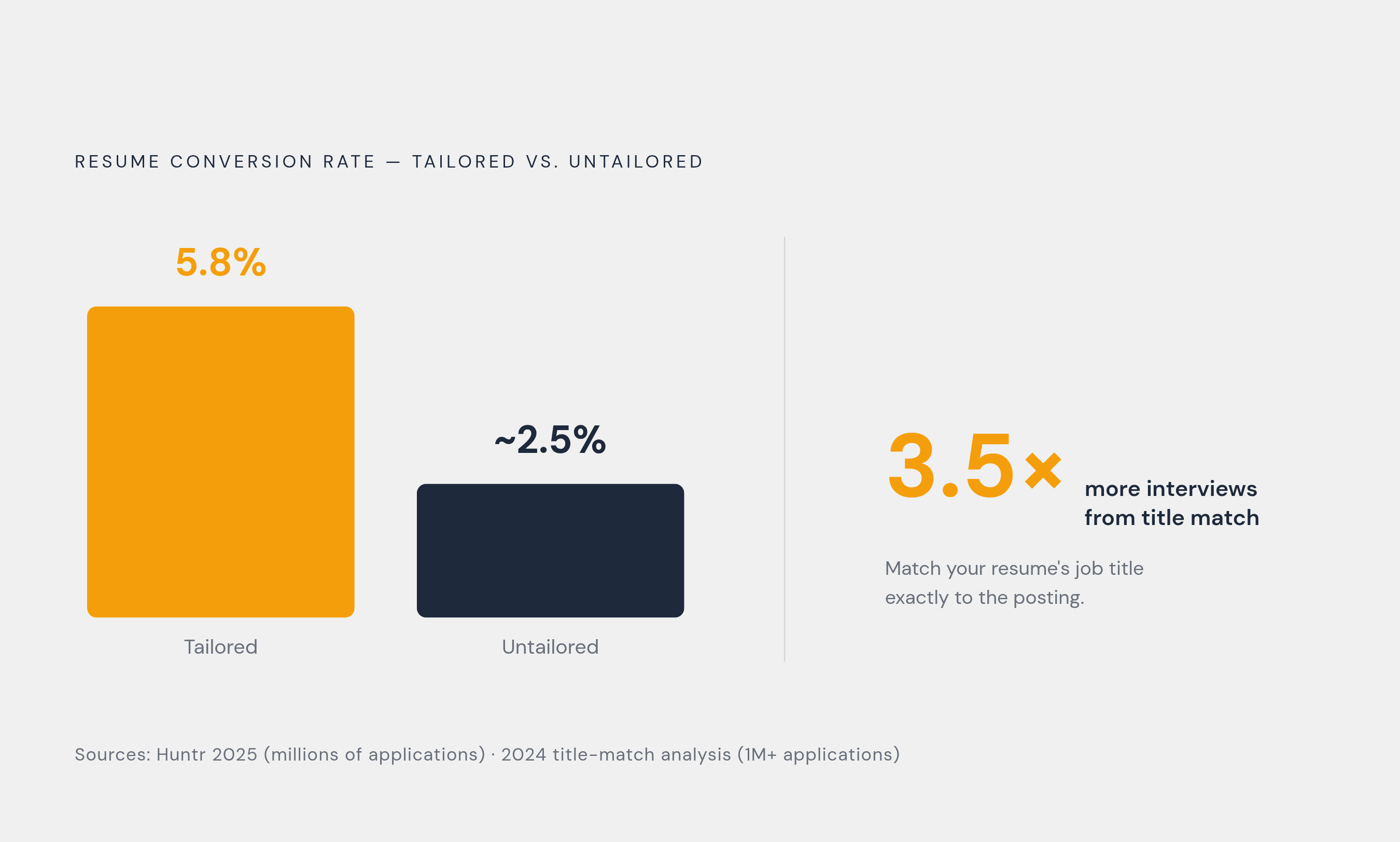
Tailoring works, and the numbers back it up cleanly. Across Huntr's 2025 annual dataset of roughly millions of applications, tailored resumes converted to interviews or offers at 5.8%, versus a noticeably lower rate for generic ones. Q2 2025 data sharpens that further: a materially higher rate for tailored resumes against a much lower rate for untailored ones, across more than a million applications tracked since Q4 2024. Put plainly, that's about six interviews per 100 tailored applications, versus fewer than three for the generic pile.
One specific move stands out. A 2024 analysis of over a million applications found that matching your resume's job title exactly to the title in the posting increased interview rates roughly 3.5 times. That's a genuine multiplier, not a rounding error, from something that takes about ten seconds to fix.
Tailoring, done properly, isn't keyword-stuffing. It's mirroring the actual vocabulary a job description uses, sticking to section headings the ATS recognizes without confusion (Work Experience, Education, Skills, nothing cute), and quantifying what you did, because screening systems are built to surface numbers. Fewer, sharper applications beat mass submissions on conversion every time, and that math matters even more when you're an international candidate with a visa clock running and no time to waste on a spray-and-pray strategy.
Why AI resume tools help — and what kind of help they actually provide
The best evidence here comes from a randomized controlled trial: Wiles, Munyikwa, and Horton studied 480,948 job seekers and found that AI writing assistance increased hires by 7.8% and wages by 8.4%. The mechanism was reducing noise rather than gaming a system. Better writing let employers assess a candidate's actual ability more accurately, and hiring managers on the receiving end didn't report lower satisfaction with the hires that came through.
People have noticed. Roughly two-thirds of job candidates reported using AI when applying, according to Career Group Companies' 2025 report. Kickresume's 2025 data found more than 1.2 million people used AI-powered job search tools that year, with over 580,000 using them to write or improve resumes and over 770,000 using them just to check ATS compatibility, the single most common use case. Pew Research found 34% of US adults have used ChatGPT, double the 2023 figure; among adults under 30, it's 58%.
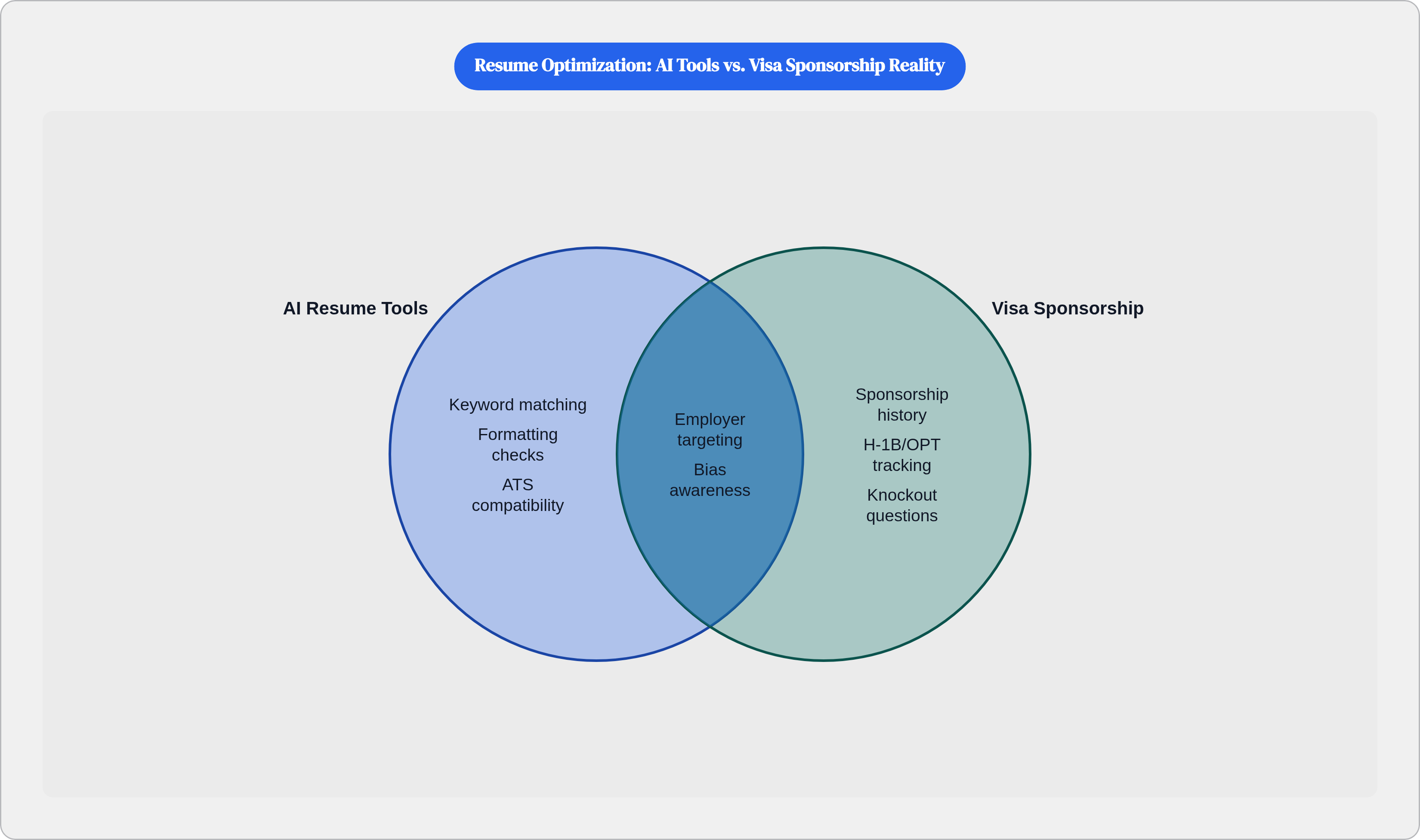
What these tools are actually good at: matching keywords to a specific posting, tightening bullet points into something metrics-forward and readable, flagging formatting that will choke a parser, and adjusting tone to fit the role. What they were built for is optimizing inside the general US job market, a market that assumes the employer on the other end is open to hiring you in the first place. None of them were built to tell you whether that employer sponsors visas. That filter simply doesn't exist in their design, which is fine, until it's the only filter that actually matters to you.
The trap a well-optimised resume can walk an international candidate into
Picture the candidate who does everything right. Tailors the resume with AI help, nails the keyword alignment, formats clean for ATS parsing, applies to a recognizable employer, and then hits a knockout question about work authorization that ends the whole thing before a human ever sees the file. Or the quieter version: no knockout question at all, just an employer that has never sponsored a visa in its history, so the application vanishes into a queue that was never going anywhere.
Most resume tools and most job boards were built with domestic candidates in mind. Visa status simply isn't a variable in their optimization logic. LinkedIn and Indeed will surface millions of listings with zero indication of which of those employers have actually sponsored a visa before. A resume perfectly matched to a job description at a company with no sponsorship history is, functionally, a resume optimized for rejection, no matter how sharp the writing is.
This is where the 108-day median time to first offer stops being just a number and starts being a warning. That median assumes the pipeline works. For an international candidate applying to non-sponsors, the pipeline is broken rather than merely slow, and no amount of resume polish fixes a broken pipe. Optimization is a necessary step, not the whole strategy. The real question is what you're optimizing toward, and sponsorship history, not job title match or brand recognition, is the far better predictor of whether an application leads anywhere at all.
The backlash against AI-generated resumes and what it means for how you use these tools
Here's the twist nobody warns you about: the same hiring managers leaning on AI to screen you are increasingly hostile to resumes they suspect were written by AI. A Resume.io survey of 3,000 hiring managers found 49% would automatically dismiss a resume they thought was AI-generated. Resume Now surveyed 925 hiring managers in 2025 and found 62% reject AI resumes that lack personalization. A 2026 Resume Genius survey of 1,000 US hiring managers found 77% believe a large share of resumes now look AI-generated, and roughly eight in ten say they can spot one. The tells are consistent: unnatural phrasing, generic language, descriptions that sound inflated because they are.
There's a real double standard buried in here. A majority of companies use AI somewhere in their own recruiting process, while a notable share of recruiters say they'd reject a candidate for using it. Employers get to have it both ways; candidates don't.
Which points to the right use of these tools: AI works best as editor rather than author. Use it to sharpen language and fix formatting, not to write the whole document from a blank page. The specific project, the real outcome, the named context, that's what separates a resume that clears the screen from one that also persuades the human who reads it next. Worth remembering that the NBER trial's 7.8% hire-rate bump came from AI editing human-written prose, not generating it from scratch. The tool worked because it sharpened something a person had already said.
For international candidates specifically, the immigrant story isn't something to sand down or hide. The employers worth applying to are already primed to sponsor, and a resume that's specific and honest about context beats a generic one that hedges every time.
Bias in AI resume screening and what international candidates should know about it
The bias in these systems is not subtle. University of Washington researchers testing three leading large language models on resume ranking found resumes with white-associated names were preferred in the large majority of test cases; resumes with Black-associated names came out ahead in only a small fraction of cases; both were ranked equal in a very small share of cases, according to a joint study with the Brookings Institution.
International candidates weren't the specific focus of that research, but the mechanism applies just the same. Names, university names, and career paths that don't match the patterns baked into a model's training data may score differently than an equivalent resume from a domestic candidate with a familiar profile. That's not a reason to hide who you are or where you're from. It's a reason to understand that these screening systems aren't neutral referees, and that the employer you're applying to matters as much as the resume you send.
Employers with a real track record of sponsoring international hires have already built hiring processes around evaluating candidates like you. The bias risk from a generic AI screener doesn't disappear in that context, but it operates inside a system designed with you in it, rather than one that never considered you at all. Optimizing the resume matters. Optimizing the list of employers you send it to matters just as much.
A practical approach to AI resume optimization for international candidates
Start with the employer list, not the resume. Look for companies with a documented history of sponsoring H-1B, OPT, or other relevant visa categories; sponsorship history predicts your odds far better than company size, brand prestige, or how closely the job title matches your last one. Some platforms aggregate verified US listings filtered specifically by sponsorship track record, which means the visa question gets answered before you ever send a resume, not after. Twenty applications to verified sponsors, each one properly tailored, will outperform two hundred sent into the void.
From there, use AI to tailor, not to generate. Match the resume's language to the specific posting: same vocabulary, same framing of skills, same job title where honest. Stick to standard headings, plain DOCX, no tables or embedded graphics, and quantify what you actually did. Let the AI catch gaps and clean up phrasing; write the substance yourself, because that's the part that survives into a document a human will actually read and believe.
Address visa status directly. Knockout questions about work authorization show up on most major ATS-powered applications, and an evasive answer isn't a clever workaround — it's a wasted application. Employers who sponsor already have the legal infrastructure and the intent; being upfront about your status filters you toward the right ones faster than any keyword trick ever could.
Last, don't treat the cover letter and application form as filler. SHRM's 2025 Talent Trends report found 51% of organizations using AI in HR apply it in recruiting, and 44% use it specifically for resume screening, but human reviewers still read what clears that first pass, and 57% of hiring managers spend one to three minutes on a resume that's caught their attention. That's not a lot of time. Make sure what they read in those three minutes is worth the visa sponsorship you're asking them to take a chance on.