AI-Powered Job Matching Platforms for International Candidates
Most AI job platforms ignore the one thing international candidates actually need to know.

JobRight.ai names the H-1B problem out loud, and that alone puts it ahead of most of the field. But naming a problem and solving it are different chores, and the gap between the two is where this piece lives. Adoption of AI hiring tools jumped from 58% to 72% in a single year, and every one of these tools is built to answer the same question: does this person's resume match this job description? Almost none of them ask the question that actually matters to a foreign national: has this employer ever filed a visa petition in its life? That omission isn't a bug you patch later. It's baked into how the matching logic gets built in the first place, and it's the subject of this piece.
The talent shortage that makes international candidates attractive on paper — and the visa friction that stops hiring in practice
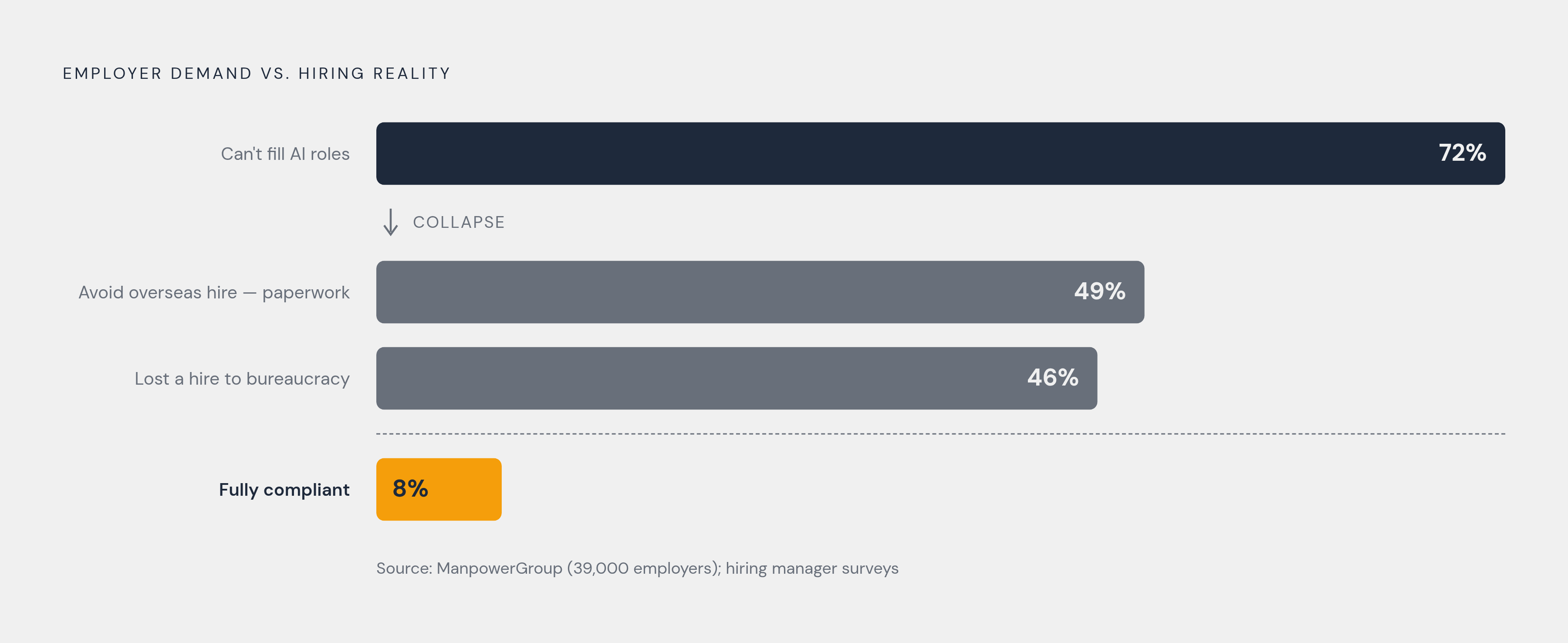
Nobody's arguing about demand. ManpowerGroup surveyed 39,000 employers across 41 countries and found AI skills are now the hardest thing to find on earth, harder than nurses, harder than welders, harder than anything: 72% of employers can't fill those roles. Korn Ferry counts 85 million unfilled digital jobs globally as of last year, which by their math leaves $8.5 trillion in revenue sitting on the table. LinkedIn's labor market research found AI engineers are eight times more likely to pack up and move for work than people in other fields. So the talent exists, it's mobile, and companies want it.
Here's where it falls apart. Deel asked 1,001 hiring managers across the UK and US whether they could find the skills they needed locally; 66% said no. Then ask a second question, would you hire from overseas to fix that, and 49% say they'd rather not bother, because the paperwork costs too much, takes too long, and might not even work. Sixty percent of UK firms and 55% of US firms in that same survey say visa rules have already blown up hiring timelines they cared about. Multiplier ran a similar survey across four countries and found 46% of companies lost an international hire to bureaucracy, plain and simple. Only 8% called themselves fully compliant with the tax and labor law that international hiring requires.
So there's a real subset of employers out there who both want to sponsor and know how to pull it off. That's a distinct market, not a rounding error. And nothing about a job title, a company's size, or its logo tells you which employers belong to it. What tells you is whether that employer has actually filed the paperwork before, and that's exactly the one data point no matching platform tracks.
How general AI matching platforms actually work, and which parts of the match logic are useful for international candidates
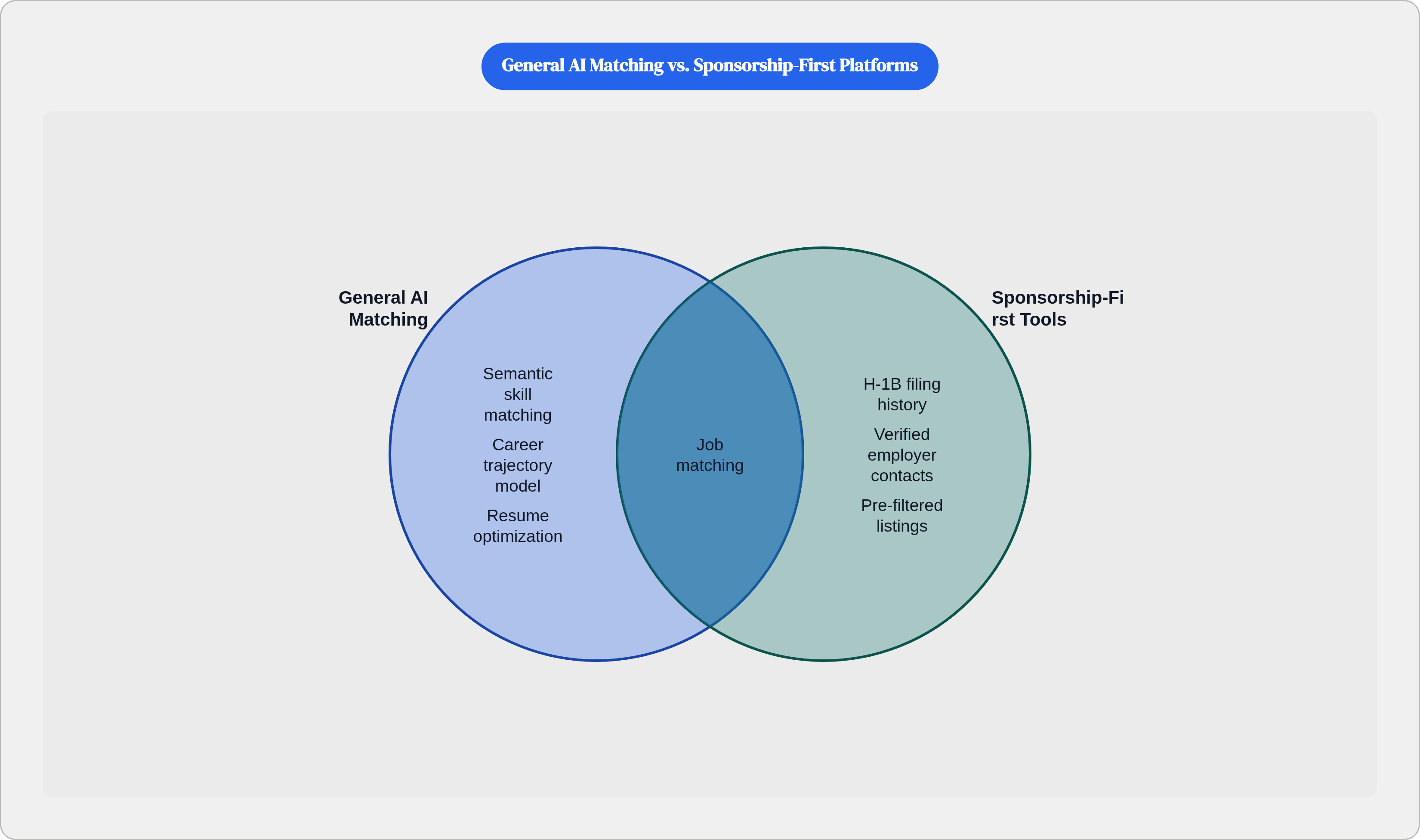
Strip away the marketing and the mechanics are pretty mundane. These tools read resumes and job postings the way a person skims them, matching meaning instead of exact words, so "built predictive models in scikit-learn" lands you a match for a "machine learning" role even though that phrase never appears anywhere on your resume. Eightfold pushes further and models career trajectory, guessing at what role you're probably ready for next based on where you've been. It runs on a large proprietary dataset of talent profiles and skills, one of the more expansive in this category.
That semantic layer earns its keep for international candidates specifically. It catches roles a plain keyword search would skip past, which matters most for someone whose foreign degree or job title doesn't map neatly onto the American equivalent. It also quietly defuses the bias toward American resume formatting, since the system reads for skills rather than for whether you used the right bullet style. JobRight.ai leans on this same mechanism to tailor resumes per role.
And then the logic just stops. Skills, trajectory, education, none of it tells you whether the company on the other end has ever sponsored a visa in its corporate history. A platform can hand you a near-perfect match to a company that has never filed a single H-1B petition, and it has no idea, so you have no idea, until the offer stage collapses or the recruiter goes quiet. Stack on top of that a problem AI hiring researchers have already documented: candidates whose writing patterns differ from training data norms can score lower on screening, not because they're worse candidates, but because the model can mistake phrasing for fit. International candidates eat both problems at once.
The platforms international candidates actually use, and what each one does and doesn't cover
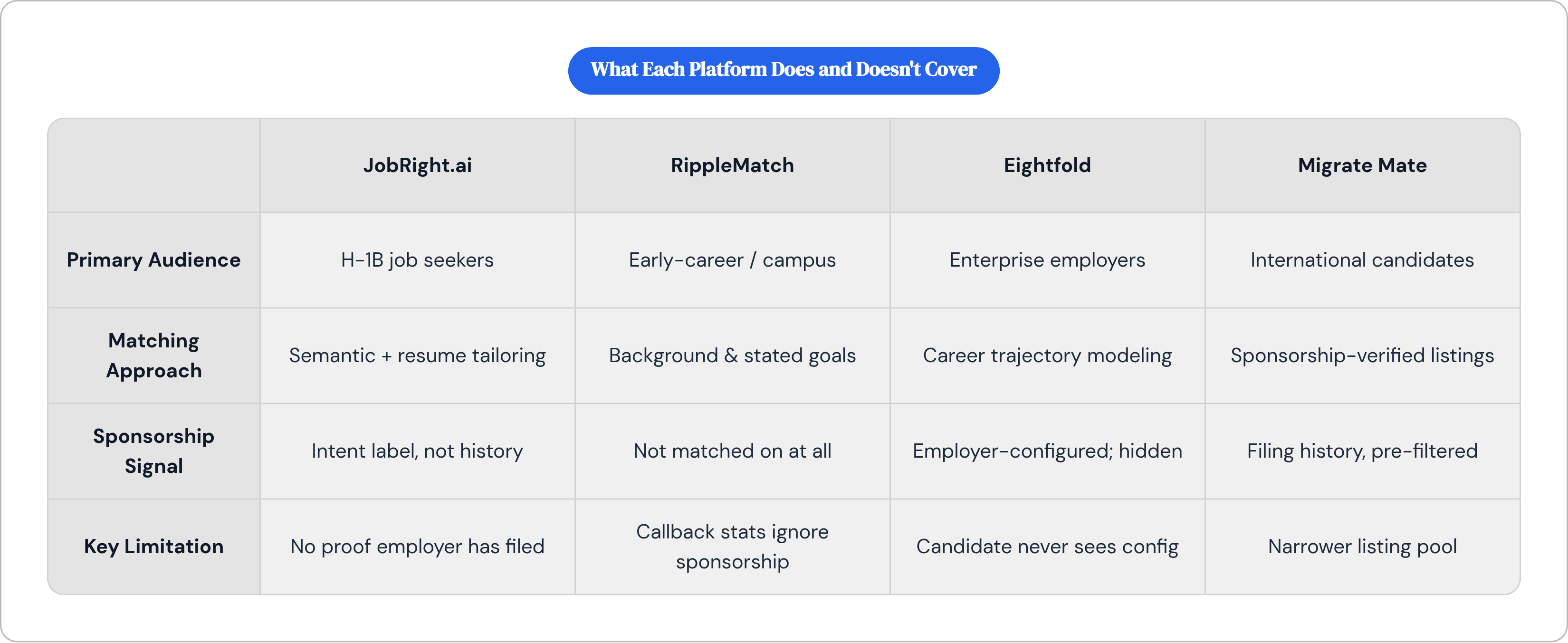
JobRight.ai gets partial credit here, it's one of the only tools built with H-1B seekers in mind, and it claims to meaningfully lift interview rates through tailored resumes. But its "H-1B friendly" label describes intent, not history. A job post that says "open to sponsorship" is a sentence someone typed, not proof anyone in HR has ever actually done it.
RippleMatch claims meaningfully better callback odds than a generic job board, matching people on background and stated goals. It's built for campus recruiting and early-career pipelines mostly, and sponsorship isn't part of what it's matching on at all; that 20x number is about match quality generally, and says nothing about who's actually willing to sponsor.
Eightfold sits on the employer's side of the table, but candidates bump into it constantly without knowing its name. It runs matching for large enterprises across multiple countries, and enterprise licensing sits at a price point no individual candidate would pay, so no candidate is choosing to use Eightfold; they're just walking into it. Its recruiting agent is built to support multilingual pipelines, which makes it genuinely useful for global hiring. Whether sponsorship gets filtered in or filtered out depends entirely on how the employer configured the tool on their end, and a candidate never sees that configuration.
One case worth sitting with: Some organizations focused on immigrant and refugee candidates have built integrations that plug those candidate pools directly into mainstream recruiting workflows, so those candidates show up in a recruiter's normal queue instead of some side folder nobody opens. That shift has less to do with candidates suddenly getting better than with what happens when immigrant status gets built into the pipeline from the start instead of tacked on as an afterthought.
Migrate Mate takes that same logic and points it at sponsorship history directly. Its listings come from employers with documented sponsorship records, pulled from public immigration filings and paired with actual employer contacts. The difference is where the filter sits: sponsorship gets checked before you ever see the listing, ahead of whatever the job description happens to say.
Why sponsorship history is a different kind of signal than job description language — and why the distinction changes how candidates should search
"Visa sponsorship available" can mean exactly what it says. It can also mean a recruiter pasted boilerplate language into a template without checking company history at all. Plenty of employers with zero sponsorship track record genuinely mean to start someday. Meaning to and following through are two different things, and the distance between them is a process that's slow, expensive, and abandoned constantly.
Sponsorship history, unlike intent, is public record. Immigration filing records are part of the public record, capturing employer-level patterns over time. A company with a documented history of H-1B filings has already proven things no job posting can prove: it knows the process, it's budgeted for the cost, and it has lawyers who finish what they start. You can't read any of that off a job title or a logo.
Getting this wrong costs more than a wasted application; it burns visa clock time you don't get back. OPT windows and H-1B cap deadlines are fixed dates on a calendar, not suggestions, and every week spent chasing a role that dies at the offer stage because the employer "isn't set up for sponsorship right now" is a week gone for good. General AI matching optimizes for how confident the algorithm feels about your skills fitting the role, which says little about the odds that a sponsored hire actually clears the finish line. Those are two different targets, and mixing them up is exactly how candidates run out the clock.
The broader shift in global talent mobility that makes this infrastructure gap more consequential now
Cross-border hiring is shrinking, not growing. BCG tracked 221 million professionals across 200-plus destinations and found skilled-worker relocations dropped from 3.7 million to 3.3 million in a year, about 430,000 fewer people moving than the year before. STEM talent took the hardest hit, down 13%; AI talent fell 12%; research professionals dropped 19%. BCG blames geopolitical noise, softer hiring across major economies, and tighter migration rules, especially in Canada and the UK.
None of this happened because the shortage went away. Global demand for AI talent still runs around 3.2 open roles for every qualified person available to fill them, over 1.6 million postings chasing something like 518,000 people. The U.S. leans on foreign nationals to keep its AI sector staffed at all; research has consistently found that a large share of STEM PhDs from U.S. programs have gone to foreign nationals.
When fewer moves succeed, the quality of the information you're acting on stops being a nice-to-have. The candidates who actually land somewhere in this climate are disproportionately the ones who aimed at sponsorship-verified employers from day one, rather than spraying applications into the general pool and hoping something sticks. Recent regulatory updates to the H-1B program have adjusted how the pathway is administered, a shift that rewards anyone who already understands how the process works. BCG also found companies with more global talent in leadership post measurably better shareholder returns, so the money case for sponsorship isn't even in dispute. What's missing is follow-through, not appetite.
What an AI matching platform built for international candidates actually needs to do differently
Here's the floor, and it's not complicated: sponsorship history needs to work as a first filter, applied before a match ever shows up on screen, rather than as a tag a candidate bolts on after the fact through some advanced search menu. A platform that treats "has this employer sponsored before" with the same weight it gives "does this job exist" would save candidates the exact weeks that visa deadlines never give back.
Everything these platforms already do well, the semantic matching, the trajectory modeling, the resume rewrites, still matters, and none of it is wasted effort. It's just aimed at a labor market that assumes whoever's on the other end of the application can say yes to sponsorship. Half the time, they can't, and no one bothers to check first.