AI Cover Letter Tools for Non-Native English Speakers
Editing beats generating when English isn't your first language.

Three ways to use these tools, and the difference matters more than which logo you pick. Generation: you give the tool a prompt, it writes a draft from nothing. Fast, forgettable, and a letter built from a blank prompt tends to read exactly like what it is. Editing: you write the draft, the AI adjusts tone, grammar, word choice. Coaching: the AI flags problems and suggests fixes, but you decide what actually changes.
For non-native English speakers, editing and coaching are where the value sits. Both leave your actual knowledge and your actual sentences in place; they smooth the surface without touching what's underneath. Generation swaps your voice for the tool's voice, and that's a bad trade when your background and your specific expertise are the whole reason you're applying.
Here's what editing and coaching fix, in plain terms: grammar slips that get an application tossed outright (recruiters reject for this almost 80% of the time), phrasing that's technically correct but reads like it got translated rather than written, tone that goes formal in one paragraph and casual in the next, and structural gaps like a missing opening line or the explicit call to action American recruiters expect and few other countries bother with. Some candidates say months of working through AI suggestions builds their own ear for professional English. Slower path to fluency, but it pays twice.
This doesn't replace expertise. The AI doesn't know you led a supply chain audit in Manila or debugged a production outage at 3 a.m. before a client demo. It only knows what you tell it. What it hands back is a better container for the same content.
The 2025 ACM finding that should change how NNES use these tools
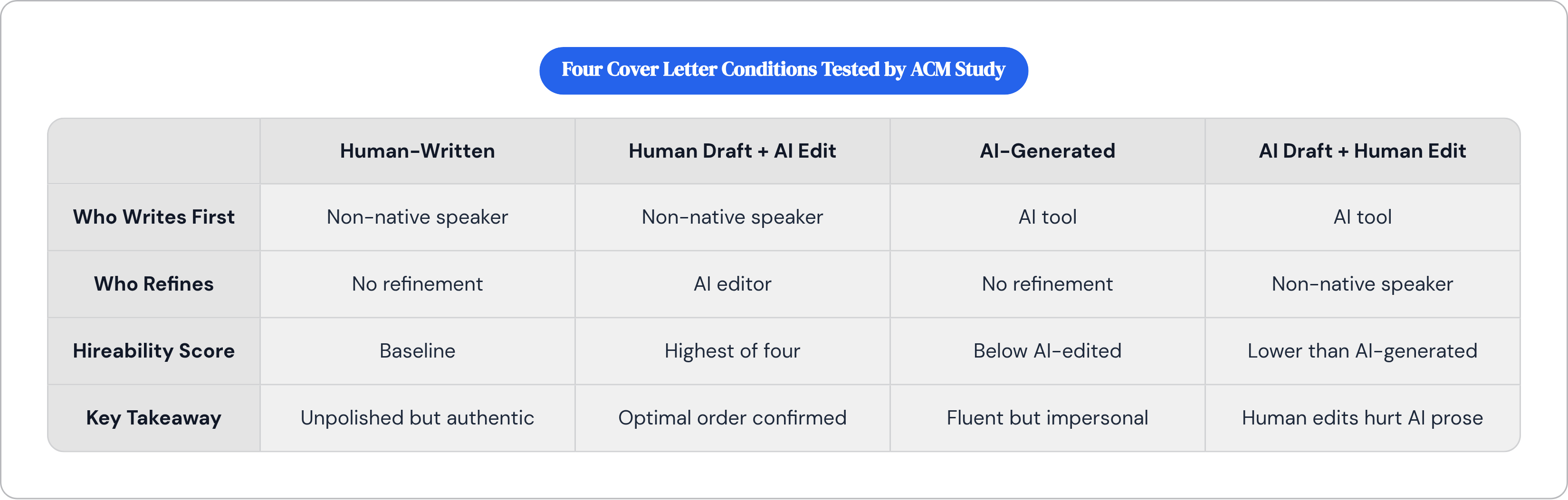
A 2025 study in the Companion Proceedings of the ACM International Conference on Supporting Group Work tested four kinds of cover letters: written entirely by non-native speakers, written by non-native speakers and edited by AI, written entirely by AI, and written by AI and edited by non-native speakers. A panel of 118 native English speakers rated each one on hireability and writing quality, blind to which was which.
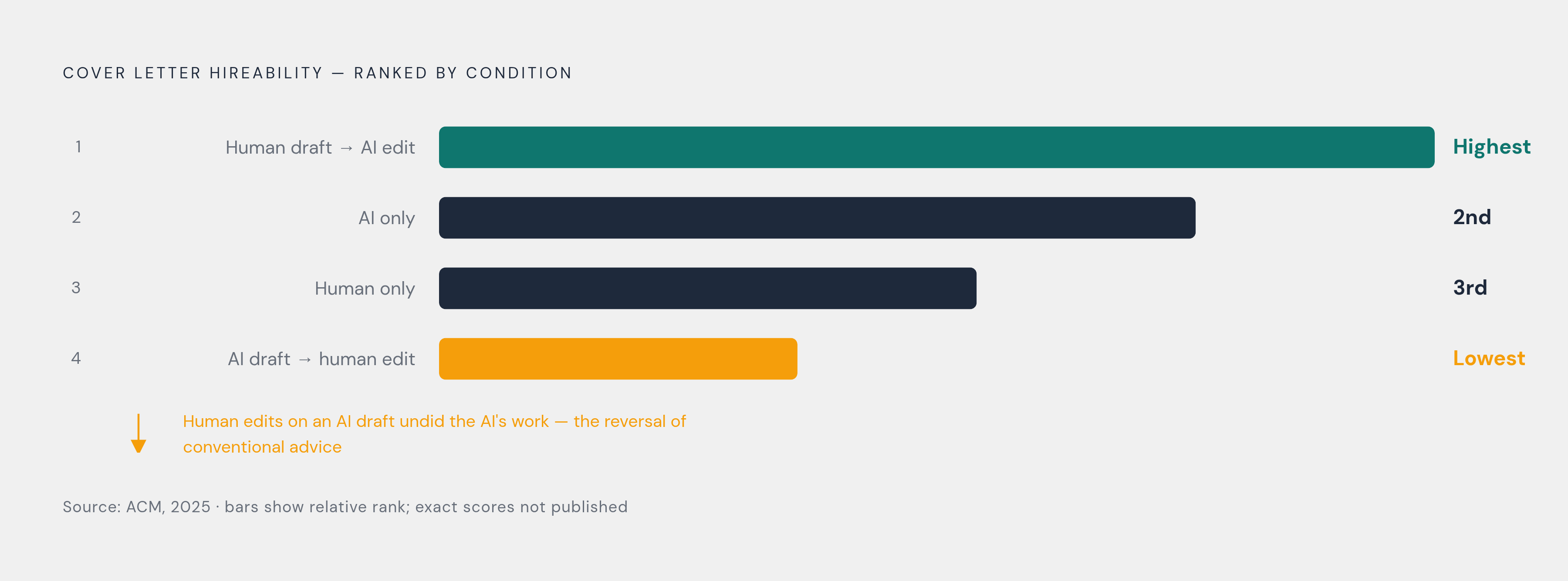
AI-edited letters, meaning a human draft refined by AI, scored highest of the four. When a non-native speaker took an AI-written draft and edited it by hand, scores dropped, and the person's own edits made the machine's writing worse.
Sit with that for a second. It means the safe order only runs one way: write first, then bring in AI. Flip it, generate with AI and revise by hand, and you tend to drag back in the exact phrasing habits the AI had already sanded down. Every job-search blog on the internet tells you to "personalize" your AI draft, yet the data says that instinct, applied in this order, quietly undoes the AI's work.
One catch worth naming: the study measured how native English evaluators rated hireability. That tells you what current recruiter expectations reward, not whether those expectations are fair, or whether they'll hold as more of the workforce writes for a living in a second language. Separate argument, and outside the scope of this piece.
Which tools are best suited to NNES needs in 2025–2026
The ones worth using share four traits: they control tone and register, not just grammar; they edit a draft you already wrote instead of only generating from a blank page; they take input in your first language for anyone who drafts before switching to English; and the output sounds like a person wrote it, not a template.
Grammarly, especially through GrammarlyGO, is strong on tone and clarity, and its suggestion-based interface keeps you making the final call on every sentence, which lines up with the write-then-refine order the ACM study points to. ChatGPT and other GPT-4-based tools are good at rephrasing and register adjustment when you feed them your own draft instead of asking them to invent one; the free tier matters too, for anyone counting every dollar during an international move. Resume.io catches phrasing that's grammatically fine but stiff or overly literal, the exact surface-fluency issue sitting underneath basic grammar checks. Rytr covers more than 30 languages and multiple tone settings, useful if you're applying across markets or drafting first in a language that isn't English. coverletter-ai.com runs on large language models and writes letters in multiple languages, which lowers the entry barrier for anyone still building confidence in English. CoverDoc.ai, BeamJobs, Kickresume, and ResumeGenius show up across current tool roundups with ATS-compatible templates, handling formatting conventions that vary more by country than most people assume.
For candidates specifically targeting U.S. sponsorship, the cover letter is one layer of a bigger problem. Migrate Mate pairs job listings with verified sponsorship-history data, so you aim your well-edited letter at employers who've actually sponsored visas before, instead of polishing prose for a company that's never filed one.
Cost isn't the real barrier here. Most of these tools sit in a manageable price range, and free tiers cover the basics. No tool, whatever it costs, substitutes for what you already know; it just renders what's already there more clearly.
The AI detection trap that hits NNES harder than anyone else
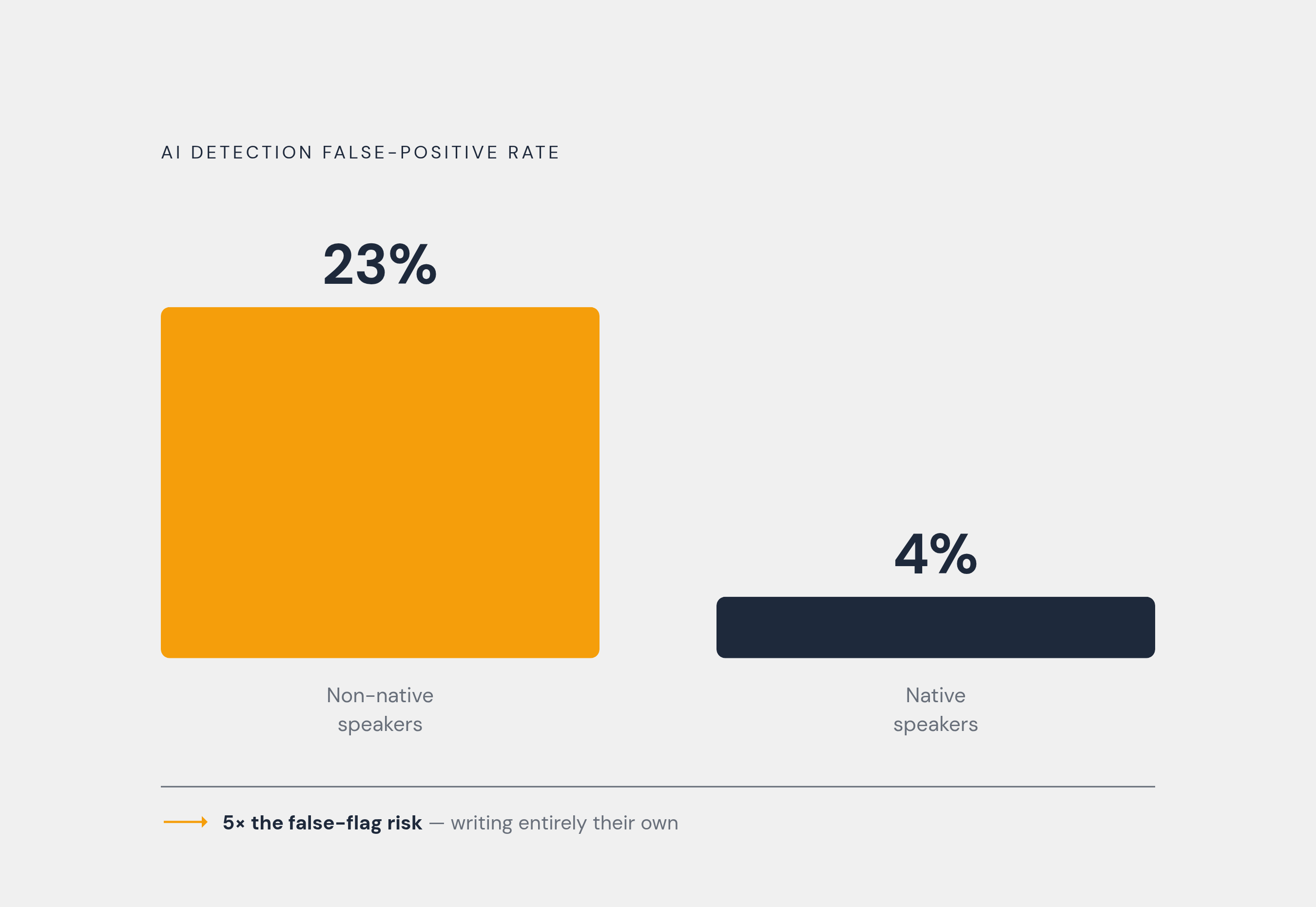
Here's the part nobody warns you about. AI detection tools, now standard in recruiter workflows, misfire on non-native English writing at a documented rate of 23%, against 4% for native speakers, which works out to five times the odds of getting flagged for something you didn't do.
The mechanism is almost funny, in a bleak way. Careful, formal English, the exact register schools teach non-native speakers to aim for, shares surface features with AI-generated text: consistent structure, low idiom density, few contractions. Write correctly and formally and you can get flagged as a machine without ever touching an AI tool, while a native speaker dashing off a casual, idiom-heavy letter sails through undetected. Try to sound professional, get accused of being a robot. Sound like you just rolled out of bed, get treated as authentically human.
Genuinely unfair squeeze, this one. Non-native speakers who use AI to reach native-level fluency risk a flag, and non-native speakers who write naturally in careful, formal English risk a flag anyway. Native speakers writing loosely mostly walk through clean.
Here's one thing working in your favor: most experienced recruiters treat a detection flag as a cue for human review, not an automatic rejection, because everyone in the field already knows the tools are unreliable. Still, don't lean on that goodwill alone. Edit your own draft with AI rather than generating from scratch, so the underlying structure stays human. Keep specific, personal detail in the letter, project names, real outcomes, named employers, since AI won't invent those on its own and they double as proof a person wrote this. And vary your sentence rhythm; detection tools flag prose that's suspiciously uniform in length and polish.
There's also a growing sense among hiring managers that using AI to close a real language gap is a far more defensible use than using it for pure convenience. That distinction doesn't fix the detection problem, but it matters to a person reading the letter, even if it means nothing to the algorithm that can't tell the difference.
The AI self-preferencing finding and what it means for NNES navigating automated screening
A separate 2025 study, presented at the ACM Conference on Equity and Access in Algorithms, Mechanisms, and Optimization, found something that should worry anyone treating AI screening as neutral. Large language models used as automated hiring screeners rate applications generated by models similar to themselves higher than human-written applications of equal quality, and consistently so.
The effect isn't subtle. Candidates using the same LLM as the screening system were 23% to 60% more likely to get shortlisted than equally qualified candidates who submitted human-written applications, across 24 occupations, with the widest gaps showing up in business-related roles. Related research put self-preference bias at 68% to 88% across both commercial and open-source models. Machines like reading their own writing. Who knew.
For non-native speakers, that's a real bind. AI-polished writing might boost your odds when an AI runs the first-pass screen, but a letter that's fully AI-generated, stripped of the personal specifics that make an application distinctive, risks failing the moment a human actually reads it, stacked on top of the detection risk above. The position that survives both filters is AI-edited human writing: it carries the stylistic patterns AI screeners seem to reward while keeping the specific, personal content human reviewers are actually looking for.
None of this is a fringe scenario. Roughly seven in ten companies expect to use AI somewhere in hiring by 2025, per a ResumeBuilder survey, and most of those same companies admit the technology carries bias. Non-native candidates are stepping into a screening environment where these dynamics already run, whether or not anyone applying has any idea.
One thing this doesn't promise: the self-preferencing effect describes screener behavior under controlled study conditions, not a guarantee that any individual application, however well-edited, gets shortlisted. Researchers found the bias can be cut by more than half through changes to how the models get deployed. That's a lever candidates don't control. What you control is the quality and honesty of what goes on the page.
Preserving authentic voice while using AI (why it matters and how to do it)
A Grammarly survey found 72% of recruiters say they can spot a generic AI-written cover letter on sight. The undifferentiated, fully-generated letter risks an algorithm flag on one end and a human reader rolling their eyes before finishing paragraph one on the other.
This is where non-native candidates have the most to lose from leaning too hard on AI, and the most to gain from getting the balance right. An international background, a specific project shipped under a different market's constraints, a career that crossed borders: these are credentials worth putting front and center, not liabilities to smooth over. A fully AI-generated letter sands all of that away in the name of sounding polished, which works against your own case.
Authentic voice, in practice, means naming the actual project and the actual outcome instead of "collaborated cross-functionally to drive results." It means saying why this employer, specifically, instead of reciting enthusiasm generic enough to paste into any application. It means being direct about your own trajectory: why the U.S., what prior experience travels with you, why this role is the next logical step and not a random one.
The workflow that protects all of this is simple, even if it takes discipline. Write a full draft first, in whatever English comes out, imperfect grammar included; that's fine at this stage. Hand that draft to an AI editor and ask for tone, grammar, and register help, not a rewrite. Read what comes back and put back any personal phrasing the AI flattened in the name of polish. Then read the final letter out loud, and if it doesn't sound like something you'd actually say to a person, it needs another pass toward the version that sounds like you.
Confidence matters too. About 73% of users report feeling more confident in their applications after AI help, and that's real, but confidence in a generic letter is confidence spent on the wrong thing. The goal is a letter that sounds like you, in English that happens to read cleanly. For someone applying through a platform where the employer on the other end has a documented history of sponsoring international hires, that international story isn't a detail to bury. It's the reason the match works, and a generic AI-generated letter misses it entirely.
How to approach AI cover letter tools as a non-native English speaker (a practical starting point)
AI use in job applications climbed fast: roughly 12% of job seekers used it for resumes and cover letters in early 2024, over 30% globally by the end of that year. Skipping these tools entirely stopped being a neutral choice a while back, and now it's just a disadvantage, one that keeps compounding.
Adoption isn't the problem worth worrying about; misuse is. About 23% of job seekers who use AI submit the output without editing a word of it, a costly habit for anyone and a worse one for non-native candidates, who need their own specifics layered back in to make the letter theirs. Submit an unedited AI draft and you get exactly the generic letter that 72% of recruiters spot on sight, minus the personal detail that would have made your application stand out in the first place.
The habit worth building is simple, even if it takes more effort than clicking generate once. Treat AI as a language editor working on your draft, not a ghostwriter you clean up after the fact; the ACM findings say that second order does more harm than good. Treat every suggestion the tool makes as a proposal you get to accept or reject, not a verdict from on high. Take the fixes that make the English read cleaner, and reject the ones that erase the parts only you could have written. That's the whole method, and it's a lot less complicated than the marketing around these tools makes it sound.