AI Salary Negotiation Tools and Benchmarks for Visa Holders
Visa holders can negotiate higher wages using regulatory changes and prevailing wage data.

58% of job applicants accept the first offer they get, according to Fidelity, and the reason isn't laziness—it's fear of losing the offer entirely. For visa holders, that same fear gets a second engine bolted onto it. Sponsorship ties your ability to keep working in the country to a single employer, so the power imbalance doesn't feel like a negotiating disadvantage; it feels like a fact of nature. Add the belief that visa fees and paperwork make you a cost center rather than a hire, and most sponsored candidates walk into salary conversations already conceding. Harvard economist George Borjas found H-1B workers switch jobs at a rate of 9.4% a year, versus 20-25% for comparable American workers in the same fields. That's not caution; that's structural leverage sitting in the employer's pocket, and it's the reason offers land low and stay there. None of this is a skill problem or a deference problem. It's an information problem, and it's fixable.
What the wage data actually shows (and why the aggregate picture misleads individual negotiators)
Look up "H-1B wages" and you'll find two contradictory stories, both backed by real research, both useless to you individually.
Story one: sponsored workers get underpaid. Borjas puts the gap at 16% below comparable American workers, which over a six-year visa term works out to roughly $100,000 in savings for the employer, per hire. A study in the Journal of Business Ethics found H-1B new hires earning about 10% less than U.S. citizen peers hired into the same office in the same year. The Economic Policy Institute has documented at least $95 million in underpayment among H-1B subcontractors placed at major corporations. That's a real pattern, not a rumor.
Story two: sponsored workers get paid more. George Mason economist Michael Clemens found H-1B holders earning up to 6% more than comparable U.S. professionals. On Deel's platform, H-1B workers show a median salary of $140,000 against $130,000 for American counterparts in equivalent roles, and they're about five years younger on average, meaning they're landing high-paying roles earlier in their careers. At venture-backed startups, foreign workers pull a median of $260,000, mostly because they're concentrated in AI and other highly technical roles.
Both are true. They're just describing different labor markets wearing the same visa category, and the variable that reconciles them is sector and hiring model, not nationality or negotiating skill. IT staffing and outsourcing firms produce most of the documented underpayment; that's where the EPI and Department of Labor cases tend to come from. Direct-hire roles at big tech companies and high-growth startups routinely match or beat U.S. peer pay. So the aggregate number you find in a headline tells you nothing about your specific offer. What matters is figuring out which bucket your employer sits in, and what people in that specific bucket actually get paid. No general salary tool does that work for you, so you have to do it yourself, and the rest of this piece is how.
The prevailing wage floor and why the $60,000 minimum is nearly meaningless for most negotiations
Every H-1B, H-1B1, and E-3 employer has to pay at least the "prevailing wage" for the role and location, set by the Department of Labor using Bureau of Labor Statistics wage data. That data comes in four tiers, and they map roughly onto percentiles of the wage distribution: Level I sits around the 17th percentile (entry), Level II around the 34th, Level III around the 50th, and Level IV, for experienced workers, around the 67th.
You'll also hear about a $60,000 statutory minimum for H-1B pay. Forget it, because that number is a legal floor from a different era of the statute, and in any high-cost metro or specialized tech role, the actual prevailing wage sits well above it. Citing $60,000 in a negotiation is like bringing a calculator to a knife fight: technically a tool, functionally irrelevant.
Here's what is relevant. Employers can't legally pay an H-1B worker less than similarly situated colleagues by pointing to market conditions, a lowball negotiated starting salary, or budget constraints. That's not a talking point; it's a compliance rule, and you're allowed to say it out loud in a negotiation. The place to start is the FLC Prevailing Wage Level Calculator, the free, official tool covering H-1B, H-1B1, E-3, H-2B, and PERM cases, running on the current July 2025 through June 2026 OEWS data set. Run your role and location through it before you do anything else. It gives you a documented floor you can reference without showing your full hand, and a framework for pushing an offer from Level I or II up toward Level III or IV.
Two regulatory shifts in 2025-2026 that change the math on negotiating for a higher wage level
Two things changed the arithmetic on this, and both reward candidates who negotiate for a higher wage level rather than just a higher number.
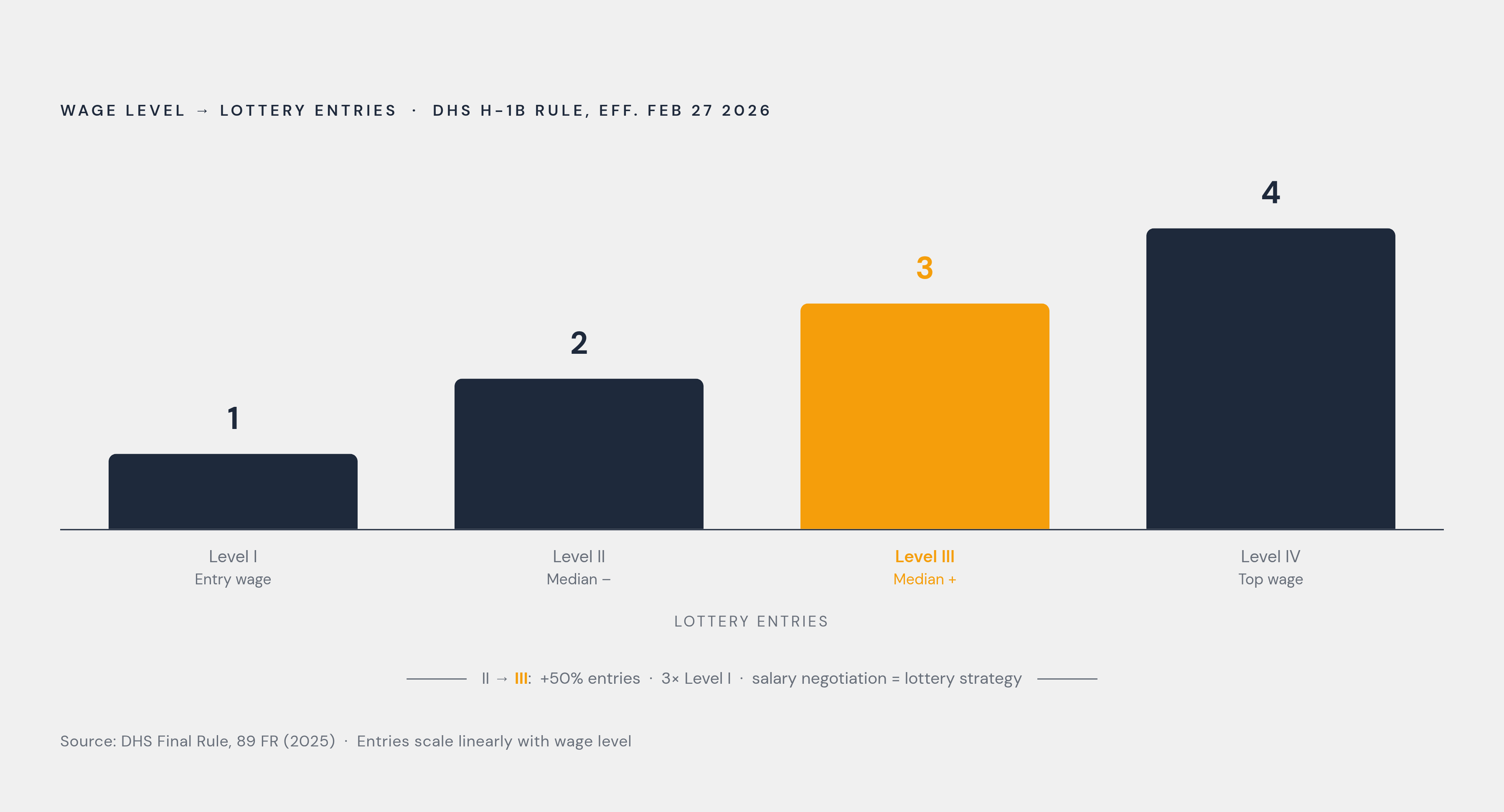
First: starting February 27, 2026, DHS replaced the random H-1B cap lottery with a wage-weighted selection system. Under the new rules, registrations tied to Level IV wages get four entries into the lottery, Level III gets three, Level II gets two, and Level I gets one. That means moving your offer from Level II to Level III doesn't just put more money in your pocket; it triples your odds of getting selected in the first place. For anyone still waiting on a cap-subject petition, salary negotiation and lottery strategy are now the same conversation.
Second: a Notice of Proposed Rulemaking published March 27, 2026 would push all four wage tiers up substantially across the board. The Department of Labor estimates this would raise average wages by about $14,000 per worker per year. Critics argue it would force employers to pay up to 33% above what private wage surveys show as market rate for comparable American workers. The comment period closed in May 2026 and the rule is still pending as of this writing, so treat it as a live variable, not a locked-in fact.
There's also the $100,000 H-1B petition fee, introduced in September 2025, which remains a live variable in the cost calculus of sponsored hiring. The lesson from all three of these moving pieces is the same: the ground is shifting under sponsored hiring, and locking in a higher wage level now is worth more than it used to be, precisely because the rules keep changing under everyone's feet.
How to read benchmarking tools when you have a visa variable the data doesn't capture
General salary databases weren't built with you in mind. They mix sponsored and non-sponsored workers, direct hires and staffing-agency placements, without telling you which group any given data point comes from. That's the blind spot, and you have to correct for it manually.
Start with base salary versus total comp. Prevailing wage calculations apply to base salary only; equity and bonus don't count toward that floor. Tools that report only base pay will make a staffing-agency placement look closer to a tech direct-hire offer than it really is. Tools that report total compensation, like Levels.fyi, give you the fuller picture for tech roles, but you need to pull out the base number yourself if you're checking it against a prevailing wage figure.
Location matters almost as much as the job title. Prevailing wage is set by metro area, so a Level II software engineer number in San Francisco means nothing when you're evaluating an offer in Columbus. Any benchmark you pull without filtering by location is just noise dressed up as data.
Then there's the leveling problem. Job titles are marketing, not job descriptions. A "Senior Engineer" at one company might land at Level III on the OEWS scale and at Level IV somewhere else, depending on the actual scope of the role. Tools that apply consistent leveling criteria across companies, which Levels.fyi does for tech, are far more trustworthy than anything relying on self-reported job titles alone.
Last, before you touch any benchmark, figure out what kind of employer you're dealing with. Direct employer, IT staffing firm, or consulting body shop: the documented wage patterns differ enough between these three that the same benchmark can point you in three different directions depending on which one you're negotiating with.
The tools that give visa holders real data: what each one does and what it misses
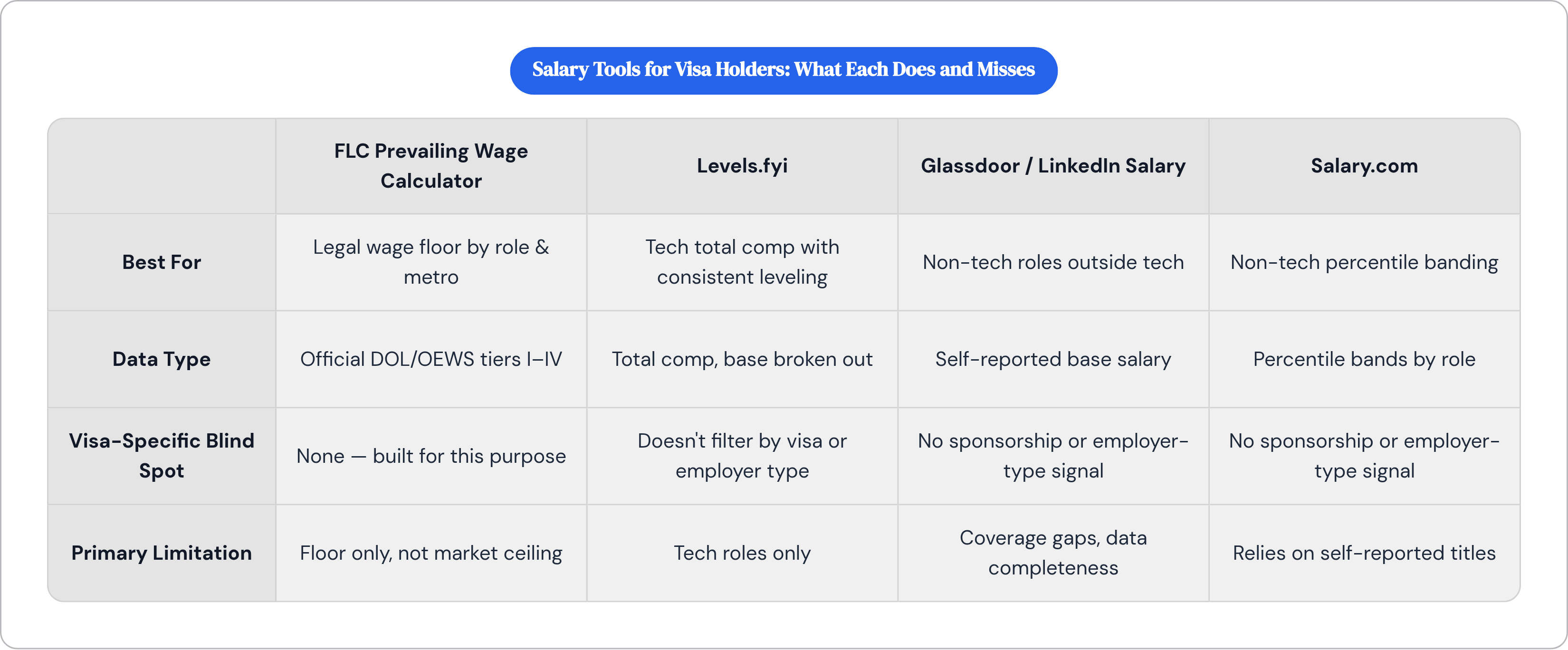
Levels.fyi is a widely used option for tech roles, tracking total compensation and applying consistent leveling across companies. Its gap is that it doesn't filter by visa status or sponsorship history, so you still have to layer in employer-type research on your own. Use it to build your total-comp anchor for engineering, product, and data roles before you say a word to a recruiter.
Glassdoor and LinkedIn Salary cover far more ground outside tech, which makes them useful for roles Levels.fyi doesn't touch. Both have well-known limitations in coverage and data completeness. Neither one tells you anything about sponsorship patterns or employer type.
Salary.com presents data in percentile bands, which can be useful for non-tech professional roles when cross-referencing against the DOL's four-tier wage structure.
Then there's the AI layer: AI scripting and negotiation prep tools. These don't give you market data. What they do is help you draft a negotiation script, run through likely counter-offers, and rehearse your responses before the actual call. The strongest use of these tools is framing your ask, pressure-testing your position, and running scenarios—rather than handing the conversation itself over to an AI. For a visa holder, this is where you can turn the sponsorship-cost anxiety into a different story: instead of apologizing for the paperwork, you're pointing to retention value and lower turnover cost, an argument the data actually supports.
And before any of that: run the FLC Prevailing Wage Calculator. It's free, official, and built on the current OEWS data, and it should be the very first thing any H-1B, H-1B1, or E-3 candidate does. Everything else in this list is context; that one is the floor.
One more piece worth naming: a job search filtered by verified sponsorship history, the kind some sponsorship-tracking job search tools provide, tells you something none of the salary tools can. Knowing upfront whether a company has an actual track record of direct sponsorship, versus a history of body-shopping placements or no sponsorship record at all, determines which benchmark is even worth pulling in the first place.
Building a negotiation range from the data: a visa holder's working method
Five steps, in order, no skipping ahead.
Run the FLC Prevailing Wage Calculator for your specific SOC code, location, and experience level, then note which wage tier, I through IV, your offer lands in. That's your legal floor and your starting reference point.
Pull market benchmarks next: Levels.fyi for tech, Glassdoor or Salary.com for everything else. Filter by metro, role, and years of experience, no exceptions, and note where your offer sits relative to the percentile range you find.
Map that market number back onto the DOL wage tiers. If your offer sits at Level II but the market data you pulled clearly supports Level III, that gap is your negotiation target, and thanks to the wage-weighted lottery, it's now a lottery-odds argument as much as a pay argument.
Build the employer-side case before you make the ask. Sponsoring companies benefit from lower turnover, and the 9.4% annual job-switching rate among H-1B workers versus 20-25% for comparable American workers is a documented retention advantage. Telling a hiring manager "you're getting a more stable hire" isn't flattery; it's a claim backed by published labor economics.
Finally, feed your benchmark numbers and your retention framing into an AI scripting tool. Have it draft language for the opening ask, the response to a counter-offer, and the pause where you say you need time to think it over.
What you shouldn't do: treat an AI-generated script as a substitute for actually knowing your numbers. A script with no data behind it collapses the moment a recruiter asks where you got that figure. And time it right: the window to negotiate is after the offer, before you accept, same as any job. Accepting first and negotiating after creates real complications for the employer's LCA filing, and gives you far less leverage than you'd have before signing anything.
The argument visa holders can make that most candidates can't
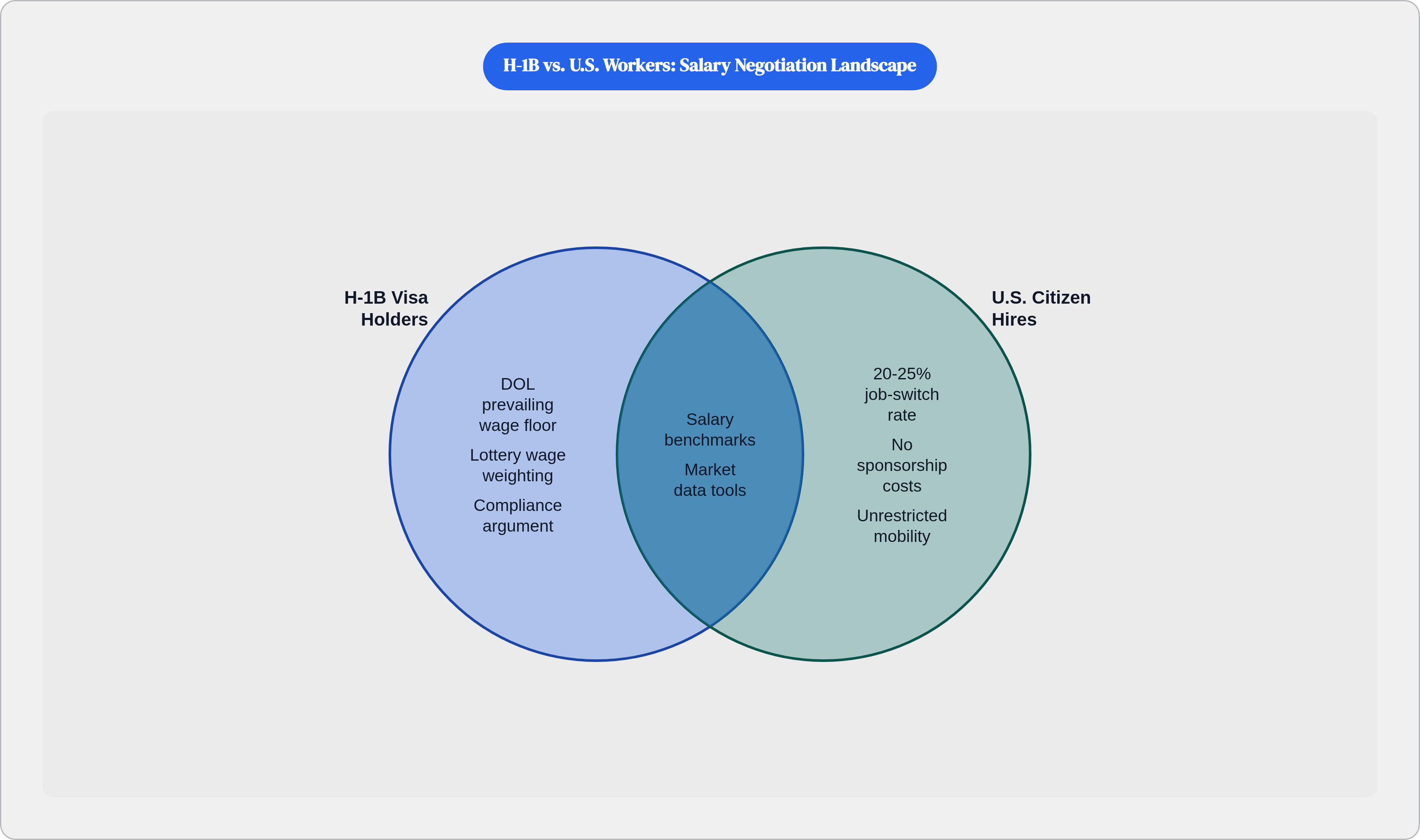
Two arguments, and neither one is available to a candidate without a visa attached to their employment.
The retention argument: a 9.4% annual job-switching rate against 20-25% for comparable U.S. peers is a quantified stability premium. You're not asking an employer to take your word for it that you'll stay; you're pointing at published labor economics research and letting the number make the case.
The compliance argument: you can invoke the DOL's prevailing wage framework by name, directly, in the room. Saying "I'd like this offer to reflect Level III for this role and location, per the DOL's OEWS data" isn't aggressive. It's citing the same rulebook the employer's own immigration counsel is already working from. Most candidates negotiate from a position of "please consider me." Visa holders, if they do the homework first, can negotiate from a position of "here's what your own compliance obligations already require." That's not a bluff; that's the actual floor, and knowing it is the whole difference between the 58% who take the first number and the ones who don't.