Using AI to Research Visa-Friendly Employers
AI can match job listings to verified H-1B sponsorship data instead of leaving you guessing.

Job descriptions lie by omission. "May consider sponsorship" and "we've sponsored 40 workers in the last three fiscal years" sit in the same applicant pool, indistinguishable to anyone scanning a posting at 11pm, and that gap is where international candidates lose months they can't spare. This isn't about too few jobs or underqualified applicants. Instead, it's about a filtering step that should happen before the application goes out, and almost never does. The data that would fix this already exists in a government database most job seekers have never opened, and AI tools have finally gotten good enough to make that database usable mid-search.
The visa clock makes everything worse. A domestic candidate who applies to a dead-end listing loses a week. An OPT candidate who does the same loses a week off a countdown that ends in unemployment or a flight home. Most people learn the sponsorship answer at the offer stage, or never, because the recruiter goes quiet the moment the "will you now or in the future require sponsorship" box gets checked yes. The information that would have saved them was public the entire time. It just sat in a quarterly government file that doesn't link to a single job board.
What the public LCA data actually contains and why it's the only reliable signal
Every H-1B, H-1B1, and E-3 sponsorship starts with a Labor Condition Application filed with the Department of Labor's Office of Foreign Labor Certification. OFLC publishes these as disclosure files. Each record names the employer, the FEIN, the SOC occupation code, the job title, the wage level (I through IV), the prevailing wage, the offered wage, full-time or part-time status, the worksite, and the immigration attorney who filed it. Third-party sites have indexed more than 4.8 million of these records going back to 2013, and that archive is what every credible AI tool in this space is quietly querying underneath the hood.
Read the caveats as closely as the numbers. An LCA is not proof anyone got hired, won the lottery, or received a visa; plenty get filed and never turn into an actual H-1B. The record shows what the employer promised on paper, not what happened after. Because DOL publishes quarterly, third-party tools also run one to three months behind, so a company's newest filing might not show up yet. None of that makes the data useless. It makes it a lagging indicator you read carefully, not a live feed you trust blindly.
One thing nobody talks about enough: wage level now touches your lottery odds, not just your paycheck. Starting February 27, 2026, the H-1B lottery moves to a wage-weighted selection system that favors petitions filed at Level III or IV. An employer's historical wage level stops being trivia and becomes a variable in your actual statistical shot at getting picked. Meanwhile the floor keeps rising: median LCA salary climbed from $110,000 in FY2022 to $125,000 in FY2025, and FY2026's first quarter already sits at $133,000. Employers filing consistently at the higher tiers aren't just paying more. They're telling you, in writing, that they compete for sponsored talent at market rate instead of squeezing it.
How to use general-purpose AI tools to interrogate employer sponsorship history before applying
ChatGPT and its competitors have no live pipe into OFLC's database. Worth saying plainly before you start typing prompts at 1am out of desperation: used well, they're a research accelerator; used carelessly, they're a very confident guessing machine.
Ask an LLM what's publicly known about a company's H-1B filing pattern: which job families it sponsors most, at what wage levels, over what stretch of time. Then ask it to name the immigration law firm attached to that employer's filings as attorney of record; a repeat relationship with the same firm signals an actual sponsorship program, not a one-off favor for a candidate someone really wanted. Finally, ask it to compare two or three employers in your field by sponsorship posture instead of brand name, because brand recognition and sponsorship activity correlate a lot less than people assume.
The prompt does the work here, and a lazy prompt gets a mushy answer every time. Specify the visa type, the SOC code or job family, and the time window. "Tell me about Acme Corp's H-1B history" gets you nothing. "Summarize Acme Corp's LCA filings for software engineers, SOC 15-1252, FY2023 through FY2025, including wage level" gives the model something to chew on.
Here's the failure mode: the model can't pull today's filings, it hallucinates specifics with total confidence, and it cannot tell an LCA filed apart from an H-1B actually approved. Treat its output as a rough draft, then check anything specific against a primary source or a dedicated sponsorship tool. Where AI actually earns its keep is decoding the posting itself. Paste the job description in and ask it to flag vague sponsorship language, check whether an "authorized to work in the U.S." clause quietly boxes out visa candidates, and draft two or three questions for the recruiter that don't sound like you're already bracing for rejection. That last part matters more than it should. Asking about sponsorship early is the exact moment a lot of international candidates lose their nerve, and a script ready to go, even an AI-drafted one you edit into your own voice, takes some of the dread out of it.
Dedicated AI platforms built to surface sponsorship signals at the point of job search
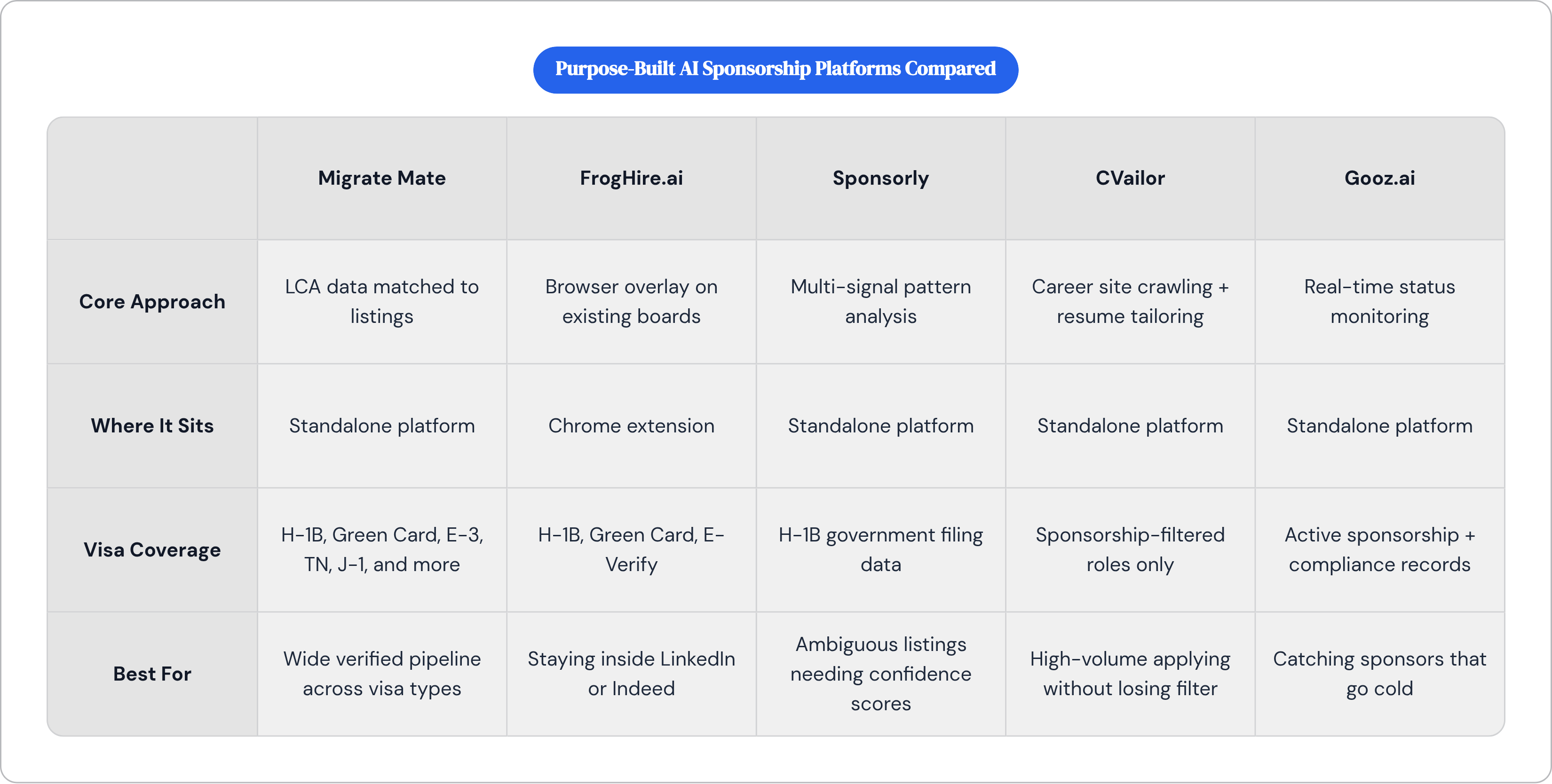
General-purpose AI gets you the framing. Purpose-built platforms get you the receipts. A handful now exist specifically to connect job listings to verified sponsorship data instead of leaving you to cross-reference two browser tabs at midnight.
Migrate Mate matches employer listings against DOL OFLC LCA filing data directly, so the sponsorship claim on a listing gets verified instead of taken on faith from whoever wrote the ad. It covers more than 500,000 verified U.S. listings across H-1B, H-2A, H-2B, Green Card, E-3, TN, CPT/OPT, H-1B1, and J-1 pathways, plus direct employer contact info alongside the sponsorship history, so you can act on the signal instead of just admiring it.
FrogHire.ai takes a different angle: a Chrome extension that overlays H-1B, green card, and E-Verify signals directly onto listings inside LinkedIn, Indeed, Glassdoor, and Handshake. Career centers at Duke and Washington University in St. Louis recommend it to international students, and the appeal is obvious once you use it. It sits inside the boards you're already on instead of asking you to learn a new one.
Sponsorly layers three signals together: regex pattern matching across more than 40 language patterns, a Llama 3.3 70B model doing contextual analysis, and actual H-1B government filing data. Explicit sponsorship language gets you a clean answer; ambiguous language gets a confidence score with the reasoning attached, which beats the binary yes/no most tools pretend to offer.
CVailor crawls more than 175,000 company career sites daily, filters for genuine sponsorship signals, then auto-tailors an ATS-safe resume to each matching role. It's solving two problems at once, finding the role and prepping the application, because a resume that never clears the applicant tracking system never gets a human to ask about sponsorship in the first place.
Gooz.ai hands out a "Visa Confirmed" badge only after checking active sponsorship history, government registrations, and compliance records, then pulls a listing within 24 hours if a company's status changes. If your anxiety is specifically about a signal going stale, that's the mechanism built for you.
Where you start depends on your situation. Fresh onto OPT with a hard deadline: a purpose-built board gives the widest verified pipeline across visa types in one place. Already living inside LinkedIn and Indeed, no interest in switching habits: layer FrogHire.ai or Sponsorly on top of what you're doing. Need to apply at real volume without losing the sponsorship filter: CVailor's daily monitoring plus auto-tailoring is built for exactly that throughput.
Reading employer sponsorship history to rank targets, not just identify them
Volume looks like a signal. Often it's just noise wearing a signal's clothes. Amazon filed 15,524 LCAs in a single fiscal year at an average salary of $157,259, and that number tells a mid-level marketing analyst in Austin almost nothing, because scale at the aggregate doesn't translate into your occupation or your city.
The employer worth watching rarely sits at the top of the headline list. JPMorgan Chase's approvals climbed from 1,719 to 2,440 in a single year, a jump that gets zero press next to the household names, while some companies everyone assumes are safe bets show flat or shrinking sponsorship activity that brand recognition papers over completely.
Rank, don't just identify. Recency comes first: a filing in the last one or two fiscal years tells you the program is active now, not a leftover policy from a previous administration's headcount that quietly lapsed. Wage level comes second, and under the February 2026 lottery rules it matters more than it used to, since Level III and IV filings directly improve odds of selection. Occupation match comes third; 26,516 LCAs got filed for Data Scientists in FY2025 alone, which means candidates in AI and machine learning have a far wider field of sponsors to work with than the five names that show up in every LinkedIn post about the industry. Geography comes fourth, since the worksite address in the LCA record lets you filter down to a specific city if relocating isn't an option. Last, the immigration attorney of record comes fifth: a repeat relationship with a known firm tells you sponsorship is institutional infrastructure there, not a favor someone in HR did once.
One thing worth repeating, because press coverage gets it wrong constantly: the annual approval figures that circulate publicly blend new petitions with renewals, transfers, and cap-exempt filings all together. Immigration attorneys warn against reading a rising headline number as fresh foreign hiring, since a big chunk of that growth is often just existing employees renewing status. LCA history, read at the occupation and wage-level, tells you more than the topline count ever will. This is also where AI earns its keep instead of being a gimmick: paste five or ten employers' LCA summaries into an LLM and ask it to score them against your occupation, wage level, location, and visa type. A structured prompt turns a spreadsheet of raw filings into an actual shortlist, which is the only output that matters at this stage.
Where AI-assisted research still leaves candidates exposed
Here's the part that should keep you honest: LCA data tells you what a company did, not what it's about to do. A company with three straight years of steady sponsorship can freeze the whole program tomorrow after an acquisition, a layoff, or a new general counsel with different priorities, and none of that shows up in the public record for months.
The regulatory ground keeps moving too. September 2025 brought a $100,000 processing payment requirement for H-1B petitions, a cost that will push some mid-size employers who sponsored occasionally, more as an exception than a program, to just stop. If your shortlist leans on smaller or mid-size employers, verify current intent directly. Don't assume last year's filing still describes this year's appetite.
Automation cuts both ways here, and it's worth saying plainly. Tools like LazyApply promise 50 to 100 applications a day against the 5 to 10 a focused person manages by hand, but volume without a sponsorship filter just means failing faster at scale. Mass-applying to unverified employers is the exact mistake the research stage exists to prevent, wearing a productivity costume.
General-purpose LLMs carry their own risk too. They can conflate LCA certification with actual H-1B approval, undersell how brutal the lottery odds really are, or hand you regulatory info that's already stale. Asking the model to flag its own uncertainty helps some, but it's a patch, not a fix. Meanwhile, the government is running its own AI on the other end of this: USCIS's Evidence Classifier uses machine learning to sort and tag the documents submitted with a petition, which means a disorganized evidence packet can get deprioritized before a human adjudicator ever looks at it. Your targeting can be flawless and the petition can still trip on paperwork.
None of this research replaces an actual conversation with the employer about sponsorship intent before an offer lands. The tools narrow the field to something manageable. Closing the loop is still a conversation you have to have yourself.
A staged research workflow that puts AI where it actually helps
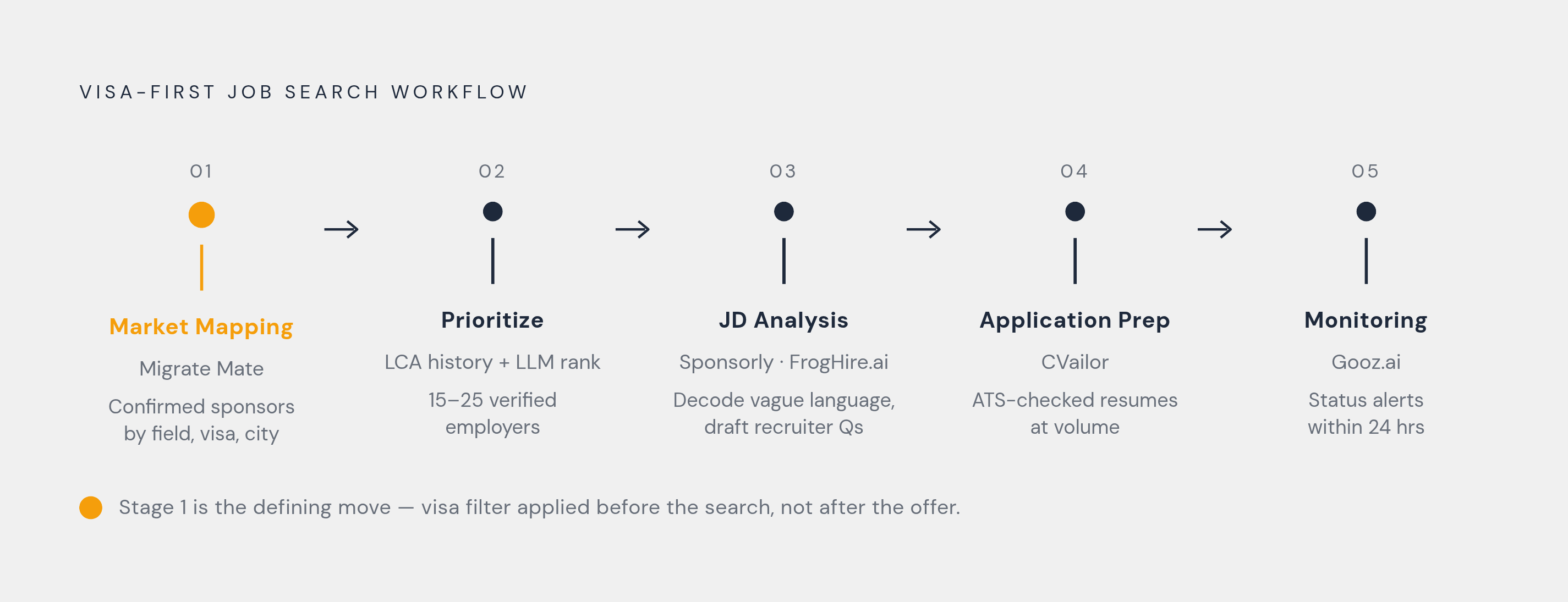
Start with market mapping, before you target a single employer. Use a verified platform to pull the bounded pool of confirmed sponsors in your field, visa type, and city. This swaps the scroll-and-hope approach for an actual list you can work through methodically.
Then prioritize, before you write a single application. Pull LCA history on your shortlist, check recency, wage level, and occupation match, and use an LLM to score and rank the list against your specific constraints. You want 15 to 25 verified, ranked targets out of this step, not 200 names you're guessing about.
Next comes job description analysis, before you apply to a specific role. Run the posting through a tool like Sponsorly or FrogHire.ai to check that listing's sponsorship signal, and paste any vague language into an LLM to decode it and draft your recruiter question ahead of time.
Application prep comes once targeting is locked. Run your resume through an ATS check, because a resume the tracking system rejects means the sponsorship question never gets asked by anyone, human or otherwise. CVailor can handle this at volume through its daily monitoring and auto-tailored resumes, without losing the sponsorship filter the earlier steps built.
Last is ongoing monitoring, and it runs the entire time you're searching. Watch your shortlisted employers for material changes: cost shifts, layoffs, acquisitions. The $100,000 processing payment from 2025 is already reshaping which employers stay active sponsors, and a platform like Gooz.ai, pulling listings within 24 hours of a status change, cuts the risk of chasing a target that quietly went cold weeks ago.
What this workflow actually does is move the visa filter to the front of the search instead of leaving it at the end, where an offer letter and a rejection collide. When the OPT clock is running, every wasted week doesn't come back.