Top EOR Platforms Compared for International Hiring
Four variables separate EOR platforms more than country count or price alone.

An Employer of Record becomes the legal employer in a given country on a company's behalf, handling contracts, payroll, tax filings, and statutory benefits so the hiring company never has to open a local entity. That single function has spawned a crowded corner of HR infrastructure, and picking the right vendor comes down to four variables most vendor comparisons barely touch. Opening a subsidiary in Germany or Brazil can take months and real legal spend; an EOR turns that into a signed contract and a payroll cycle. Buyers still shop on country-count headlines instead of the variables that actually decide whether the arrangement works.
Small and mid-sized companies drive most of the growth in this category. A tool originally built to help Fortune 500 companies avoid entity sprawl is now mostly used by 20-person startups hiring their third and fourth employee abroad, and no vendor has run away with the market either. The field stays fragmented, which means the comparison question is genuinely open rather than a formality before everyone picks the obvious winner.
One structural detail explains most of what follows. The aggregator model accounts for the largest share of the market, where the EOR platform doesn't own legal entities in every country but routes employment through local partners instead, while a smaller share use wholly-owned entities everywhere they operate. That distinction sounds like back-office trivia, but it marks the difference between a vendor being directly on the hook when a compliance failure hits in Vietnam, and a vendor being one contractual layer removed from whoever actually is.
The four variables that actually separate EOR platforms
Country coverage is the first variable, and the headline number lies by omission. A vendor advertising 180 countries through local partners is selling a meaningfully different product than one covering 85 countries through entities it owns outright. Breadth matters, but so does who's actually standing behind the paperwork when something breaks.
Pricing structure is the second. Some platforms publish a flat per-employee fee, while others bolt on modules for equity administration, contractor conversion, or HRIS integration, and some skip a pricing page entirely in favor of a sales call. Opaque pricing tends to inflate the real cost, because the quote lands after the buyer has already sunk weeks into evaluation.
Compliance depth is the third, and it's the one procurement teams underweight most. When a labor authority flags a misclassified benefit or a botched termination, the question of who is legally exposed, the EOR itself or a local partner three steps removed, decides how fast that problem actually gets fixed.
Speed to hire is the fourth. Onboarding a candidate once a company has decided ranges from a few days to more than three weeks depending on vendor and country, and for a company racing a competing offer, that gap is the whole ballgame.
A handful of secondary factors matter without deciding anything alone: HRIS or IT integration depth, contractor-to-employee conversion support, cross-border equity handling, and whether onboarding runs self-service or drags a sales rep into every step. None of these should be the tiebreaker, but all of them show up eventually. A startup hiring its first two engineers abroad wants something entirely different than an enterprise running payroll across 30 countries, and the framework only works once a buyer names which of the four variables is the actual binding constraint.
Deel: the broadest country coverage at a mid-market price
Deel runs EOR services in more than 150 countries, with wholly-owned entities in over 100 of them and more than 250 legal entities globally. That's the widest footprint in this comparison, full stop.
Pricing starts at $599 per employee per month for EOR and $49 per contractor per month for contractor management, both published openly instead of hidden behind a sales funnel. That transparency alone separates Deel from a chunk of the field. Contractor-to-employee conversion works in more than 110 countries, a real advantage for companies that start relationships as contractor gigs and formalize them once headcount approval finally clears.
Deel counts more than 40,000 companies as customers and landed a Leader spot in Everest Group's EOR Solutions PEAK Matrix Assessment for 2025. It fits companies that need payment flexibility, cross-border contractor management, and volume across many geographies at once. It's a weaker fit for buyers who need deep HRIS or IT infrastructure integration; that's not where the product's weight sits.
Worth flagging for anyone doing diligence: in March 2025, Rippling filed a lawsuit alleging corporate espionage against Deel, and Deel countersued for defamation. Neither suit had produced a court finding as of mid-2025, and the litigation hasn't dented Deel's scale, so treat it as background noise worth knowing and factor it into due diligence accordingly.
Remote.com: owned-entity compliance in fewer markets at a matching price
Remote covers 85 countries, all through wholly owned entities, with zero local partner intermediaries anywhere it operates. That's roughly half of Deel's country count, but the compliance chain is cleaner in a specific, checkable way: Remote is the legal employer everywhere it operates, with no third party sitting between the contract and the accountability for it.
Pricing starts at $599 per month on an annual commitment, or $699 month-to-month, with contractor management at $29 per month. Remote cut its EOR price from $699 to $599 in late 2024, landing in line with Deel, and that $599 covers the full package: employment contract, payroll, tax filings, statutory benefits, an onboarding specialist, and HR platform access. Volume discounts are available at higher headcount levels.
The gaps are real and worth naming directly. Southeast Asia, most of Sub-Saharan Africa, and Central Asia are thin or missing from Remote's map, which rules it out for anyone with hiring plans there. For scaleups hiring in Europe, Latin America, and parts of Asia, though, Remote trades maximum reach for a compliance story that fits in one sentence on a board slide. Global equity support is a genuine edge here too, particularly for venture-backed companies distributing stock options across borders.
Globalization Partners (G-P): the deepest compliance footprint at the highest price
G-P effectively invented the EOR category, and it still holds the widest owned-entity coverage in the field at more than 180 countries. Nobody else in this comparison owns entities in more markets, not close.
There's no public pricing page. Buyers go through a sales process to get a quote, and third-party estimates put the range at several hundred to well over a thousand dollars per employee per month depending on country, volume, and contract terms, the highest range in this comparison. For a team under roughly 50 employees, that premium over Deel or Remote is steep, and it's fair to ask whether the extra capability actually gets used at that headcount.
Onboarding speed is a documented soft spot. Onboarding timelines have been noted as noticeably slower than competing platforms covered here, which matters for companies racing a competing offer. The interface has drawn criticism for lagging newer entrants, a trade-off buyers should weigh against G-P's compliance depth.
Here's the case for paying anyway: G-P fits mid-market and enterprise companies scaling across many countries at once, especially in unusual or heavily regulated jurisdictions, where owned infrastructure and in-house legal depth provide a compliance backstop that partner-model vendors can't match. If a compliance failure in an emerging market triggers back-taxes, a wrongful termination claim, or a regulatory action, the cost blows past years of the price gap between G-P and its cheaper competitors. Treat the premium as an insurance cost, one that only looks expensive until the thing it insures against actually happens.
Rippling: an HCM and IT operating system that includes EOR
Rippling's EOR product covers a narrower set of markets than Deel, Remote, or G-P, with contractor support extending further than its core EOR footprint. That's a narrower EOR footprint than Deel, Remote, or G-P, worth saying plainly rather than dressing up.
The real strength is the platform wrapped around it. Payroll, HR, and global EOR all sit under one login, with IT-related workflows integrated into the same platform in a way competing EOR-only vendors don't offer. That combination effectively folds an IT department into an HR tool.
Pricing isn't public; it requires a custom quote, and most capabilities arrive as modular add-ons, with the core HR platform as a prerequisite for the EOR module. Pricing is not publicly listed and requires a custom quote, with capabilities arriving as modular add-ons. Financially, Rippling is well capitalized, a factor that does real work for a buyer worried about vendor longevity on a multi-year contract.
Rippling makes sense for mid-sized to larger companies that want one platform running HR, payroll, IT provisioning, and international employment together, where EOR is one piece of a bigger deployment rather than a standalone tool. Companies that just want pure-play EOR simplicity, transparent day-one pricing, or coverage beyond that 80-country footprint should look elsewhere.
Papaya Global: automation-heavy infrastructure for established enterprise operations
Papaya Global is oriented toward larger operations coordinating employment across many countries at once, and that positioning shows up everywhere in the product.
The differentiator is automation built to cut manual HR work at scale across payroll and cross-border payments. For a company already running payroll across a dozen countries, that automation compounds fast. For a company hiring its first employee in Portugal, the same depth reads as overhead nobody asked for.
Pricing is not publicly listed, consistent with its positioning toward larger buyers. The platform's complexity is a real barrier for smaller buyers who want to hire one or two people abroad quickly; Papaya is built for scale that already exists, and speed-to-hire for a first international employee sits low on its list of strengths.
How the platforms stack up across the four decision variables
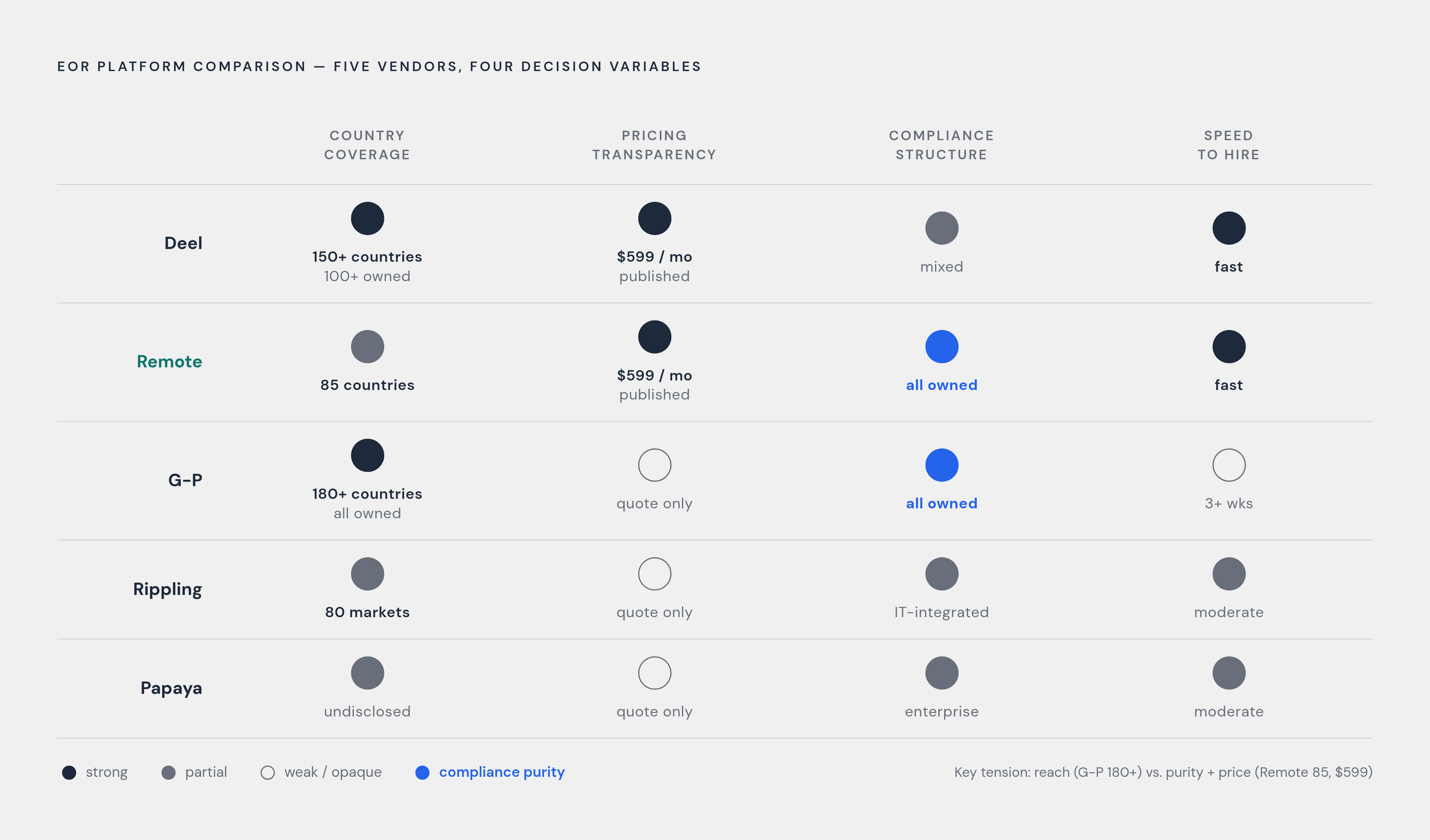
On country coverage: G-P leads with more than 180 owned entities, Deel has the broadest total footprint at 150-plus with over 100 owned, Remote sits narrowest at 85 but fully owned, and Rippling covers 80 EOR markets, with Papaya similarly scoped for enterprise operations rather than geographic maximization.
On pricing transparency: Remote and Deel both publish a $599-per-month starting EOR price, while G-P and Rippling require a sales conversation, and Papaya is quote-only across the board. That gap is itself informative: it tells a buyer who the product was actually built for, self-service SMEs versus committee-driven enterprise procurement, before a single sales call happens.
On compliance structure: Remote's fully owned-entity model is the purest version of this within the 85 countries it covers, and G-P's 180-plus owned entities are unmatched in geographic depth. Deel's mixed model of owned entities plus partners is the pragmatic middle ground, and Rippling and Papaya lean more heavily on partner infrastructure behind the scenes.
On speed to hire: Deel and Remote are generally fastest in straightforward markets, G-P's three-week-plus onboarding is the slowest documented here, and Rippling's speed shifts depending on which modules a company has configured.
On contractor management: Deel leads on flexibility and payment variety, Rippling leads on IT integration tied to contractor onboarding, and Remote's $29-per-month contractor tier is the most transparent entry point in the field.
Boiled down, the decision rules aren't complicated. Maximum coverage, pricing transparency, and contractor flexibility points to Deel, while compliance purity and ease of use in core markets points to Remote. Enterprise scale in unusual or heavily regulated jurisdictions points to G-P, a full HCM and IT stack with international payroll bolted on points to Rippling, and a large existing global workforce that needs automation, not discovery, points to Papaya Global. Pick the variable that's actually binding for the hire in question, then pick the vendor built around it. Most buyers skip that step and pick whoever's sales rep called back first, which is how companies end up paying G-P prices for a Remote-sized problem.
What these platforms don't solve for international candidates seeking U.S. sponsorship
Every platform above solves a problem for employers who've already decided to hire internationally. None of them help a candidate figure out which employers are willing, or equipped, to make that decision in the first place. That's a different problem, and it sits on the other side of the hiring relationship entirely.
For international professionals targeting jobs in the United States specifically, the equivalent gap isn't country coverage or pricing transparency. It's knowing which U.S. employers actually have a track record of sponsoring work visas, H-1B, H-2B, OPT and CPT transitions, TN status, before a candidate burns hours on an application. The EOR model covered here is built primarily for U.S. companies hiring workers abroad who stay abroad, which leaves untouched the case of a candidate who wants to physically relocate and work inside the U.S. under employer sponsorship.
Sponsorship history predicts a candidate's actual odds far better than company size, job title, or how prominently a role gets advertised. A company with no EOR infrastructure and no prior sponsorship record is unlikely to build the internal process required for a single candidate, no matter how qualified that candidate is or how badly a hiring manager wants them. The lesson mirrors the entity-coverage logic from earlier: candidates should prioritize employers with a verified sponsorship track record over employers who simply look large, well-funded, or global. Coverage depth is the signal that matters on the employer side of this market; sponsorship history is the equivalent signal on the candidate side, and it deserves the same scrutiny.