Family-Based Green Card Filing Services Compared
Processing times vary wildly by family category, from months to decades.

The architecture of family-based immigration is simpler than most applicants expect, at least structurally. Every case moves through two distinct phases: establishing the qualifying relationship, then applying for the actual green card. What changes between cases is the timeline, the forms, and the jurisdiction in which the second step happens.
Step One: The Petition
The U.S. sponsor files Form I-130, Petition for Alien Relative, to prove the qualifying relationship exists. As of the 2025 USCIS fee schedule, that costs $675 by mail or $625 online. The I-130 does not grant any immigration benefit on its own. It is a placeholder, a claim that says: this relationship is real and documentable. USCIS adjudicates it, and if approved, the case moves forward.
Who can petition for whom is not intuitive to everyone. U.S. citizens can sponsor parents, spouses, unmarried children under 21, and adult children, both unmarried and married, as well as siblings. Green card holders can sponsor spouses and unmarried children only. That distinction matters enormously because it determines which preference category the beneficiary falls into, and that category shapes the entire downstream timeline.
Step Two: It Splits Depending on Where the Beneficiary Lives
If the beneficiary is already inside the United States, the pathway is Adjustment of Status via Form I-485, which costs $1,440. Immediate relatives of U.S. citizens can file the I-130 and I-485 concurrently, which shaves meaningful time off the total process. If the beneficiary is abroad, the case moves through consular processing: the National Visa Center coordinates the transfer of the approved petition, the applicant completes Form DS-260 and pays a $325 visa fee, then a $220 USCIS immigrant fee after approval.
Every route requires three additional elements that applicants routinely underestimate. First, the I-864 Affidavit of Support, in which the sponsor demonstrates income at or above 125% of the Federal Poverty Guidelines; a joint sponsor is permitted if the petitioner falls short, but that introduces another person's financials into the file. Second, a medical examination by an authorized civil surgeon; a December 2024 revision to Form I-485 now requires concurrent submission of Form I-693, the medical exam report, closing off the old practice of submitting it separately. Third, biometrics for I-485 applicants, or an in-person consulate interview for those going through consular processing.
One administrative note worth flagging: effective October 28, 2025, USCIS no longer accepts paper checks or money orders. Payment is through ACH, credit or debit card, or prepaid card only. USCIS fees are non-refundable on denial.
How Long Each Category Actually Takes, and What the Backlog Means for Case Strategy
The range here is wide enough that quoting a single average is almost dishonest. An immediate relative of a U.S. citizen already in the country is looking at roughly 5 to 18 months total, based on USCIS data. An I-130 petition filed by a U.S. citizen has a median adjudication time of around 14.8 months; the same petition filed by a permanent resident runs closer to 35 months, based on FY 2025 USCIS data. Concurrent I-485 filing adds roughly nine more months for the adjustment itself.
Preference Categories: A Different Universe
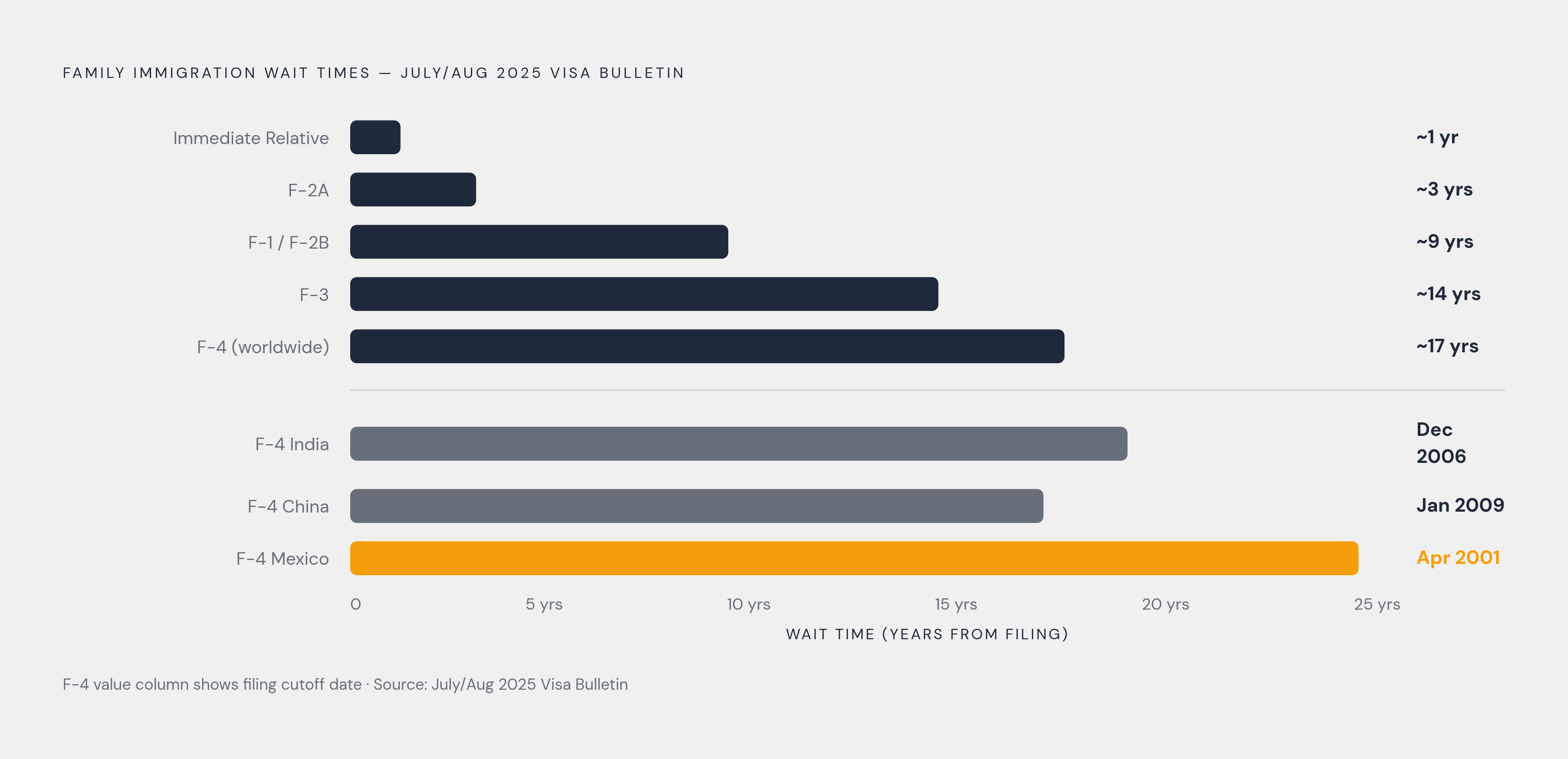
Preference-category wait times are not merely longer. They are a categorically different planning problem. As of the July 2025 Visa Bulletin, F-1 and F-2B cases are running approximately nine years. Most F-2A cases sit around three years. F-3 is fourteen years. F-4 is seventeen or more years as a baseline, and the country-specific extremes are genuinely staggering: the August 2025 Visa Bulletin shows Mexico processing F-4 filings from April 2001, India from December 2006, and China from January 2009.
A sibling petition filed today for someone in one of those countries is not really an immigration plan. It is more like planting a tree in whose shade you do not expect to sit — an act of faith across two decades, filed by someone who will be a materially different person when the visa number finally becomes available, assuming it does.
F-2A final action dates advanced by more than 18 months in the August 2025 Visa Bulletin for most countries, the largest single advance in that bulletin — a meaningful shift for spouses and children of green card holders.
Why the Wait Time Changes What Kind of Help Is Actually Useful
A 17-year F-4 queue means the petition is filed and then essentially warehoused. The filing work is finite; the applicant will hear nothing about next steps for years. An I-485 case for an immediate relative moving in real time is a different animal entirely; form errors, missing translations, and insufficient relationship evidence all arrive as Requests for Evidence that require a response. The cases most susceptible to preparation errors are also the cases on the fastest timelines, which is an irony the process does not acknowledge or apologize for.
What Self-Filing Actually Involves and Which Cases It Suits
USCIS does not require legal representation. Any applicant may file on their own, and approximately 38% of family-based green card applications in FY 2025 were self-filed. The approval data supports this, within limits. Self-filed cases in straightforward categories came within 3 percentage points of attorney-represented cases in FY 2025. The gap is not inherent to self-filing; it is a function of case complexity. When the facts are clean and the category is unambiguous, the distance between a well-prepared self-filer and a represented applicant is narrow.
The Cases Where DIY Holds Up
Immediate relative petitions are the natural home for self-filing. The relationship is binary: either the marriage is valid, or the parent-child relationship is documented, or it is not. The documentary requirements are clearly laid out in USCIS instructions. If the applicant has no prior immigration violations, no criminal history, continuous lawful status, and no prior denials, and if they are genuinely detail-oriented and willing to invest real time, self-filing is a viable choice.
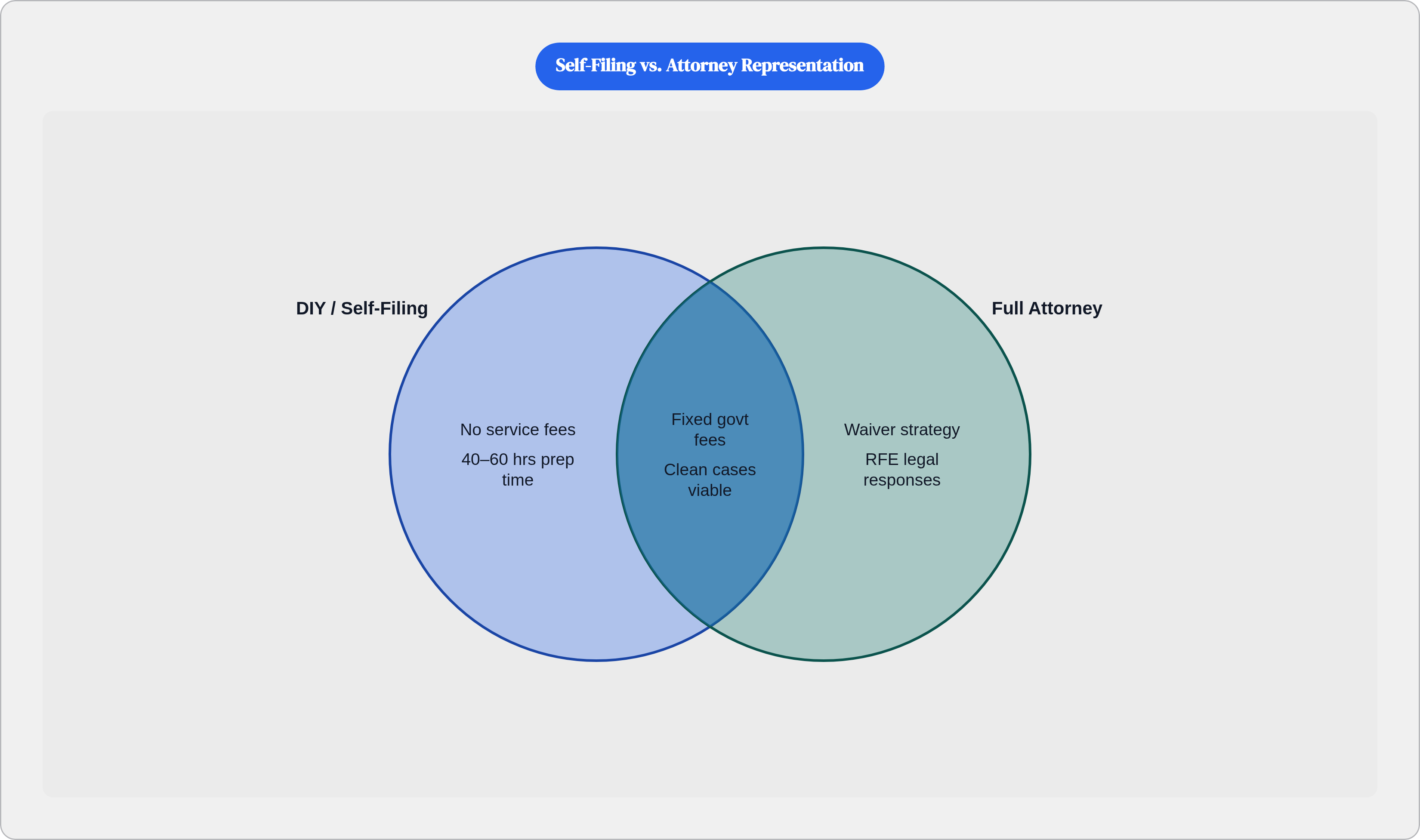
First-time self-filers on a straightforward case should expect to spend 40 to 60 hours reading form instructions, reviewing USCIS policy manuals, gathering documents, and checking consistency across all filings. That is real opportunity cost and should be counted as such before deciding the filing fee savings are worth it.
Where Self-Filing Breaks Down
A denied I-485 forfeits $1,440 in non-refundable fees and can add 12 to 24 months to the timeline. During those months, the applicant has neither work authorization nor travel freedom. In cases involving visa overstays, criminal history, prior denials, or waivers of any kind, the approval gap between self-filers and attorney-represented applicants widens sharply. These are cases requiring legal analysis, not form completion, and conflating the two is expensive.
What Online Guided Platforms Cover and Where Their Model Has a Hard Boundary
The middle tier serves a specific and legitimate niche. Guided platforms offer more structure than pure DIY at a fraction of attorney cost, built on a reasonable premise: most errors in straightforward cases are mechanical. A missing field, an inconsistent answer, a checklist item overlooked. Address those failure modes and the approval rate converges with the attorney tier for clean cases.
What They Typically Provide
These platforms generally offer step-by-step form completion with alerts for missing or inconsistent entries, document checklists tailored to the specific situation, and, in some cases, attorney review of the completed packet before submission.
Boundless has built attorney review into its product through Boundless Legal LLC, licensed by the Arizona Supreme Court with federal immigration practice, and as of 2025 holds a strong rating from more than 5,136 Trustpilot reviews. The platform absorbed RapidVisa in 2020. RapidVisa, founded in 2007, reports more than 70,000 users and a 99.7% success rate, carries a BBB A+ rating, and is explicit about its scope: inadmissibility, prior violations, and waivers fall outside its service model. CitizenPath targets applicants who are comfortable filing independently and want error-checking and a structured checklist rather than strategic guidance.
The Structural Ceiling That Applies to All of Them
"Attorney-reviewed" means an attorney reviewed the completed application. It does not mean the attorney evaluated your eligibility, advised on strategy, or will represent you if USCIS issues a Request for Evidence or denies the case. On most platforms, no attorney-client relationship is formed. That distinction is invisible when nothing goes wrong and immediately consequential when something does.
These platforms are well-suited to clean facts, unambiguous eligibility, and no complications. The platform's job is accuracy, not strategy. The wrong fit is any case requiring a waiver, involving a prior violation, or where eligibility itself is in question. Most platforms are honest about this. The problem is that applicants sometimes do not know which category they are in until they have already paid.
What Full Attorney Representation Adds and When the Cost Difference Is Actually the Cheaper Option
Full representation for family-based cases runs $2,000 to $12,000 in professional fees, depending on complexity and market. One California firm published a range of $5,000 to $7,000 for marriage and family adjustment of status cases as of March 2025.
What Full Representation Actually Covers
The qualitative difference between an attorney and a platform is not primarily about form accuracy. It is about what happens before the forms and what happens when something goes wrong. Full representation includes eligibility analysis before any filing, identifying potential bars or inadmissibility grounds that would sink the case before it is ever submitted. It includes waiver strategy: not just whether a waiver exists, but whether it is viable, and how to build an evidentiary record that gives it a credible shot. It covers drafting legal responses to Requests for Evidence, which require legal arguments rather than additional documents. It covers representation at the interview and attorney-client privilege throughout. A platform can tell you that a field is blank. An attorney can tell you that filling it in honestly will trigger a ground of inadmissibility requiring a waiver you probably qualify for, and then build that waiver.
When the Attorney Fee Is the Cheaper Option
For cases involving prior visa overstays, deportation orders, removal proceedings, criminal history including arrests without conviction, previous USCIS denials, or immigration fraud findings, an attorney is not optional in any practical sense. A $1,440 I-485 denial plus 12 to 24 months of lost work authorization and travel freedom, plus the cost of then hiring an attorney to fix the problem, can readily exceed the upfront attorney fee. For complex cases, paying for representation at the outset is frequently the cheaper path when total cost and time are counted together.
For straightforward immediate-relative cases with clean records, the marginal value of full representation is genuinely lower. That is not a controversial position; it is what the approval data shows.
A Side-by-Side Read of Total Costs Across All Three Tiers
Government fees are fixed regardless of which service tier you choose. They are the floor for every applicant.
The I-130 petition costs $675 by mail or $625 online. Form I-485 costs $1,440, tiered by age; work authorization via Form I-765 is included if filed on or after April 1, 2024, or $260 if filed separately. Consular processing costs $325 for the DS-260 visa fee and $220 for the USCIS immigrant fee after approval.
On top of those fixed government costs, the service tier adds: nothing for pure DIY, beyond the 40 to 60 hours of time invested and the non-refundable risk of a denial; a few hundred dollars for online platforms, with variation by platform and package; and $2,000 to $12,000 in professional fees for full attorney representation, with complex and waiver-requiring cases at the high end.
One fee waiver note: USCIS allows fee waivers on Form I-485 for documented financial hardship, including unemployment and high medical expenses. No other major family-based form currently qualifies.
What the service fee buys is risk reduction, time savings, and, at the attorney tier, legal representation and professional accountability. For simple cases, the marginal risk reduction from each step up the tier ladder is real but modest. For complex cases, it is the difference between approval and years of remediation.
How to Read Your Own Case Against the Three Tiers and Pick the Right One
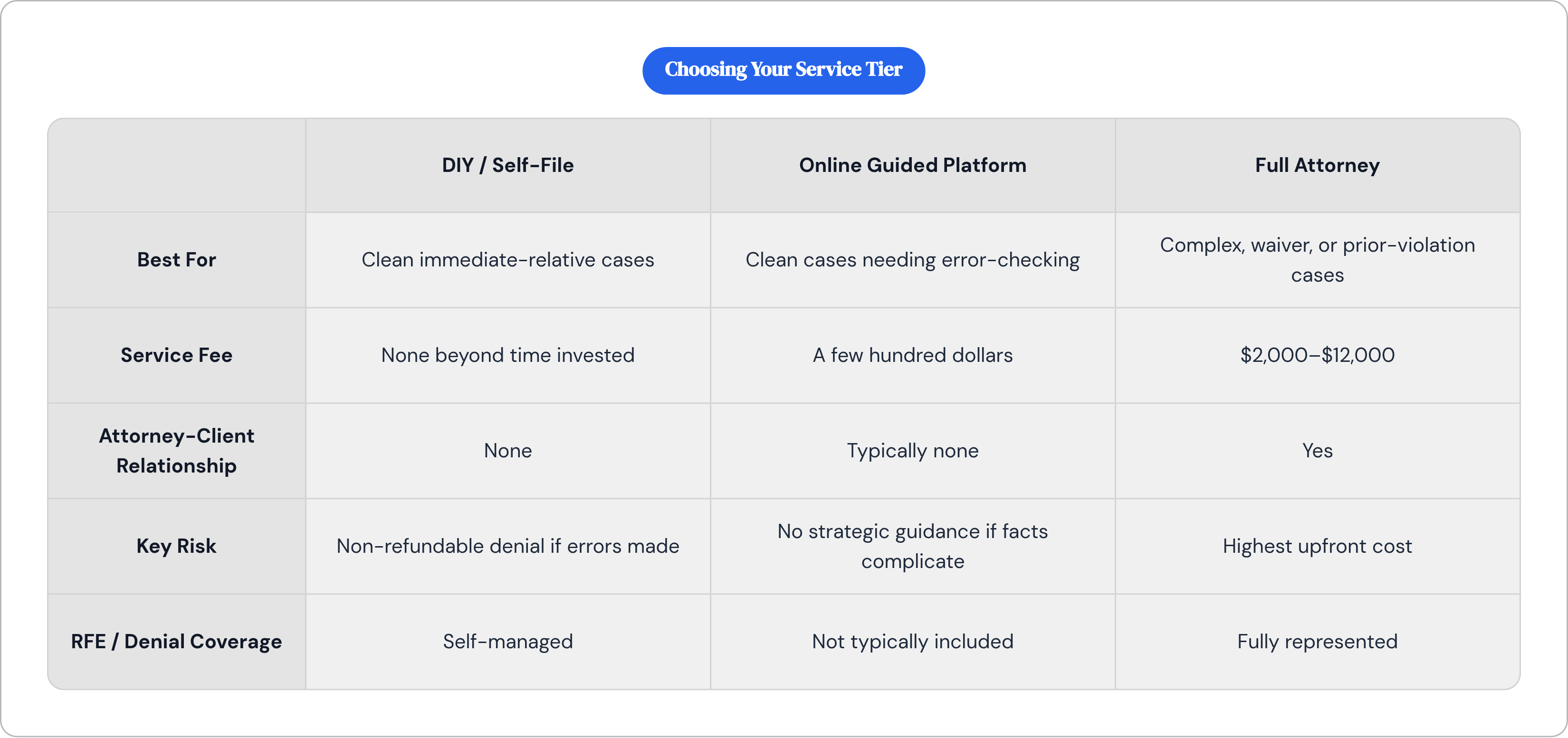
Three variables drive the choice: case complexity, budget, and how much of the process the applicant wants to own.
DIY is a reasonable choice when the applicant is an immediate relative of a U.S. citizen, carries a clean immigration history, has no criminal record, can invest 40 to 60 hours in careful preparation, and faces a budget where the government fees are the binding constraint.
An online platform makes sense under those same clean-case criteria, when the applicant wants error-checking and a guided process without attorney-level cost. Understanding what the attorney review on platforms like Boundless actually covers before relying on it is not optional. The structural ceiling described above applies regardless of what the platform's marketing says.
A full attorney is the right call when any prior immigration violation, overstay, removal order, or criminal history is present; when the case requires a waiver; when a previous application was denied; or when the case sits in a preference category where a filing error today costs years rather than months. No platform covers these scenarios, and careful form-reading cannot substitute for legal analysis when the underlying facts are complicated.
One practical diagnostic before choosing: pull the Visa Bulletin date for your category and country. In an F-4 backlog measured in decades, the petition filing is finite and bounded; accuracy matters more than active management. In an I-485 case for an immediate relative moving in real time, active management of a live file matters quite a lot.
One thing no service tier can fix: applying in the wrong category, or filing for a relationship that does not qualify under the statute. Sort out the category first. Everything else follows from that. For beneficiaries still in the workforce pipeline, finding the right employer before a visa deadline closes is a parallel concern; some subscription job boards connect international candidates with US companies willing to sponsor work visas and address that side of the equation. Migrate Mate, a visa-sponsorship job platform that filters verified US employer listings by visa type so international candidates can see who actually sponsors before applying, is one concrete option for that search.