AI Cover Letter Generation for Visa Sponsorship Requests
Visa sponsorship plummeted, making AI-drafted cover letters riskier for international candidates.

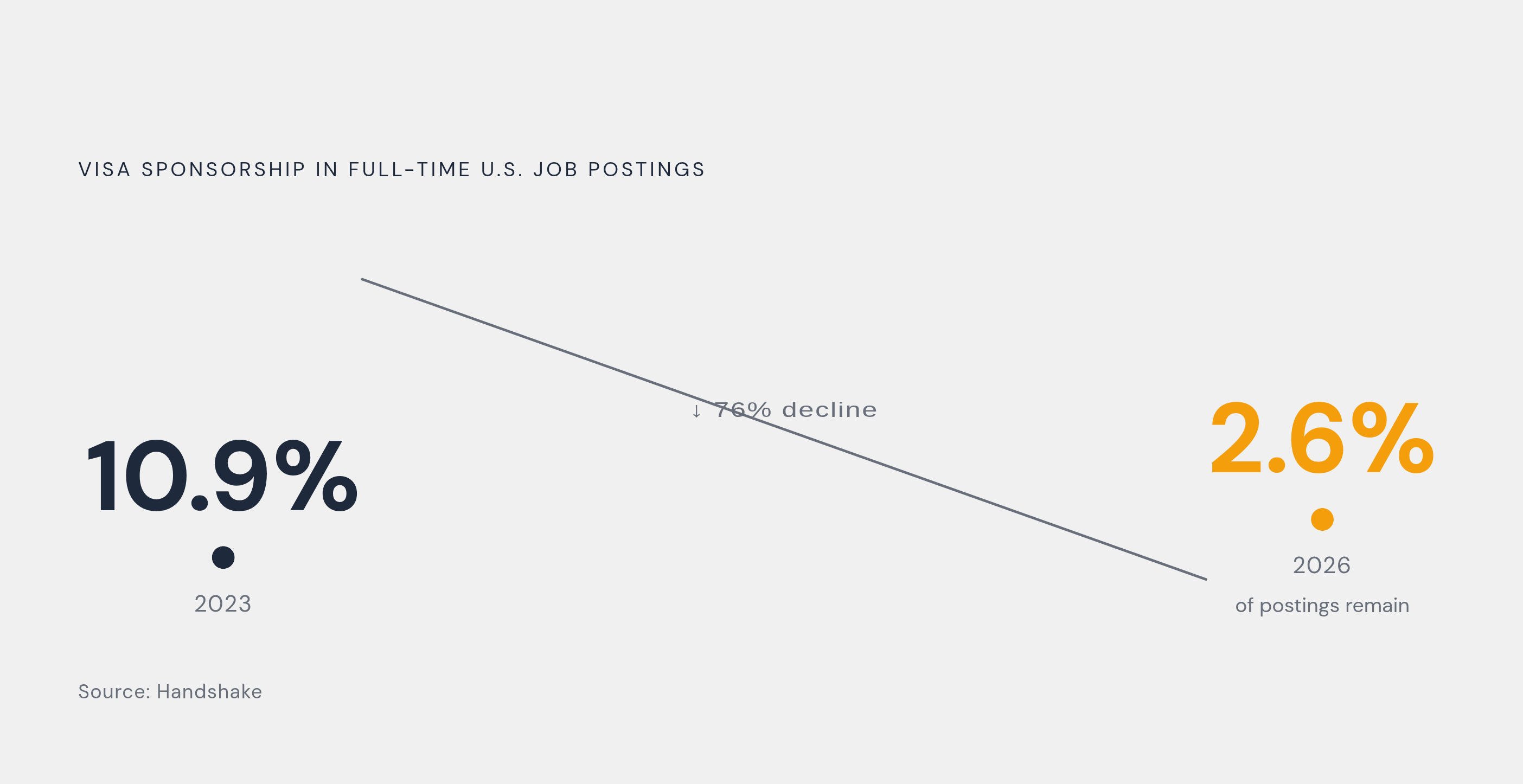
Full-time U.S. job postings offering visa sponsorship dropped from 10.9% in 2023 to 2.6% by 2026, according to Handshake. Platforms like Migrate Mate, a subscription job board that filters verified US employer listings by visa type so international candidates can see who has actually sponsored before applying, exist precisely because that shrinking pool makes applying to the wrong employer a costly mistake. That's a market that's nearly evaporated. If you're an international candidate applying into that 2.6%, the cover letter you send isn't one shot among many. It might be your only shot at the handful of employers who'll actually consider you.
Which makes it worth asking what's actually happening when candidates open an AI tool and ask it to write that letter for them.
What AI cover letter tools are actually built to do
Tools like Jobscan, Enhancv, Grammarly's cover letter generator, and Venngage all run on the same basic recipe: feed in a resume, feed in a job description, get a drafted letter back. They're good at what they're built for. Structure, grammar, tone, formatting that clears an applicant tracking system without getting flagged as a wall of unreadable text (all of that gets handled competently and fast).
They can also mirror language straight out of the job posting, which is a real time-saver if you're applying to fifteen roles in a week and don't want to reword "cross-functional collaboration" fifteen separate times by hand. For candidates writing in a second language, the polish helps too: an AI tool can clean up phrasing without changing what you meant to say, which takes some of the dread out of writing formally in English when English isn't your first language.
None of this is a knock on using them. A candidate applying broadly can turn a blank page into a structurally sound draft in the time it takes to make coffee, instead of the hour or two it used to take.
Here's the gap, though. These tools never see your visa status. They don't know whether the employer you're applying to has sponsored anyone before, ever. And nobody built a prompt field for "how do I bring up the fact that hiring me costs extra money and legal paperwork." That input simply doesn't exist in the system.
The recruiter reality that makes generic AI output risky for anyone
Job applications have surged sharply year-over-year in 2025, and AI is widely cited as the reason why. Recruiters aren't just busy; they're buried. Greenhouse CEO Daniel Chait has said the average recruiter is now getting around 400% more applications than they were a few years ago, and that those applications are "starting to look more and more alike." That's the recruiter's actual, lived experience.
Surveys of hiring managers have found that a significant share report they can spot an AI-written application almost immediately. Sounds damning. Worth asking, though: spot it how?
They're detecting the absence of a person. Phrases like "passionate about your company" or "leveraging my skills" are red flags because nobody who actually read the job posting would write them. It's the tell of someone who skipped a step.
That distinction matters, because research has suggested that recruiters without prior warning struggle to reliably identify every AI-written letter in a stack. So the fear of "will they know I used AI" is somewhat misplaced. The better question is whether the letter sounds like it was written for this job or for any job. The data backs that framing up directly: hiring managers tend to view obviously AI-generated letters negatively, but view AI-assisted letters favorably once they're personalized. Same tool, opposite verdict, depending entirely on what the candidate did with it.
Career advisers commonly flag the usual tells: overuse of em-dashes, formulaic transitions, prose that's suspiciously smooth with no actual voice behind it. Fixable, all of it, but only if someone knows to go looking.
Which raises the stakes considerably once you add a second, harder task to the letter: convincing an employer to take on a cost and a legal process most of them would rather not think about at all.
Why the sponsorship paragraph is a category of writing AI tools can't draft on autopilot
The sponsorship ask doesn't behave like the rest of the letter. Every other paragraph is trying to make the candidate look good. This one has to raise a genuine complication for the employer and somehow make that complication feel smaller, not bigger.
An AI tool generating your draft doesn't know whether this employer has sponsored a visa before. It doesn't know if you're on OPT, chasing an H-1B slot, holding TN status, or working under an E-3. It has no idea whether you're writing to a company with in-house immigration counsel that's filed a hundred of these, or a 40-person startup encountering the question for the very first time. It can't, because nobody told it, and nobody could, because that information doesn't live in a resume or a job posting.
Cost is part of why this matters. Standard H-1B sponsorship runs $2,000 to $8,000 in filing fees alone; premium processing tacks on another $2,965; the all-in number for an employer can clear $10,000 once legal fees are counted. Nobody expects you to write that figure into a cover letter. But the employer reading your letter is thinking about it, even if they never say so, and the tone of your sponsorship paragraph either accounts for that unspoken math or ignores it at your own risk.
Ignore it, and you tend to land in one of two ditches. Some candidates bury the sponsorship need entirely, hoping it won't come up until an offer is already on the table (this wastes everyone's time and burns the one resource an international candidate can't get back, which is the visa clock ticking in the background of a hiring process that has no idea it's racing anything). Others overcorrect and over-explain, hedging every sentence until the paragraph reads like an apology. Both versions draw more attention to the complication, not less.
The fix isn't cleverer phrasing. It's knowing, before you write a word, that this employer has sponsored someone like you before. Sponsorship history predicts an employer's willingness far better than job title, seniority, or brand recognition does; applying blind and hoping the cover letter will do the convincing is the mistake the letter can't undo.
The employer side of the equation: who is actually sponsoring and what they expect
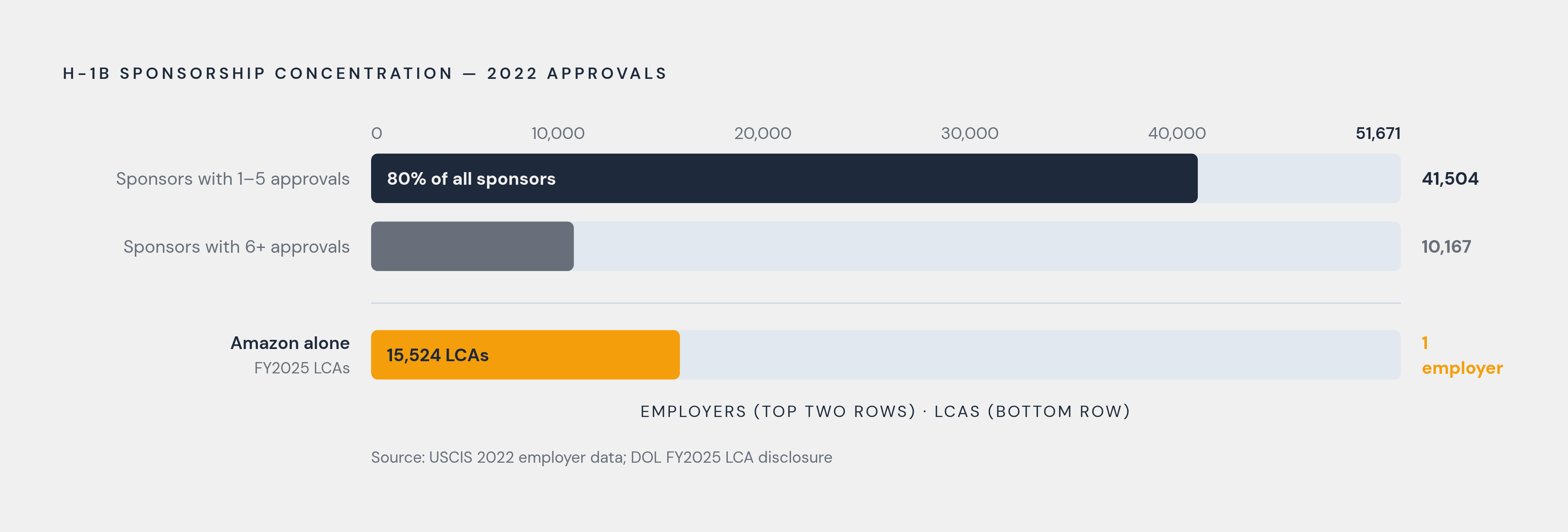
Picture the typical H-1B sponsor. If you pictured a household-name tech company, you pictured the exception. Out of 51,671 employers who received at least one H-1B approval in 2022, 41,504 of them, roughly 80%, sponsored just one to five visas that year. Meanwhile Amazon alone filed 15,524 Labor Condition Applications in fiscal year 2025. The market is a long, flat line of small and mid-sized employers each doing this a handful of times a year, rather than a pyramid with a few giants at the top.
That distinction should change how you write to them. A company sponsoring its second or third case ever needs a different kind of reassurance than a company with a standing immigration department. The former needs to know this isn't going to be a mess. The latter already assumes it isn't.
Healthcare fills out a lot of the remaining sponsorship market in 2025: physicians and surgeons at 3.2% of postings offering sponsorship, therapy roles at 1%, dental at 0.6%, pharmacy at 0.5%. Chronic labor shortages and licensure requirements in these fields mean sponsorship is closer to routine than exception, and a letter to one of these employers can treat it that way instead of tiptoeing around it.
Geography narrows the field further. As of May 2025, 20% of all U.S. job postings offering immigration support were located in New York, with California, Texas, Washington, New Jersey, and Illinois rounding out the rest of the top tier.
The takeaway isn't subtle: most sponsored hires are deliberate matches between a candidate who found the right small or mid-sized company and an employer already primed to say yes, more often than they're lottery wins at a famous employer. This is the exact gap a sponsorship history database is built to close. Tracking verified listings from employers with a documented record across H-1B, OPT/CPT, TN, and E-3 pathways turns "I hope they sponsor" into "I know they've sponsored three people this year." That knowledge is what makes the letter possible in the first place.
What a well-constructed sponsorship cover letter actually contains
No single sentence should be asked to carry the entire weight of "please sponsor me." Spread the load, and the sponsorship ask stops dominating the letter's tone.
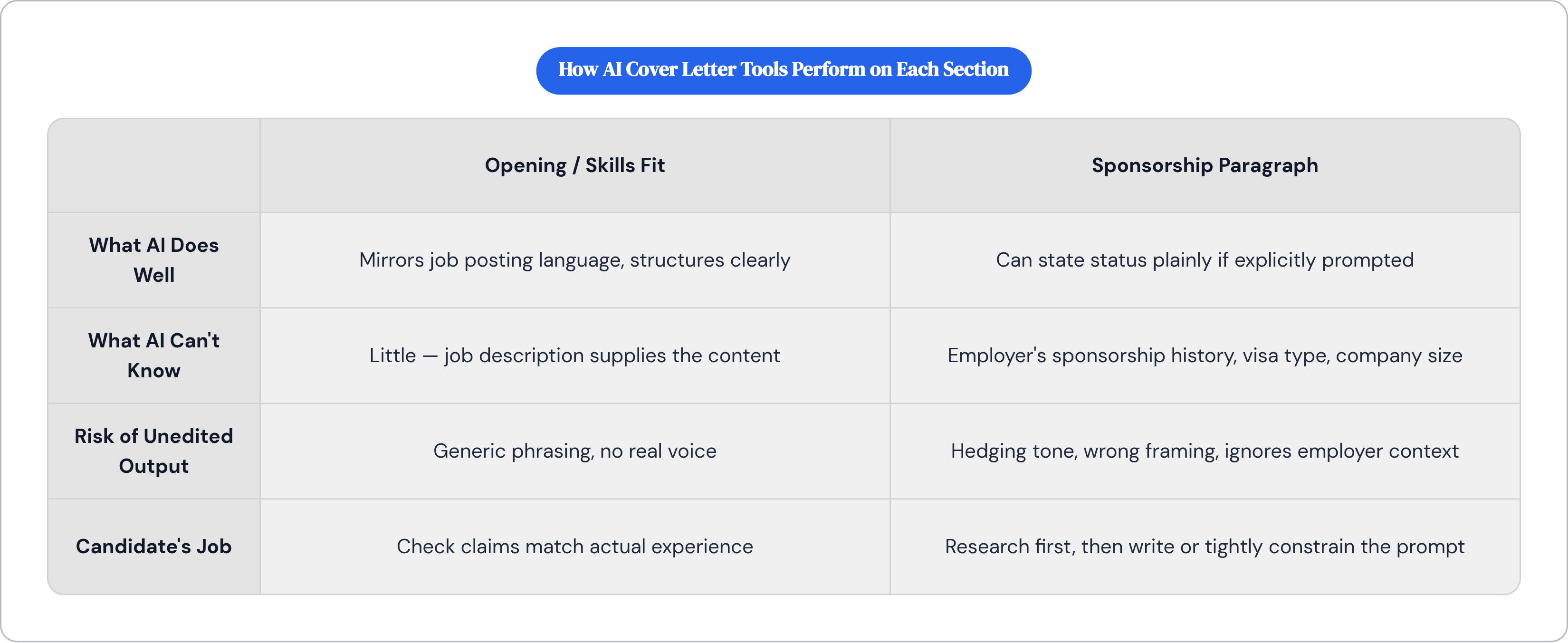
Start with value, not visa status. The opening paragraph is about what you bring to the specific role in front of you, and this is exactly where AI performs well, provided you feed it a real job description and your actual accomplishments rather than a generic template. The skills and fit section that follows should mirror language from the posting itself; again, AI is useful here, so long as you check that the output describes something you actually did, not something that merely sounds plausible.
Then comes the paragraph no AI tool can write for you without the groundwork described above. It needs to do four things, and it needs to do them briefly:
State your status plainly. "I am currently on OPT" or "I will require H-1B sponsorship," no qualifiers, no cushioning. If your research confirms the employer has sponsored before, say so: "I understand [Company] has sponsored visa holders in the past." Keep the whole thing to one to three sentences; this is not the place for a tutorial on visa mechanics. Frame the next step as a shared logistics item rather than a favor: "happy to discuss the details at any point in the process" does more work than three sentences of justification.
What kills the paragraph is hedging. "I hope this won't be an issue" doesn't soften anything; it just tells the reader you're worried it will be. Skip the visa timeline explainer, skip the cost breakdown, skip any pre-emptive defense of why international candidates are worth the trouble. All of that redirects attention toward the complication instead of past it.
Close the letter the way you'd close any other: reinforce fit, express interest in next steps. AI handles this part fine.
The tone to aim for is the one a dual citizen uses when mentioning their second passport. Factual. Brief. A detail, not a plea.
How to use AI tools in the drafting process without letting them own the sponsorship language
The workflow that actually works has two stages, and the order matters: research first, then prompt.
Before you open any AI tool, confirm whether the employer has sponsored before, how recently, and under which visa category; this is the step that turns a cold guess into an informed pitch. Pin down your own status and stage too: OPT, approaching the H-1B cap, TN-eligible, E-3-eligible, because the answer changes what that sponsorship paragraph should actually say. While you're at it, dig up one or two specific, non-obvious details about the employer, their team, or their hiring patterns; that goes in your opening paragraph, not your sponsorship paragraph, and it's the detail that separates a letter that sounds like you did homework from one that sounds like it was sent to fifty companies this morning.
Only then open the AI tool, and give it everything: the job description, your resume, your visa status, and what you found about the employer's sponsorship history. A generic prompt produces a generic draft; a loaded prompt produces something worth editing. For the sponsorship paragraph specifically, either tell the AI to skip it entirely, or hand it the exact sentence you want built out: "I need H-1B sponsorship. [Company] has sponsored H-1B holders before. Draft one sentence stating this plainly, without apology." Then read the whole draft back looking for the tells: em-dashes doing too much work, transitions that feel templated, phrases that sound nice but say nothing.
Last step, and don't skip it: read the sponsorship paragraph out loud. Does it sound like a professional stating a fact, or someone asking permission? Check that cost, processing time, and visa lottery odds don't appear anywhere; save those for the conversation after you get a callback, not the letter that gets you one. And ask yourself honestly whether this letter could be sent to any company in your field with the names swapped. If it could, it's not ready.
AI buys back the hours it used to take to get from blank page to solid draft. What it can't buy is the specific knowledge of who's actually willing to sponsor you and why. The candidates getting responses are the ones who applied only to employers already primed to sponsor, and wrote a letter that made it obvious they'd done that homework first.