AI Interview Coaching Platforms for International Candidates
International candidates face unique barriers that go far beyond vocabulary.

Two billion people are learning English right now, which technically makes it the most popular second language on Earth and, less technically, the reason so many hiring processes quietly punish people for not sounding like a Delaware native. The surface problem gets named constantly: language fluency. But the actual friction point for international candidates going through a U.S. hiring process is rarely vocabulary. The harder challenge is performing under pressure, in a second language, while also code-switching into a set of cultural norms nobody explained to you. A confident answer in Seoul can read as arrogance in Chicago. Waiting to be addressed before speaking, which is basic professional courtesy in Tokyo, reads as shyness in an American interview room, especially paired with the eye contact you were taught to avoid at home and now have to force yourself into. That's less an attitude problem than a calibration problem, and calibration is fixable if you know what you're calibrating against.
Then there's the part almost nobody talks about, which is that international candidates aren't preparing for one interview. They're preparing for two, and the tools built to help them mostly cover one.
How AI coaching tools are already being used against international candidates
Here's the part that should bother you: most candidates meet an AI system before they ever talk to a human. AI now handles some part of recruitment and screening at the large majority of organizations globally, and nearly nine in ten employers use AI-driven tools to screen, filter, or rank people before a recruiter looks at anything. The first gate isn't a hiring manager with a coffee and mild curiosity about your resume, but a model, and that model was not built with accent diversity in mind.
The documented cases are not subtle. HireVue's AI video interview platform rated applicants lower based on accents, facial expressions, and background noise, producing rejections that had nothing to do with whether the person could do the job. Separately, AI text detectors misclassify up to 61% of essays by non-native English speakers as AI-generated, which tells you something uncomfortable about how these models treat unfamiliar sentence rhythm: they register it as suspect or fabricated rather than simply different. Facial recognition systems used in video interview scoring have shown error rates as high as 34.7% for darker-skinned women, versus 0.8% for light-skinned men. A 2025 meta-analysis in the International Journal of Selection and Assessment traced the mechanism: these models train on human judgments, and human evaluators already carry accent bias that intersects with gender, so the bias doesn't get filtered out in automation. It gets baked in and scaled up.
Regulators have noticed, on paper at least. The EU AI Act, in force since 2024, classifies employment-related AI systems as "high-risk," which means transparency requirements, human oversight, and bias testing before deployment. In the U.S., EEOC guidance says employers can be held liable for discriminatory AI outcomes under disparate impact doctrine, even if they didn't build the tool themselves. The gap between that guidance and what actually happens at the platform level remains wide. Nobody's auditing this in real time.
Coaching tools and screening tools are different categories doing different jobs: one prepares you, one judges you. Understanding how the judge thinks before you walk into the room matters more than trying to erase your accent. The goal is to deliver clearly enough, and with enough structural confidence, that a biased system has less surface area to penalize.
What features actually matter for non-native English speakers — and which ones are marketing noise
The interview prep tool market was worth about $2.5 billion in 2023 and is projected to hit $6.3 billion by 2031, growing at roughly 11.8% a year. Every company entering that space slaps "AI-powered" on the landing page. Most of them were built for native English speakers navigating U.S. corporate hiring, and "multilingual support" often just means someone translated the buttons, not that the feedback engine understands non-native speech patterns.
So here's what actually matters. Accent-aware speech analysis: does the tool separate unclear delivery from a non-native accent, or does it treat them as the same failure? If a platform's feedback engine dings you for sounding like you're from Lagos or Manila, it's the wrong platform, full stop. Filler word and pacing tracking helps everyone, but it helps international candidates more, because the instinct under pressure is often to default to native-language cadence, which throws off timing in English. Cultural coaching that goes past "just be confident" into specifics: talk-to-listen ratio, direct answer structure using something like the STAR method, how much eye contact is expected and when. Real multilingual support, meaning the AI transcribes and responds in your preferred language, not a translated UI wrapped around an English-only engine. Sponsorship conversation prep, which almost nobody builds for: how do you answer "will you need visa sponsorship?" without triggering an instant pass. And visa or consular interview simulation, which is a completely separate skill from job interview coaching and which maybe a handful of platforms even attempt.
What's noise, or at least lower priority for this specific audience? ATS resume scanning is fine, but the international candidate's bottleneck usually isn't getting past a keyword filter, it's performing once they're in the room. Company-specific question banks are nice to have once the language and culture layer is solved, not before. Real-time copilot tools that feed you answers during a live interview reduce anxiety in the moment, sure, but they're best treated as a crutch for a single high-stakes conversation rather than a substitute for building the underlying skill you'll need in every conversation after that.
One question cuts through the marketing fastest: was this tool's feedback engine trained on diverse speaker data, or on native English speech? Almost no vendor publishes an answer. That silence tells you what you need to know.
Platforms worth using for job interview preparation: what each one actually does for international candidates
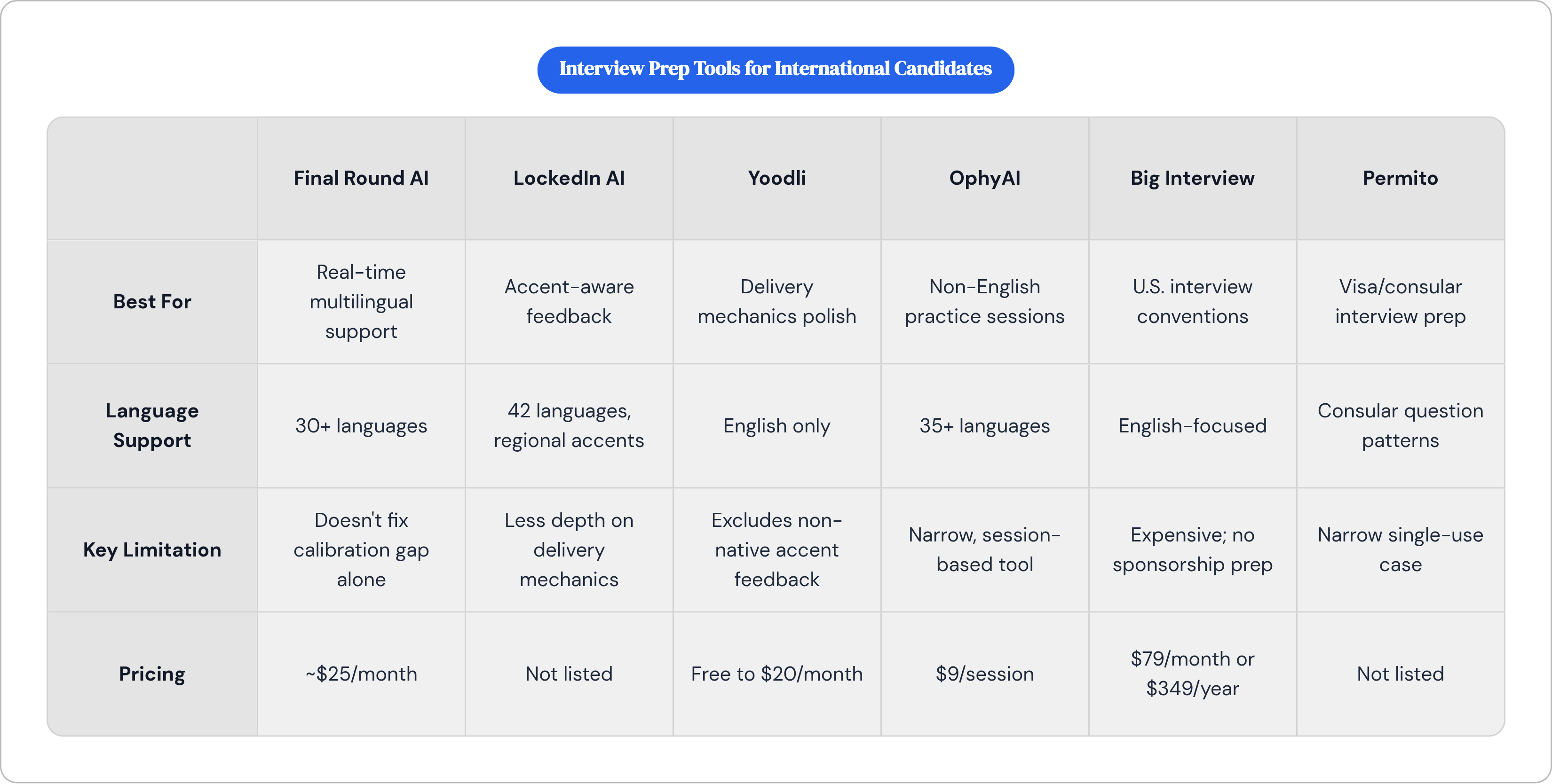
No single tool wins every category, so here's what each one is actually good for.
Final Round AI is the strongest option for real-time support across languages. It supports more than 30 languages as of 2025, including Spanish, Mandarin, German, Japanese, and Portuguese, with the AI transcribing and responding in whichever language you pick. Its core feature is a real-time Copilot that surfaces a structured suggested answer on-screen during a live Zoom, Meet, or Teams call, invisible to the interviewer. It serves more than 10 million users across 80-plus countries and carries SOC 2 Type 1 and 2 certification. Pricing starts around $25 a month. The catch: real-time assistance calms you down in the moment, but it doesn't fix the underlying language calibration gap, so pair it with a practice-mode tool rather than relying on it alone.
LockedIn AI is built for speed and accent accommodation. It answers technical and behavioral questions in 116 milliseconds and handles 42 languages with regional accent recognition, the most explicit accent accommodation of anything on this list. If "accent-aware feedback" is the feature you care about most, this is currently the closest thing to it on the market.
Yoodli is the best tool for delivery mechanics, with one hard limitation. It analyzes six speech dimensions: filler words, pacing, eye contact through the webcam, vocabulary diversity, talk-to-listen ratio, and conciseness. That's the most granular delivery feedback available anywhere in this category. It has real enterprise credibility too: more than 15,000 Google employees have trained on it, it raised a $40 million Series B in December 2025 at a $300 million valuation, and revenue grew 900% year over year. But as of early 2026, Yoodli is English only. That's a disqualifier if you need to practice in another language or want feedback calibrated for a non-native accent. Pricing runs free for five lifetime roleplays, $8 a month billed annually for the Pro tier at 10 roleplays a week, and $20 a month billed annually for unlimited. Honest read: Yoodli is excellent once you've cleared the language threshold and are polishing English delivery, not before.
OphyAI covers non-English interview practice without locking you into a subscription. It supports more than 35 languages and is specifically useful for candidates interviewing in a language other than English, priced at $9 a session, low commitment for targeted practice.
Big Interview works more like an interview prep university than an open-ended coach: video lessons, structured lectures, AI feedback layered on top. That structure helps candidates who are unfamiliar with U.S. interview conventions like STAR-format answers. It costs $79 a month or $349 a year, on the pricier end, but worth it if it's replacing a career office you don't have access to.
Mocky.pro is built for candidates prepping from non-English-speaking markets, with a voice-first design and a native Traditional Chinese interface, aimed at people preparing for English interviews from places like Taiwan. It costs roughly NT$199, about $6.50 US, one time. It's a narrow tool, but it's evidence the market is starting to build for specific non-English speaker contexts instead of slapping a generic "multilingual" label on everything.
Acedit is a Chrome extension offering invisible real-time coaching during an actual interview, adjusting to your experience level and the questions you're getting asked live. Lower friction than installing a separate app, useful if you've got an interview tomorrow and no time to build a practice routine.
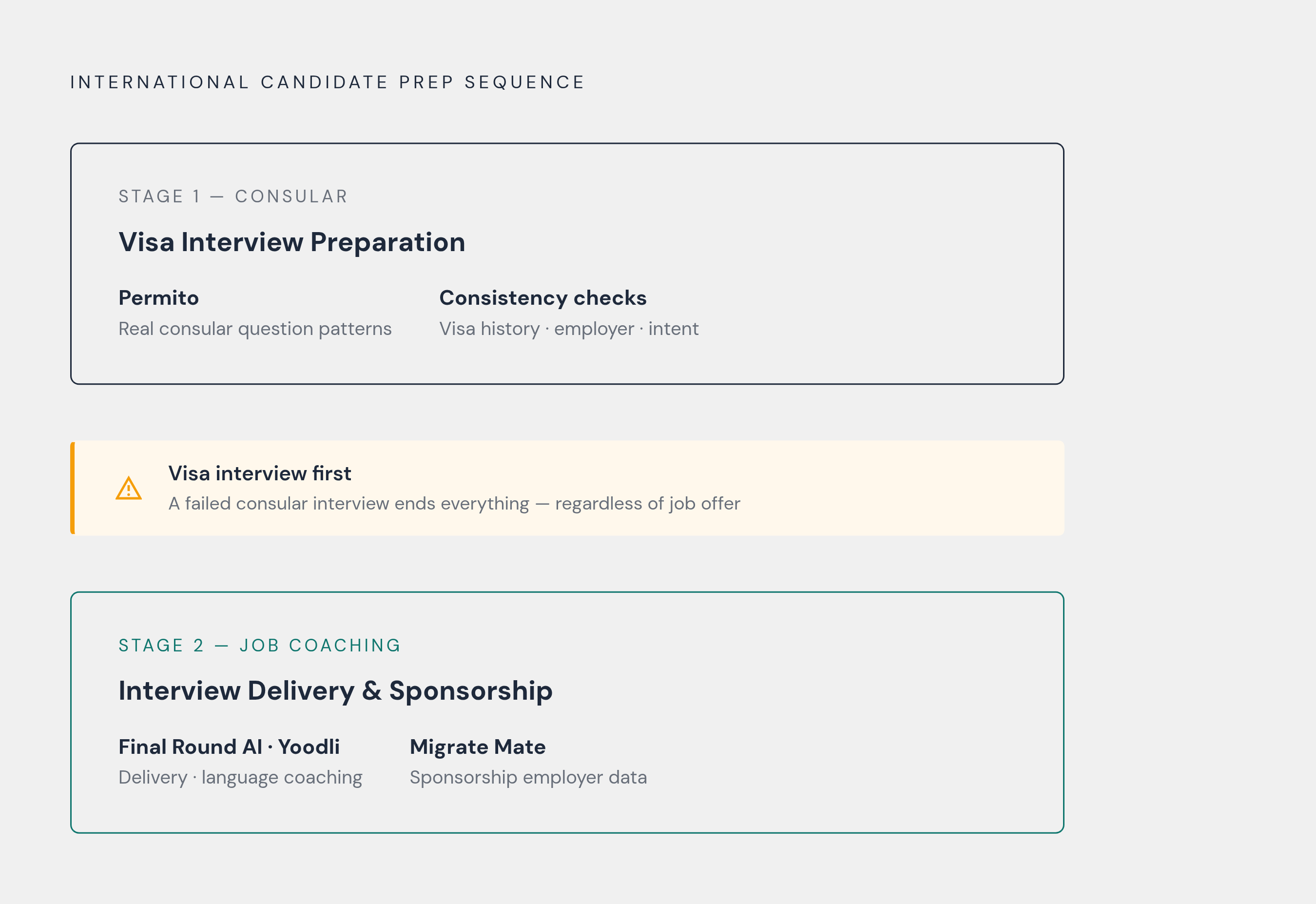
None of the above touch the sponsorship conversation itself, which is where Migrate Mate fits. No general-purpose coaching tool tells you when to disclose your work authorization needs, how to frame an OPT or CPT timeline, or which employers have a track record of actually sponsoring people in roles like yours. Migrate Mate's sponsorship history data closes that gap before you even get to the interview: knowing in advance that a company has sponsored H-1B, OPT, or Green Card candidates changes how specifically and confidently you can answer "will you need sponsorship?" The pairing that actually works is a delivery and language tool, Final Round AI or Yoodli depending on your language needs, combined with Migrate Mate's employer data so your practice time goes toward employers who'll actually follow through.
Preparing for the visa interview — a separate process most coaching tools ignore
2025 and 2026 changed the rules for H-1B holders in ways that make this section non-optional. Interview waivers, the dropbox process that let renewals skip an in-person appointment, are gone. Every applicant, including renewals, now sits an in-person consular interview. Social media vetting is now mandatory. A $100,000 fee applies to certain new petitions. None of this is background noise: international students make up roughly 75 to 80% of full-time graduate students in AI-related fields at U.S. universities, which means the population most exposed to these changes is also the one driving a huge share of the talent pipeline everyone claims to want.
A visa interview and a job interview draw on different skills entirely. A consular officer isn't running a behavioral competency framework. They're checking for consistency: your visa history, your employer relationship, your intent to return, all have to line up cleanly, because a vague answer that would just cost you points in a job interview can end the whole visa process in a consular one. Add in the social media vetting piece, and candidates now need to know what their own digital footprint says about them before an officer pulls it up.
Permito is the one platform actually built for this, specifically. It runs AI mock interviews using real consular question patterns rather than generic behavioral prompts. Context matters here: in 2025, 1.4 million Indians successfully obtained visas, and H-1B petition denial rates stayed under 3%. That floor holds up only when preparation quality keeps pace with a regulatory environment that tightened mid-process. Permito is a narrow tool solving one specific problem, but it's solving the right one, and no general-purpose interview coach even attempts this ground.
Sequence matters more than people think. Do the consular prep first, because a failed visa interview ends everything regardless of how good the job offer is. Layer job interview coaching on after that, once the visa process feels less like a black box. The anxiety compounds when both tracks feel uncertain at once; solving one first genuinely lightens the other.
How to build
Interview anxiety runs at roughly 92% among U.S. adults, and that's for people interviewing in their native language, in their own culture, with no visa clock running in the background. International candidates carry all of that plus two more layers: language performance under pressure, and cultural code-switching that nobody hands you a manual for. A single platform claiming to do everything rarely holds up; a stack does better: a delivery and language tool that actually handles accent and multilingual practice instead of just translating buttons, a data source that tells you which employers actually finish the sponsorship process instead of ghosting at the offer stage, and, if you're on an H-1B track, a consular-specific tool that treats the visa interview as the distinct, high-stakes event it now is. Build in that order, and the two interviews that used to feel like separate gauntlets start to look like one process you're actually prepared for.